


language:
  - ru
  - en
  - de
  - pl
  - it
  - fr
  - es
  - bn
license: mit
library_name: transformers
pipeline_tag: audio-classification
base_model: Aniemore/unispeech-sat-emotion-russian-resd
base_model_relation: finetune
datasets:
  - Aniemore/resd
  - Aniemore/resd_annotated
  - amu-cai/CAMEO
tags:
  - audio-classification
  - emotion-recognition
  - speech-emotion-recognition
  - speech
  - multilingual
  - russian
  - quantized
  - compressed-tensors
  - int8
  - fp8
  - int4
metrics:
  - f1
  - accuracy
  - recall
model-index:
  - name: unispeech-sat-emotion-v1-crosslingual
    results:
      - task:
          name: Speech Emotion Recognition
          type: audio-classification
        dataset:
          name: RESD test
          type: Aniemore/resd
        metrics:
          - name: Macro F1
            type: f1
            value: 0.5697
          - name: Unweighted accuracy
            type: recall
            value: 0.6158
      - task:
          name: Speech Emotion Recognition
          type: audio-classification
        dataset:
          name: Dusha podcast test
          type: dusha
        metrics:
          - name: Macro F1
            type: f1
            value: 0.3705
          - name: Unweighted accuracy
            type: recall
            value: 0.6992
      - task:
          name: Speech Emotion Recognition
          type: audio-classification
        dataset:
          name: CAMEO test
          type: amu-cai/CAMEO
        metrics:
          - name: Macro F1
            type: f1
            value: 0.5689
          - name: Unweighted accuracy
            type: recall
            value: 0.5706

unispeech-sat-emotion-v1-crosslingual
Speech emotion recognition over seven classes — anger, disgust, enthusiasm, fear, happiness, neutral, sadness.
Same architecture as Aniemore/unispeech-sat-emotion-russian-resd, retrained on a mix of 27,939 clips spanning eight languages and three speaking registers instead of one acted Russian corpus. The point of the change is spontaneous speech: the previous release was trained only on acted dialogue, where every class is equally frequent and every utterance is performed, and real speech is neither.
Quantized builds ship in the same repository under int8/, fp8/ and int4/.
Results
| test set | what it is | macro-F1 | UA | WA | previous release |
|---|---|---|---|---|---|
| RESD test | acted Russian, 7 balanced classes | 0.5697 | 0.6158 | 0.6179 | 0.7027 |
| Dusha podcast test | spontaneous Russian, majority neutral | 0.3705 | 0.6992 | 0.6993 | 0.1000 |
| CAMEO test | 7 non-Russian languages | 0.5689 | 0.5706 | 0.6832 | 0.1946 |
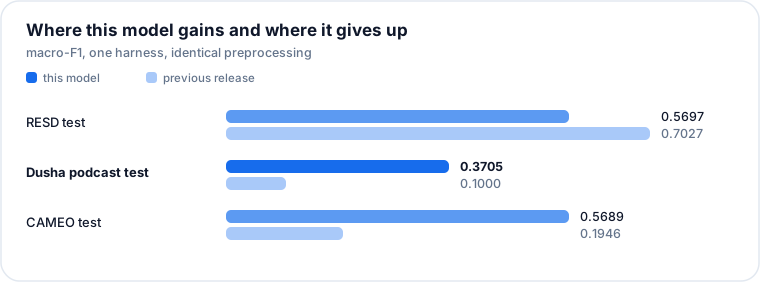
Read the first two rows together. The acted score goes down and the spontaneous score goes up; both follow from the same change, and which one matters is a deployment question. If your audio is read or performed speech, the previous release may still suit you better.
About the CAMEO row
CAMEO ships no train/test partition, and the usual way to make one — a random split over clips — puts nearly every test speaker into training as well: three of its twelve constituent corpora contain a single speaker each, so no clip-level split of them can be speaker-disjoint even in principle. The number above is reported for completeness. Treat it as an in-domain figure, not as evidence of cross-lingual transfer.
Per class, across the panel — recall and F1 for every class on every test set
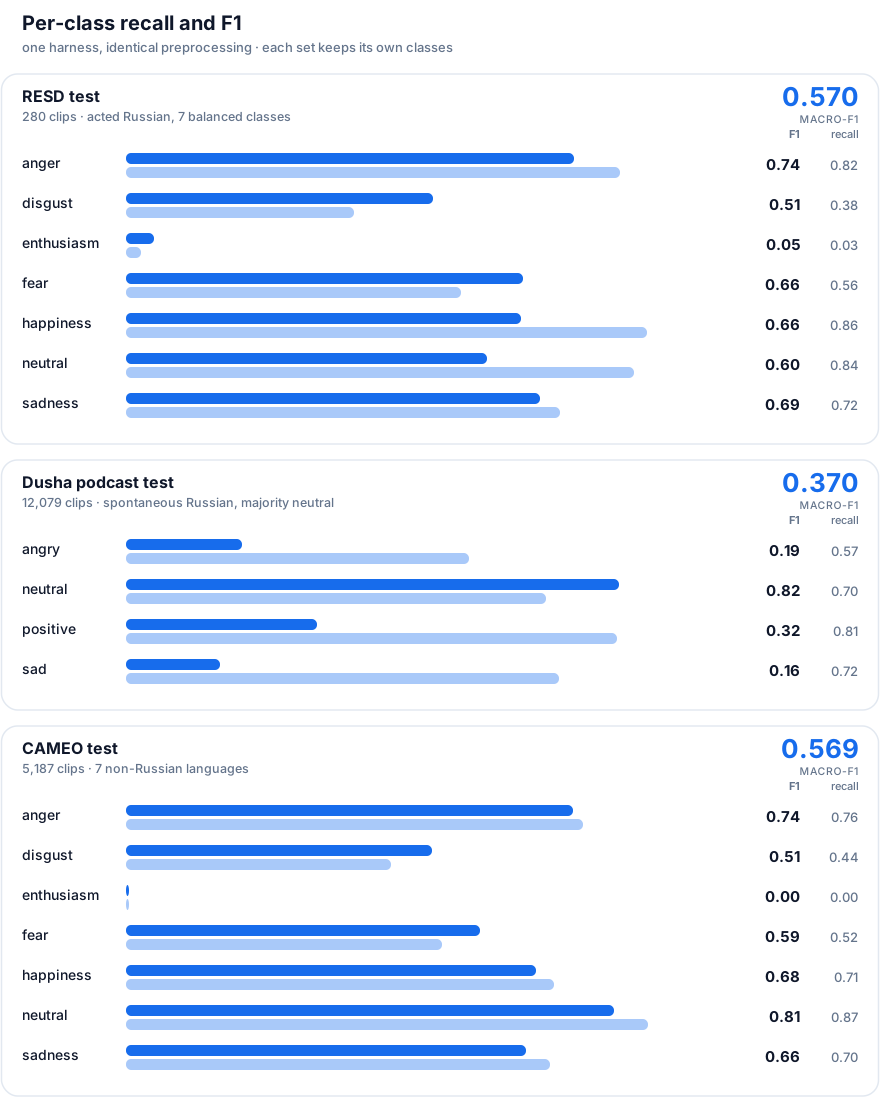
Each card leads with the macro-F1 for that set; the rows are the detail behind it. Both per-class numbers are shown because they disagree in a way that matters: recall rewards a class the model over-predicts, so on the spontaneous set the minority classes reach decent recall at poor F1 — most clips called sad there are not sad. If you are going to act on one class, read its F1.
Each set keeps its own class list: the spontaneous corpus has four classes and the other two have seven, and there is no correspondence between positive and any single one of happiness/enthusiasm to line them up with.
Per-class recall on spontaneous speech
| class | this model | previous release |
|---|---|---|
angry |
0.5689 | 0.5629 |
neutral |
0.6958 | 0.0583 |
positive |
0.8138 | 0.5029 |
sad |
0.7184 | 0.2718 |
neutral carries most of real speech and is the class the previous release missed.
Quantized variants
| subfolder | scheme | weights | vs fp32 | macro-F1 | UA | WA |
|---|---|---|---|---|---|---|
| (root) | fp32 | 1206 MiB | 1.0x | 0.5697 | 0.6158 | 0.6179 |
int8 |
W8A16 | 351 MiB | 3.4x smaller | 0.5697 | 0.6158 | 0.6179 |
fp8 |
W8A16-float | 343 MiB | 3.5x smaller | 0.5663 | 0.6126 | 0.6143 |
int4 |
W4A16_ASYM | 209 MiB | 5.8x smaller | 0.5714 | 0.6163 | 0.6179 |


Weight-only, round-to-nearest, no calibration. Every variant lands within the seed spread of the fp32 parent on RESD test, so the choice is about download size rather than about quality.
Training data
| corpus | clips | language | register |
|---|---|---|---|
| RESD | 948 | Russian | acted dialogue |
| Dusha crowd | 6,800 | Russian | acted, crowd-sourced |
| CAMEO | 6,800 | 7 languages | 12 corpora, no Russian |
| Dusha podcast | 6,060 | Russian | spontaneous podcast speech |
| IEMOCAP | 4,735 | English | elicited dyadic sessions |
| ASVP-ESD | 2,596 | multilingual | mixed register |
| total | 27,939 | 8 languages | 3 registers |
A slice is held out of every corpus in the mix, in the same proportion, and model selection is on that held-out split — never on any of the test sets above. Labels are unified to seven classes; four-class corpora are mapped upward and scored on the classes they actually contain.
Usage
import torch, librosa
from transformers import AutoModelForAudioClassification, AutoFeatureExtractor

repo = "Aniemore/unispeech-sat-emotion-v1-crosslingual"
model = AutoModelForAudioClassification.from_pretrained(repo).eval()
fe = AutoFeatureExtractor.from_pretrained(repo)

# Resample to 16 kHz. Do not skip it: RESD itself ships at 44.1 kHz,
# and handing the model 44.1 kHz audio while telling the extractor it
# is 16 kHz stretches time 2.8x and silently changes the answer.
wav, _ = librosa.load("clip.wav", sr=16000, mono=True)
x = fe(wav, sampling_rate=16000, return_tensors="pt", padding=True)
with torch.no_grad():
    probs = model(**x).logits.softmax(-1)[0]
print({model.config.id2label[i]: round(p.item(), 3) for i, p in enumerate(probs)})
For a quantized build, name the subfolder — only that subfolder is downloaded:
model = AutoModelForAudioClassification.from_pretrained(
    repo, subfolder="int8").eval()          # or "fp8", "int4"
fe = AutoFeatureExtractor.from_pretrained(repo, subfolder="int8")
Limitations
- Scores are the mean of two seeds; the seed spread on the 280-clip RESD split is ±0.03–0.05, so differences smaller than that are not differences.
- The spontaneous set has four classes where the model has seven, so its numbers are computed over a mapped label space and are not comparable to seven-class figures.
- Spontaneous scores are at zero decision bias. Calibrating the
neutralthreshold on your own development split will move them. - Inherited from
microsoft/unispeech-sat-large; the licence follows the base model.