


DS4-Mixed-Quant-for-Spark
Collection
ds4 mixed quant collection • 7 items • Updated
# Install OpenClaw:
npm install -g openclaw@latest# Register the local server and set it as the default model:
openclaw onboard --non-interactive --mode local \
--auth-choice custom-api-key \
--custom-base-url http://127.0.0.1:8080/v1 \
--custom-model-id "Baekpica/Qwen3.8-Flash-Next-Mixed-Quant-SSD-PLE-GGUF:BF16" \
--custom-provider-id llama-cpp \
--custom-compatibility openai \
--custom-text-input \
--accept-risk \
--skip-healthopenclaw agent --local --agent main --message "Hello from Hugging Face"Two accelerator-resident precision variants are published with one shared BF16 SSD-PLE sidecar.
MQ-Q6-SSD-PLE-BF16is the original Q5/Q6 recipe;MQ-Q5-SSD-PLE-BF16lowers theQ5_KandQ6_Ktargets by one tier, freeing 13.4082 GiB of resident-memory headroom while retaining the optimizedQ5_0down tail.Update 2026-09-02: the five-round prefill campaign on
ds4-dfm-rs@230655dbrings this Q5+Sidecar artifact to 908.1 tok/s median cold prefill on an 8,259-token repeated-passage prompt (three fresh workers: 908.1, 906.3, 911.4 tok/s; the same-day unmodified baseline measured 558.1 tok/s on that prompt) and 584.4 tok/s on a 7,937-token markdown prompt whose n-grams miss the PLE page cache. The 64-token greedy continuation of the repeated prompt is byte-identical before and after. See the campaign section below for the per-round table.On a single NVIDIA DGX Spark, the Q5+Sidecar path on
ds4-dfm-rs@f879bf5reached 606.4 tok/s median cold prefill across three fresh-worker 8,025-prompt-token runs: 607.4, 606.4, and 605.4 tok/s, all with zero cached tokens. With--mtp-draft 2, a short MTP-friendly two-bank run reached 28.3 tok/s API-timing-derived aggregate decode from concurrent 140- and 192-token completions. The decode figure is aggregate across both banks, not single-stream throughput.Native still-image input is also verified end to end across OpenAI Chat Completions, OpenAI Responses, and Anthropic Messages. An 8,243-token multimodal request measured 489.4 tok/s prefill and 22.5 tok/s decode through the model's embedded vision tower. Identical image-bearing prompts can reuse live recurrent checkpoints and disk-KV records through decoded-pixel cache identity; different pixels remain isolated.
The Q5 artifact also completed an exact 262,144-token direct prefill at 277.06 tok/s, with all 248,320 final logits finite and the independently recomputed argmax matching the recorded result. An instrumented incremental sweep measured 277.49 tok/s token-weighted prefill and the SSD-PLE latency distribution reported below.
ds4-dfm-rs@ccd2d39also adds a one-bank 524,288-token Qwen YaRN path. Its staged DGX Spark run used the same-layout Uncensored sibling Q5+Sidecar artifact and completed an HTTP 200 request with 524,240 prompt tokens plus one generated token at 215.4 prefill tok/s, with zero memory-census faults. This verifies the shared 512K runtime path, not this base artifact's long-context quality, multi-bank serving, MTP decode, or sustained throughput.The API figures remain guarded, content-sensitive serving checks. The full-window result is a direct no-decode run, not a full-window API-generation or sustained-throughput claim.
Update 2026-09-04: On one DGX Spark / GB10, a 32-frontier
ds4-benchsweep onds4-dfm-rs@a8fcd97measured 1,163.5 tok/s mean incremental prefill and 28.0 tok/s mean decode from 2K through 64K context in 2K steps, with 128 greedy tokens generated at each frontier. Embedded MTP draft 2 remained active throughout without quenching; the prefill figure includes MTP prefix maintenance.

I work on making large language models practical on hardware they were never really designed to fit on — through mixed quantization, inference optimization, custom kernels, and serving experiments.
While much of the development happens on local hardware, calibration, profiling, and large-scale validation often require expensive on-demand GPUs.
Contributions help pay for that compute, storage, and testing infrastructure, so I can keep experimenting and publishing the results openly.

This is a memory-hierarchy-aware mixed-precision conversion of Qwen/Qwen3.8-Flash-Next, pinned to revision f5d08274bafd880402bd16f5e3e6c514136ec06c.
The design moves the 51.2B-parameter predictive latent embedding (PLE) table out of the accelerator-resident GGUF weight set and stores it as BF16 SSD-backed sparse lookup memory. Nearly all of the released residency budget is then reassigned to the 128.8B-parameter compute backbone. Compatibility with upstream llama.cpp, vLLM, SGLang, or other GGUF runtimes is not implied; a dedicated ds4 SSD-PLE loader is required.
These measurements are reproducible with ds4-dfm-rs, a Rust-host continuation of DwarfStar for explicit, hardware-validated large-model inference on NVIDIA DGX Spark. It preserves the antirez → Entrpi → Baekpica lineage and integrates a growing set of model families with minimal abstraction while retaining the native CUDA/MMQ kernels.
| Variant | Routed expert tiers | Main payload | Shared PLE | Runtime status |
|---|---|---|---|---|
MQ-Q6-SSD-PLE-BF16 |
Q5_K / Q6_K / Q5_0 |
90.9538 GiB | 95.3682 GiB | DGX Spark smoke passed |
MQ-Q5-SSD-PLE-BF16 |
Q4_K / Q5_K / Q5_0 |
77.5456 GiB | same files | DGX Spark 262K-config profile passed |
Download only the original Q6 variant, including its canonical PLE directory:
qwen_repo=Baekpica/Qwen3.8-Flash-Next-Mixed-Quant-SSD-PLE-GGUF
qwen_root=./Qwen3.8-Flash-Next-Mixed-Quant-SSD-PLE-GGUF
hf download "$qwen_repo" \
--include 'MQ-Q6-SSD-PLE-BF16/*' \
--local-dir "$qwen_root"
(cd "$qwen_root/MQ-Q6-SSD-PLE-BF16" && sha256sum -c SHA256SUMS)
Download only the lower-residency Q5 main GGUF plus the same canonical PLE files. The local link preserves the ple/ple-manifest.json path embedded in the GGUF without storing a second 95.37 GiB copy:
qwen_repo=Baekpica/Qwen3.8-Flash-Next-Mixed-Quant-SSD-PLE-GGUF
qwen_root=./Qwen3.8-Flash-Next-Mixed-Quant-SSD-PLE-GGUF
qwen_variant=MQ-Q5-SSD-PLE-BF16
hf download "$qwen_repo" \
--include "$qwen_variant/*" \
--local-dir "$qwen_root"
hf download "$qwen_repo" \
--include 'MQ-Q6-SSD-PLE-BF16/ple/*' \
--local-dir "$qwen_root"
test -e "$qwen_root/$qwen_variant/ple" || \
ln -s ../MQ-Q6-SSD-PLE-BF16/ple "$qwen_root/$qwen_variant/ple"
(cd "$qwen_root/$qwen_variant" && sha256sum -c SHA256SUMS)
If the Q6 PLE directory is already present, only the first hf download and the link are needed; the additional transfer is about 77.56 GiB rather than downloading the PLE again.
The three Q5 main weight files occupy exactly 83,274,984,384 bytes / 77.5559 GiB. A fresh local setup with the four shared PLE files occupies 185,675,770,816 weight-file bytes / 172.9240 GiB; the PLE is not duplicated in this repository.
Build ds4-dfm-rs with make cuda-spark, then start the weight owner from that checkout and keep it running:
MODEL=/path/to/Qwen3.8-Flash-Next-Mixed-Quant-SSD-PLE-GGUF/MQ-Q5-SSD-PLE-BF16/Qwen3.8-Flash-Next-MQ-Q5-SSD-PLE-BF16-00001-of-00003.gguf
MANIFEST=/tmp/qwen38-q5.weights.manifest
CUDA_VISIBLE_DEVICES=0 ./ds4_weight_server \
--base "$MODEL" \
--manifest "$MANIFEST" \
--backend vmm \
--scope base \
--reserve-gb 32 \
--no-repack-iq2-aligned \
--no-repack-q2k-aligned \
--repack-q8-aligned
After the owner reports ready manifest=..., start the Rust-host worker in another terminal. This is the 196,608-context, two-bank Q5+Sidecar configuration used for the measurements above:
MODEL=/path/to/Qwen3.8-Flash-Next-Mixed-Quant-SSD-PLE-GGUF/MQ-Q5-SSD-PLE-BF16/Qwen3.8-Flash-Next-MQ-Q5-SSD-PLE-BF16-00001-of-00003.gguf
MANIFEST=/tmp/qwen38-q5.weights.manifest
KV_DIR=./qwen38-q5-kv
mkdir -p "$KV_DIR"
CUDA_VISIBLE_DEVICES=0 \
DS4_CUDA_WEIGHT_IPC_MANIFEST="$MANIFEST" \
DS4_CUDA_WEIGHT_IPC_SCOPE=base \
DS4_MEMGOV=observe \
DS4_SESSION_GRAPH_FIT=0 \
DS4_SESSION_GRAPH_HEADROOM_MB=0 \
DS4_QWEN_BATCH=1 \
DS4_QWEN_PREFILL_CHUNK=8192 \
DS4_QWEN_PLE_CACHE_MB=512 \
DS4_QWEN_PLE_WORKERS=16 \
DS4_SERVER_CONTINUOUS=1 \
DS4_SERVER_COALESCE_MAX=2 \
DS4_SERVER_COALESCE_MAX_TOKENS=16384 \
DS4_SERVER_COALESCE_WAIT_MS=20 \
DS4_SERVER_WARM=1 \
DS4_SERVER_FORK=1 \
DS4_SERVER_FORK_PARTIAL=1 \
./ds4-server --cuda -m "$MODEL" -c 196608 -n 32768 \
--host 0.0.0.0 --port 8002 --cors \
--model-id Qwen3.8-Flash-Next-Mixed-Quant \
--mem-floor-gb 2 --mtp-draft 2 --no-update-check \
--kv-disk-dir "$KV_DIR" --kv-disk-space-mb 32768
The example binds to all interfaces; use --host 127.0.0.1 unless remote access is intended. Keep the published ple/ layout beside the first GGUF shard.
For the 512K-capable path, retain the same owner but use one worker bank with
-c 524288 -n 256 --cont-width 1, set DS4_QWEN_PREFILL_CHUNK=1024 and
DS4_SERVER_COALESCE_MAX=1, and set DS4_SERVER_WARM=0,
DS4_SERVER_FORK=0, and DS4_SERVER_FORK_PARTIAL=0. The verified run did not
enable --mtp-draft 2. The runtime selects static YaRN factor 2 for this
context. DS4_SESSION_GRAPH_FIT=0 remains an explicit fit-check override, not
a guarantee that the allocation fits. Direct completed-prompt evidence for
the base artifact itself remains the exact 262,144-token run above.
| Model region | Q6 variant | Q5 variant | Residency policy |
|---|---|---|---|
| 51.2B-parameter PLE n-gram table (128 shards) | BF16 SSD sidecar | same files | non-resident; bounded pinned page cache only |
| Routed expert gate/up, interior layers 2–45 | Q5_K |
Q4_K |
accelerator-resident |
| Routed expert gate/up, edge layers 0, 1, 46, 47 | Q6_K |
Q5_K |
accelerator-resident |
| Routed expert down, main 512 columns | Q6_K |
Q5_K |
accelerator-resident |
| Routed expert down, 128-column tail | Q5_0 |
unchanged Q5_0 |
accelerator-resident |
| MTP routed experts and most always-active matrices | primarily Q8_0 |
unchanged | accelerator-resident |
| Hyper-connection, non-quantizable convolution/vision tensors | BF16 | unchanged | accelerator-resident |
| Norms, gates, recurrent/control state | F32 where required | unchanged | accelerator-resident |
| Integer PLE controls | I64 | unchanged | accelerator-resident |
The original 128-column tail target was Q5_K, but standard GGUF Q5_K uses 256-value blocks and therefore cannot encode a tensor whose row width (ne[0]) is 128. The Q6 artifact realizes that tier as width-compatible Q5_0, and the Q5 variant deliberately retains all 48 Q5_0 tail tensors so ds4 can continue using its current optimized tail accumulator and dispatch. Only the K-quant tiers are lowered: Q5_K -> Q4_K and Q6_K -> Q5_K. No Q5_0, Q8_0, BF16, F32, or I64 target changes between variants, and both are generated directly from the pinned source BF16 checkpoint rather than by requantizing the Q6 GGUF.
Baekpica/ds4@0951d03 recognizes the MQ-Q5-SSD-PLE-BF16 label and validates its exact per-layer precision map. The existing Q4_K paired gate/up, routed Q5_K MMQ, and Q5_0 tail paths are reused.
Overall model BPW is not the useful metric for this artifact because the shared PLE is intentionally non-resident. The audited resident-backbone census is:
| Metric | Q6 variant | Q5 variant |
|---|---|---|
| Main GGUF logical parameters | 128,799,735,699 | 128,799,735,699 |
| Main GGUF tensor count | 1,628 | 1,628 |
| Resident backbone payload | 97,660,877,400 bytes / 90.9538 GiB | 83,263,928,920 bytes / 77.5456 GiB |
| Resident backbone effective BPW | 6.0659 | 5.1717 |
| Actual main GGUF files | 97,671,932,960 bytes / 90.9641 GiB | 83,274,984,384 bytes / 77.5559 GiB |
| Resident savings versus Q6 | — | 14,396,948,480 bytes / 13.4082 GiB |
| Shared PLE parameters | 51,200,245,760 | same |
| Shared PLE storage dtype | BF16 (16 bpw) | same files |
| PLE payload on SSD | 102,400,491,520 bytes / 95.3679 GiB | same files |
| PLE files including 4 KiB alignment | 102,400,786,432 bytes / 95.3682 GiB | not duplicated |
The published resident-PLE baseline spends 38,400,184,320 bytes / 35.7630 GiB on a Q5_1 PLE table. The original Q6 compute backbone costs 37,570,478,080 bytes / 34.9902 GiB more, so its resident payload is 829,706,240 bytes / 0.7727 GiB smaller than that baseline. The lower-tier Q5 resident payload is 15,226,654,720 bytes / 14.1809 GiB smaller than the same baseline. These are exact tensor payload calculations using GGUF block sizes; final file size, CUDA allocations, page cache, KV state, and runtime workspace are separate.
MQ-Q6-SSD-PLE-BF16/
├── Qwen3.8-Flash-Next-MQ-Q6-SSD-PLE-BF16-*.gguf
├── SHA256SUMS
├── quant-recipe.yaml
├── artifact-manifest.json
└── ple/
├── ple-bf16-00001-of-00004.bin
├── ple-bf16-00002-of-00004.bin
├── ple-bf16-00003-of-00004.bin
├── ple-bf16-00004-of-00004.bin
└── ple-manifest.json
MQ-Q5-SSD-PLE-BF16/
├── Qwen3.8-Flash-Next-MQ-Q5-SSD-PLE-BF16-*.gguf
├── SHA256SUMS
├── SHA256SUMS.main
├── shared-ple-reference.json
├── quant-recipe.yaml
└── artifact-manifest.json
The Q5 directory intentionally does not duplicate the PLE files. After selective download, its local ple symlink points at the Q6 directory's canonical sidecar. The 128 logical checkpoint shards remain individually addressable through ple-manifest.json; four larger physical files reduce descriptor and Hub-transfer overhead. Every logical-shard start is 4 KiB aligned. The manifest records the source tensor, global row range, physical file and offset, row stride, per-head prime vocabulary sizes and offsets, SplitMix64-derived layer multipliers, total bytes, and checksums.
The full 95.37 GiB PLE sidecar must never become resident in the 128 GB unified-memory pool. The planned ds4 path uses exact CPU-side Qwen n-gram row derivation, asynchronous SSD prefetch overlapped with decoder layer 0, a bounded 512 MiB / 1 GiB / 2 GiB pinned mapped page cache, and a separate CUDA UVA gather kernel. O_DIRECT plus aligned asynchronous reads is preferred; a buffered fallback must evict sidecar pages with an explicit POSIX_FADV_DONTNEED-class policy.
Registering the whole file with CUDA, relying on unbounded mmap, or allowing Linux page cache to retain the full sidecar fails the residency objective. A successful load of the main GGUF alone is not proof that SSD-PLE works.
The current ds4 handoff implementation covers the correctness-critical core of
this contract: exact EOS-bounded CPU hashing, strict manifest validation,
bounded four-way page caching, asynchronous worker prefetch, O_DIRECT with a
page-cache-dropping fallback, mapped-cache UVA gathering, and cache-slot leases
held until the consuming CUDA stream has completed. Decoder-layer-0 overlap
is active; detailed SSD latency-distribution profiling remains target-hardware
integration work. Cache and worker-count measurements are reported below.
The results in this section apply to MQ-Q6-SSD-PLE-BF16, not yet to the new Q5 variant. On 2026-08-27, Baekpica/ds4@a06f06d
on branch dfm was verified on one
DGX Spark (NVIDIA GB10) with the server configured for a 262,144-token context.
O_DIRECT (4/4) behind a bounded 512 MiB
cache. A bounded mincore check after inference found 0.00 MiB of the
95.37 GiB sidecar set resident in Linux page cache; the sidecars were not
present in the server's memory map.function_call_output continuation completed successfully.The host run used a 115 GiB hard memory cap and a 6 GiB admission floor; no cgroup high/max/OOM event occurred. These observations establish functional serving with the runtime configured for 262,144 tokens. They do not establish a completed 262,144-token prompt run, full-model quality, sustained throughput, or SSD latency percentiles.
On 2026-08-27, Baekpica/ds4@0951d03
on branch dfm was verified on one
DGX Spark (NVIDIA GB10) with MQ-Q5-SSD-PLE-BF16 and the server configured for
a 262,144-token context. The measured configuration used
DS4_QWEN_PREFILL_CHUNK=8192, DS4_QWEN_PLE_CACHE_MB=512, O_DIRECT on 4/4
sidecars, a 115 GiB hard memory cap, and a 2 GiB admission floor. Prefix-cache
reuse was zero for every reported request.
| Workload | Measured requests | Mean prefill | Mean TTFT | Mean decode |
|---|---|---|---|---|
| 5,384-5,385 prompt tokens + 64 output tokens | 3 | 154.6 tok/s | 34.91 s | 18.7 tok/s |
| 21,037 prompt tokens + 64 output tokens | 2 | 149.1 tok/s | 141.28 s | 18.8 tok/s |
For the same 24,000-byte story workload family, three 256-token-chunk requests (5,392-5,393 prompt tokens) averaged 139.7 prefill tok/s, 38.67 s TTFT, and 18.8 decode tok/s. The 8,192-token configuration improved mean prefill by 10.7% and reduced mean TTFT by 9.7%; decode differed by -0.5%. The request prefix labels and resulting token counts differed slightly, so this is a live serving A/B rather than a bit-exact kernel microbenchmark.
The 262K session graph reported a 24.85 GiB logical plan and 11,238.2 MiB of measured committed memory. The 512 MiB-cache run peaked at 60,942,938,112 bytes (56.76 GiB) in its guarded cgroup, with zero high/max/OOM events. A separate 21,037-token two-request check with a 2 GiB PLE cache averaged 150.0 prefill tok/s, 140.43 s TTFT, and 18.7 decode tok/s: about +0.6%, -0.6%, and -0.5% relative to 512 MiB. The 512 MiB default was retained because the larger cache did not produce a material gain in this workload.
/v1/models, /v1/stats, Chat Completions, and text Completions all returned
successfully, and the generated text was coherent. This establishes functional
Q5 serving and preliminary prefill/TTFT/decode measurements with a 262K-configured
server. It does not establish a completed 262K prompt, full-model quality,
sustained multi-request throughput, or SSD latency percentiles.
Later on 2026-08-27, Baekpica/ds4@64f7e41
was tested on the same DGX Spark and Q5 artifact after Q5_0 down-tail tiling,
Gated DeltaNet state-column parallelization, and a compact bounded Q5_K routed
MMQ worklist were added. A fixed 8,192-token ds4-bench workload with no
decode measured 275.81, 293.20, and 293.55 prefill tok/s: 287.52 tok/s mean
(275.81-293.55 range), versus 145.02 tok/s before those changes using the same
command and input (+98.3%).
A subsequent QSA reduction change in
Baekpica/ds4@4b5eb39
reused each selected value across the 12 query heads sharing a KV head. The
real-weight QSA check retained 1.2470e-07 relative RMS error and
1.4544e-14 one-minus-cosine distance. The identical fixed 8,192-token direct
benchmark then measured 293.58, 321.00, and 285.32 prefill tok/s:
299.97 tok/s mean (285.32-321.00 range), +4.3% over the preceding
287.52 tok/s result and +106.8% over the initial 145.02 tok/s baseline.
This direct run used --gen-tokens=0, so API TTFT and decode throughput are
not applicable; the latest end-to-end values remain the 64f7e41 results
reported below.
The next PLE change in
Baekpica/ds4@11e1d219
kept the shared 2,560-row key/value prefix on the paired Q8 kernel and sent the
remaining 7,680 key-only rows through the existing single-output kernel. On
the same fixed 8,192-token direct workload, a same-binary 3-by-3 A/B measured
302.46, 332.15, and 312.64 tok/s with the split enabled versus 287.06, 297.64,
and 286.06 tok/s with DS4_CUDA_NO_Q8_PAIR_ASYM_SPLIT=1: 315.75 versus
290.25 tok/s mean (+8.78%). The optimized mean is 5.3% above the previously
published 299.97 tok/s run, but the same-binary comparison is the controlled
result. A full-model 256-token on/off check matched all 248,320 logits exactly,
including the argmax and top-10 set.
The 64f7e41 build was also exercised through Chat Completions on a server
configured for a 262,144-token context, 8,192-token prefill chunks, two
independent Qwen banks, a 512 MiB PLE cache, and O_DIRECT on 4/4 sidecars:
| Prompt / output tokens | Prefill | TTFT | Decode |
|---|---|---|---|
| 8,774 / 64 | 317.8 tok/s | 27.637 s | 22.8 tok/s |
| 12,256 / 64 | 317.5 tok/s | 38.617 s | 22.7 tok/s |
| 8,095 / 64 | 296.0 tok/s | 27.360 s | 22.8 tok/s |
| Mean (9,708 prompt tokens) | 310.43 tok/s | 31.204 s | 22.77 tok/s |
All three requests were cold (cached_tokens=0); token-weighted prefill was
311.30 tok/s. /v1/models advertised 262,144 tokens, all six requests in the
complete smoke sequence succeeded, and the server reported zero continuous
fallbacks and zero governor faults. Two simultaneous 3.8K prompts also
completed as served=2 fallback=0, establishing two-bank function but not
row-batched kernel throughput; their per-request decode rates were uneven and
are not included in the single-request mean above.
This 8,192-by-two-bank run required DS4_MEMGOV=observe because the internal
governor rejected cold materialization under enforcement despite the external
memory guard. The 109 GiB reclaim threshold and 115 GiB hard cgroup limit
remained active. Device-live memory stabilized at 97.88 GiB and observed system
available memory stayed at or above 15.46 GiB during the reported requests.
This remains a 262K-configured serving check, not a full-length 262K prompt run.
The 11e1d219 build was then checked through the same API shape with three
distinct cold prompts (cached_tokens=0):
| Prompt / output tokens | Prefill | TTFT | Decode |
|---|---|---|---|
| 7,121 / 64 | 360.3 tok/s | 19.799 s | 18.1 tok/s |
| 9,769 / 58 | 232.5 tok/s | 42.057 s | 18.0 tok/s |
| 5,660 / 64 | 258.3 tok/s | 21.954 s | 18.1 tok/s |
| Mean (7,517 prompt tokens) | 283.70 tok/s | 27.937 s | 18.07 tok/s |
The server advertised a 262,144-token context and reported two banks. A barrier-synchronized two-request smoke also completed, with 5/5 total requests completed and zero failures. The 9,769-token request crossed the 8,192-token chunk boundary and included second-chunk/bank warm-up, so these content- and chunk-sensitive API values are reported as a serving check rather than a controlled comparison with the earlier table. The external 115 GiB guard remained active throughout.
On 2026-08-28, the QSA scoring path in
Baekpica/ds4@f9f14a7
replaced the fixed 24-query/2-KV shared-memory block reduction with a four-warp
register/shuffle reduction. A controlled cold fixed-8K 3-by-3 A/B measured
306.45, 309.58, and 334.18 tok/s before versus 369.77, 347.64, and 362.98 tok/s
after: 316.74 versus 360.13 tok/s mean (+13.70%). The real-weight arbitrary-
chunk and single-token checks retained 1.2470e-07 relative RMS error and
1.4544e-14 one-minus-cosine distance.
The following Q5_0 expert-major tail change in
Baekpica/ds4@c733f5e
staged the existing 32 warp sums and let the first warp write contiguous output
columns. Its controlled cold fixed-8K 3-by-3 A/B measured 364.05, 359.54, and
370.08 tok/s before versus 384.28, 389.49, and 368.47 tok/s after:
364.56 versus 380.75 tok/s mean (+4.44%). The full MMQ parity suite and the
real-weight MoE forward gate passed after this change.
The c733f5e build was then exercised through Chat Completions with three
distinct cold prompts (cached_tokens=0):
| Prompt / output tokens | Prefill | TTFT | Decode |
|---|---|---|---|
| 6,384 / 64 | 466.5 tok/s | 13.731 s | 17.9 tok/s |
| 9,807 / 64 | 474.6 tok/s | 20.687 s | 17.7 tok/s |
| 8,151 / 64 | 472.3 tok/s | 17.278 s | 17.2 tok/s |
| Mean (8,114 prompt tokens) | 471.13 tok/s | 17.232 s | 17.60 tok/s |
Token-weighted prefill was 471.68 tok/s. This serving check used a 262,144-token
context, 8,192-token prefill chunks, two Qwen banks, the 2 GiB PLE cache and 16
PLE workers, O_DIRECT on 4/4 sidecars, DS4_MEMGOV=observe, and the external
109/115 GiB reclaim/hard guard. /v1/models advertised 262,144 tokens; all six
requests in the complete smoke sequence finished with zero failures, and a
barrier-synchronized pair completed as served=2 fallback=0. Final stats
reported 97.72 GiB device-live memory, 14.32 GiB system-available memory, and
zero governor/census faults. These content-sensitive API values are a serving
check, not a controlled comparison with earlier tables, a full-length 262K
prompt run, sustained-concurrency throughput, quality, or SSD-latency validation.
On 2026-08-28, Baekpica/ds4@c8bc5c9
completed three Qwen runtime items that were previously listed as pending:
[normal, draft] before accepting it. Rejected drafts roll the
recurrent target state back, and a timing-based auto-quench returns to plain
decode if speculation is slower. The real-Q5 gate produced the identical
target token stream with multi-token accepts. This initial path was enabled
with --mtp-draft 2 for greedy scalar/session decode.The combined guarded API check used a 196,608-token configured context,
DS4_QWEN_BATCH=1, two banks, 8,192-token prefill chunks, a bounded 512 MiB
PLE cache, and O_DIRECT on all four sidecars. Seven of seven requests
completed with zero failures; exact and partial forks were both observed, and
a synchronized three-request epoch reported served=3 fallback=0. Device-live
memory moved from 98.08 GiB after boot to 99.00 GiB during the run, observed
system-available memory remained at least 14.24 GiB, and the external 109/115
GiB reclaim/hard guard stayed active with zero governor or census faults. This
is a 196K-configured serving and feature check, not a full-length 196K or 262K
prompt run, sustained-concurrency throughput result, or proof of row-batched
Qwen kernels.
Later on 2026-08-28,
Baekpica/ds4@4226b60
extended the same target-verified embedded MTP path to the opt-in continuous
two-bank loop. Each bank keeps independent draft state, verifies
[current, draft] in one two-row target call, rolls recurrent target state
back on rejection, and automatically quenches speculation when its measured
cost exceeds plain decode. Bank reset/copy, partial-prefix restore, disk-KV
restore, and graph retire/rebuild invalidate or rebuild the draft state.
The real-Q5 two-bank regression matched the existing serial target-verified
MTP output for both prompts. Both banks drafted (6/6 cycles), accepted 5/4
drafts, and then passed the existing disk-KV, partial-prefix, and graph
lifecycle gates.
A same-binary API A/B used four distinct cold 58-token prompts with a 128-token output budget:
| Decode mode | Mean prefill | Mean TTFT | Mean decode | Draft acceptance |
|---|---|---|---|---|
| Plain | 225.38 tok/s | 260.7 ms | 23.65 tok/s | n/a |
| Embedded MTP | 223.35 tok/s | 261.1 ms | 28.65 tok/s | 84.98% |
This is a +21.1% mean decode-throughput result with essentially unchanged TTFT and prefill in that short workload. Device-live memory was 100.02 GiB after the plain run and 101.00 GiB after the MTP run. One low-acceptance prompt was slower than plain decode, so the gain is content-dependent and the auto-quench remains part of the serving path. A synchronized two-request run also completed, followed by Chat Completions, Responses streaming, and Anthropic Messages checks. The final server counters were 10/10 requests completed, 419 drafts, 362 accepts (86.40%), zero quench events, and zero governor faults under the external 109/115 GiB reclaim/hard guard. This is a two-bank functional and short-workload A/B, not a sustained-concurrency result or a claim of true row-batched Qwen kernels.
On 2026-08-28, Baekpica/ds4@63d4ce7 was checked with the Q5 artifact at a
262,144-token configured context, two Qwen banks, 8,192-token prefill chunks,
a 2 GiB PLE cache with 16 workers, partial-prefix reuse, and a 32 GiB disk-KV
budget. Chat Completions and Anthropic Messages ran simultaneously and returned
their native HTTP 200 response shapes. A high-reasoning Responses function
call and its function_call_output continuation also both returned HTTP 200;
the second turn reused 377 cached tokens and computed its 23-token suffix.
Final counters reported two serial Responses requests, zero serial refusals,
zero failed requests, and zero governor or census faults.
At that commit, the serial lane was required for this agent shape. Some live Responses
reasoning/tool frontiers deliberately route there; a cont-only launch with
--no-serial returns a typed 503 rather than silently recomputing or using the
wrong state. With two banks, boot device-live memory was 96.49 GiB with
15.46 GiB system-available. After the serial tool continuation allocated its
right-sized session graph, device-live memory was 106.22 GiB and
system-available memory was 5.55 GiB under the external 109/115 GiB guard.
On 2026-08-29,
Baekpica/ds4@0f66b89
removed that requirement when the continuation registry resolves an exact
bank-owned frontier. A guarded Q5 server used two banks, a 262,144-token
configured context, 8,192-token prefill chunks, the 2 GiB PLE cache with 32
workers, a fresh 16 GiB disk-KV directory, embedded MTP-2, and --no-serial.
The first streaming Responses request produced a function call after 42 hidden
reasoning tokens. The follow-up replayed that completed function_call without
the hidden reasoning and appended only its new function_call_output; it
returned HTTP 200 response.completed from the same bank with 395 cached
tokens plus a 27-token suffix. Final stats reported two continuous Responses
requests, zero serial requests, one continuous bank continuation, and zero
request, continuous-batch, refusal, census, or governor failures. Device-live
memory was 100.98 GiB and observed system-available memory was 9.01 GiB at the
final sample.
This supersedes the serial requirement only for a live bank-owned output-only continuation whose generation and committed frontier still match. Buffered first tool-generation requests remain serial because their model-visible corrective retry has no row-local continuous equivalent; serial-owned, expired, or unresolved continuation state is not silently accepted.
A three-bank 262K trial was not retained on the 128 GiB reference host. It booted at 107.47 GiB device-live with 4.25 GiB system-available, but a small serial tool continuation reduced system-available memory to 1.12 GiB, below the configured 2 GiB floor. This establishes two banks, not three, as the guarded 262K agent-serving configuration on this machine. These were API and memory checks, not full-length 262K prompt or sustained-throughput results.
On 2026-08-28,
Baekpica/ds4@02cac0b
completed three additional fixed-8K optimization rounds on the same DGX Spark
and Q5 artifact. Each row is a same-binary cold 3-by-3 A/B with the CPU helpers
pinned to cores 5-9,15-19, 8,192-token prefill chunks, and the external
109/115 GiB reclaim/hard guard. The percentages are per-row comparisons and
are not additive.
| Round / change | Enabled runs | Disabled runs | Mean A/B | Disposition |
|---|---|---|---|---|
| Restore the derived-artifact catalog for valid 5D vision tensors | 430.91, 433.12, 363.82 tok/s | 374.36, 350.16, 360.52 tok/s | 409.28 vs 361.68 tok/s (+13.16%) | Accepted |
Admit the Qwen 2560 x 640 shared-expert pair to the existing aligned Q8 kernel |
469.30, 373.61, 421.78 tok/s | 372.77, 364.34, 422.40 tok/s | 421.56 vs 386.50 tok/s (+9.07%) | Accepted |
Admit the 640 x 2560 shared-down matrix to the existing D2R kernel |
415.83, 405.10, 500.83 tok/s | 422.78, 376.81, 394.95 tok/s | 440.59 vs 398.18 tok/s (+10.65%) | Rejected and removed |
The third round changed the fixed-8K frontier by 5.38% relative RMS and one
member of the top-10 set, so its apparent speedup was not retained. After its
removal, enabling or disabling only the accepted shared-pair path produced
byte-identical JSON for all 248,320 frontier logits, including the argmax and
top-10 set. The real-weight MoE, Gated DeltaNet, QSA, and two-bank recurrent
state/disk-KV/partial-fork/MTP lifecycle gates also passed. The wide run ranges
are reported rather than hidden; the Spark was thermally variable during these
measurements.
The accepted build was then served with a 262,144-token configured context,
two Qwen banks, 8,192-token prefill chunks, a 2 GiB bounded PLE cache, a fresh
32 GiB disk-KV directory, and embedded MTP-2. Three distinct streaming Chat
requests were cold (cached_tokens=0):
| Prompt / output tokens | Prefill | TTFT | Decode tail |
|---|---|---|---|
| 8,221 / 64 | 456.71 tok/s | 18.001 s | 23.34 tok/s |
| 8,941 / 64 | 453.58 tok/s | 19.712 s | 23.29 tok/s |
| 7,588 / 64 | 437.02 tok/s | 17.363 s | 24.13 tok/s |
| Mean (8,250 prompt tokens) | 449.10 tok/s | 18.359 s | 23.58 tok/s |
Prefill is prompt tokens divided by measured streaming TTFT; decode tail is
the 63 tokens after the first token divided by the remaining stream time.
Token-weighted prefill was 449.38 tok/s. The three measured requests completed
with 88/98 MTP drafts accepted (89.80%) and no quench. A subsequent
barrier-synchronized pair returned two HTTP 200 responses and logged
served=2 fallback=0; the full gate completed 5/5 requests with zero request,
governor, or census failures. Device-live memory moved from 100.65 GiB at boot
to 102.34 GiB after the requests, while observed system-available memory was
8.21 GiB at the final sample. This remains a content-sensitive 262K-configured
serving check, not a full-length 262K prompt, sustained-concurrency, quality,
or SSD-latency-distribution result.
On 2026-08-29,
Baekpica/ds4@cc771c0
added native still-image input for the Qwen path. Chat Completions image_url,
Responses input_image, and Anthropic base64 image blocks share one ordered
request representation. The runtime applies the pinned
Qwen3VLProcessor/Qwen2VLImageProcessorFast geometry, executes the GGUF's
embedded 27-layer vision tower, replaces image-pad rows with projected image
features, and carries the reference three-axis M-RoPE positions through
prefill and decode.
The interface accepts base64 PNG/JPEG data URIs only: at most four images, 10 MiB decoded per image, and 20 MiB decoded per request. Network/file URLs, video, and other image formats are rejected. In the original V1 commit, image requests were deliberately cold because token-only cache keys cannot identify pixel content; text-only exact, partial-prefix, and disk-KV reuse remained enabled.
The Q5 artifact passed Chat Completions, Responses, and Anthropic Messages on
the guarded DGX Spark server configured for a 262,144-token context, two Qwen
banks, and 8,192-token prefill chunks. A synchronized Responses/Anthropic pair
completed as served=2 fallback=0. An 8,243-token Chat request placed its 64
projected image rows across the 8,192-token chunk boundary and completed at
489.4 prefill tok/s, 17.232 s TTFT, and 22.5 decode tok/s. A later text-only
repeat exercised a partial fork after both banks had served images. The
post-gate worker reported zero request, continuous-batch, census, or governor
failures under the external 109/115 GiB reclaim/hard guard.
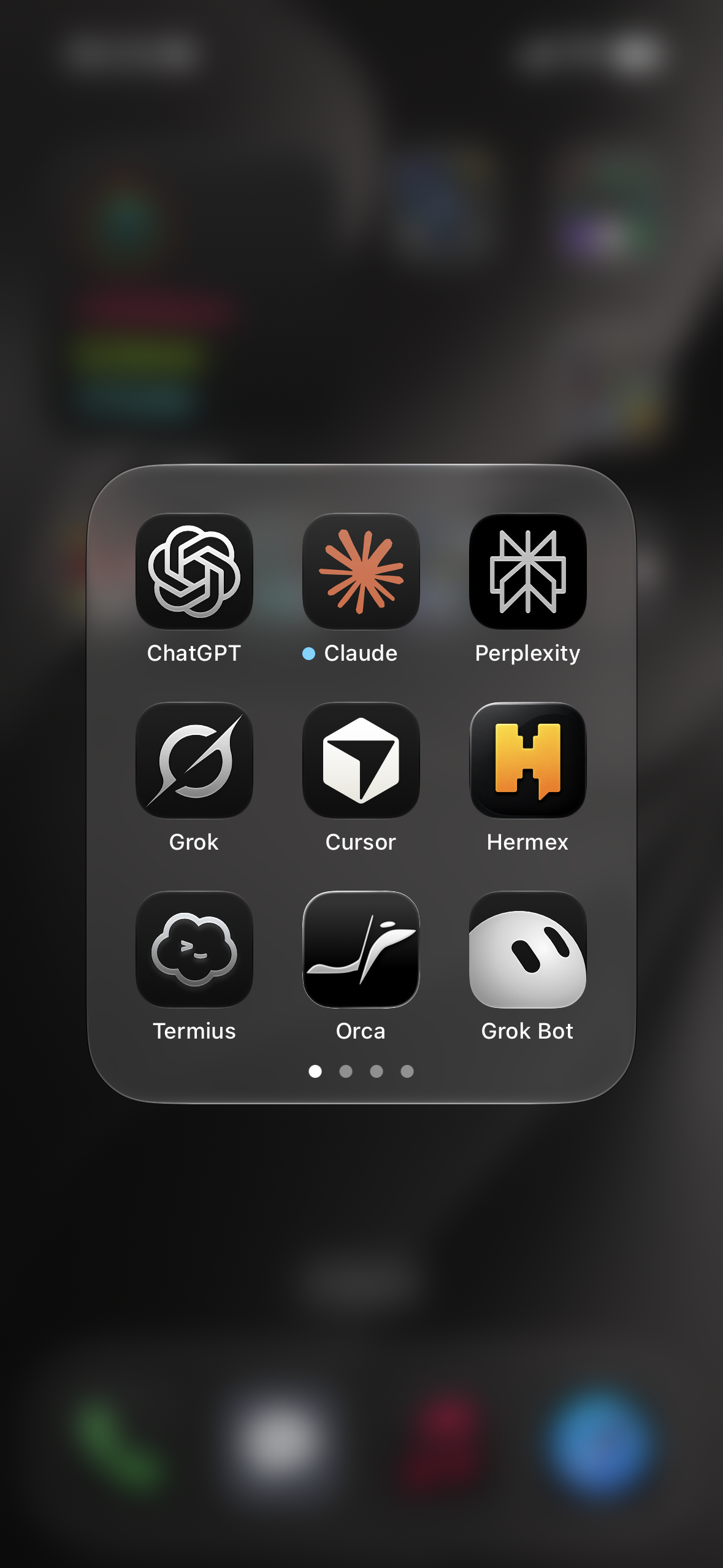
Baekpica/ds4@9a55e03
then corrected the vision-attention score broadcast after warp reduction. An
exact-source Responses API check read all nine visible labels from the
screenshot below: ChatGPT, Claude, Perplexity, Grok, Cursor,
Hermex, Termius, Orca, and Grok Bot.
| Source screenshot | Served result |
|---|---|
 |
 |
These are still-image API and integration checks, not a general vision throughput or OCR benchmark, nor a cross-runtime hidden-state/logit comparison. The first implementation used correctness-first per-query online attention; the later tiled large-image follow-up is reported below.
On 2026-08-29,
Baekpica/ds4@f7830ba
added image V2 cache identity. The server hashes decoded RGB pixels and source
geometry into an internal-only replay key; the marker is never tokenized or
returned by an API. A same-image continuation reused 90/110 prompt tokens,
while a same-geometry different-pixel request stayed cold. After a worker
restart, an image-bearing 1,890-token bank restored from disk and a 1,909-token
follow-up reused all 1,890 stored tokens. A separate same-image divergent
20,087-token request restored the 16,384-token recurrent checkpoint and
computed 3,703 prompt tokens. The final worker counters reported zero request,
continuous-batch, census, or governor failures under the external 109/115 GiB
reclaim/hard guard. Disk exact restore and live divergent partial reuse were
exercised separately; no cross-restart divergent-partial performance claim is
made.
On 2026-08-29,
Baekpica/ds4@538fe62
changed vision attention from one warp rereading K/V for every query to an
8-query by 32-key shared-memory tile. It retains the same online-softmax order
and never allocates an N-by-N score matrix. A 67-row, two-image-segment test at
the model's actual 16 heads and 72-value head width was bit-exact against the
previous path. NCU measured 24.67 us for the tiled kernel versus 31.81 us for
the previous kernel on that check (-22.4%).
A same-binary 3-by-3 API A/B used a 4,408-patch document image, 1,159 prompt tokens, 64 output tokens, and disabled live/disk prefix reuse:
| Vision attention | Mean prefill | Mean TTFT | Mean decode |
|---|---|---|---|
| 8-query / 32-key tiled | 494.47 tok/s | 10.262 s | 13.77 tok/s |
| Previous per-query path | 494.50 tok/s | 14.143 s | 14.70 tok/s |
The controlled result is a 27.45% TTFT reduction for this image size. Decode is reported for completeness but is not attributed to the vision kernel; the 64-token MTP tails were thermally variable. This is exact full attention and still performs O(P^2) arithmetic. It is a shared-memory tiled online-softmax kernel, not a tensor-core FlashAttention claim.
On 2026-08-29,
Baekpica/ds4@1c9628a
retained the existing same-chunk prefetch overlap with token embedding and
decoder layer 0, and changed the bounded page-read worker default from 16 to
32 after controlled tuning. Identical fixed 8,192-token direct runs used the
same binary and input with --gen-tokens=0, three runs per setting:
| Setting | Mean prefill |
|---|---|
| 512 MiB cache, 16 workers | 252.17 tok/s |
| 1,024 MiB cache, 16 workers | 397.72 tok/s |
| 2,048 MiB cache, 16 workers | 450.26 tok/s |
| 2,048 MiB cache, 32 workers | 464.67 tok/s |
| 2,048 MiB cache, 64 workers | 466.88 tok/s |
The 32-worker default retained nearly all of the 64-worker result with less
host submission overhead. A cold 9,854-prompt / 64-output API check using the
2 GiB cache and 32-worker defaults measured 467.2 prefill tok/s, 21.111 s
TTFT, and 25.4 decode tok/s. A synchronized two-request check completed as
served=2 fallback=0; all four requests in the smoke sequence completed with
zero request, census, or governor failures. The external 109/115 GiB
reclaim/hard guard remained active and the minimum observed system-available
memory was 8.07 GiB. Direct runs do not measure TTFT or decode throughput, and
these measurements do not claim SSD latency percentiles or sustained
concurrency.
On 2026-08-29,
Baekpica/ds4@7ccbfb9
replaced the two independent scalar calls for token embedding and all
Hyper-Connection transforms with one actual two-row operation whenever two
Qwen banks are decode-ready. At that commit, PLE, QSA, routed MoE, output
projection, and the remaining Gated DeltaNet stages retained bank-owned arithmetic. This is a
state-safe incremental row batch, not a claim that the complete Qwen graph is
one batched kernel. DS4_QWEN_NO_ROW_BATCH=1 restores the scalar path.
The Hyper-Connection BF16 projections use a fixed native reduction for decode so one-row and two-row execution are bit-identical across a two-bank-to-one-bank transition. The same change superseded the earlier two-row MTP target verifier: the target now verifies committed tokens sequentially with its ordinary one-row arithmetic, advances the drafter from the first target hidden row before evaluating an accepted draft, and no longer allocates a recurrent-state rollback buffer.
The real-Q5 regression matched both 12-token outputs to their scalar oracles, forced one request to finish after four tokens while the other continued to 12, retained MTP draft accepts, and passed disk-KV, partial-fork, and graph retire/rebuild gates. The integrated Hyper-Connection test also matched the two-row BF16 projections and residuals bit-for-bit against two scalar rows.
A same-process alternating 3-by-3 micro A/B used the two short test prompts and generated 12 tokens per request on each pass:
| Decode carrier | Three elapsed times | Aggregate output rate |
|---|---|---|
| Two-row embedding/HC | 1.059, 1.057, 1.060 s | 22.67 tok/s |
| Scalar per-bank path | 1.150, 1.149, 1.151 s | 20.86 tok/s |
The controlled improvement was 8.65% under the external 109/115 GiB reclaim/hard guard. This is a short generation microbenchmark that isolates the row-path switch; it is not an API prefill, TTFT, long-context decode, or sustained-concurrency measurement.
On 2026-08-30,
Baekpica/ds4@a34ef22
placed the two independent Gated DeltaNet recurrent-state updates in one CUDA
grid. Each (bank, value head) still owns its original block, state, token
order, and arithmetic; only the duplicate kernel launch was removed. The
input projections are now covered by the later two-bank change below;
convolution, controls, gated norm, and output stay bank-owned.
DS4_QWEN_NO_GDN_RECURRENT_BANK2=1 restores the two-launch path.
The production-shape CUDA gate used different inputs, controls, and initial states for the two banks. Both outputs and both final recurrent states matched two scalar launches bit-for-bit. The guarded real-Q5 regression also retained both 12-token scalar-oracle streams and passed MTP, recurrent disk-KV, partial-prefix fork, and graph retire/rebuild checks.
An alternating same-process 3-by-3 A/B isolated only this recurrent launch:
| GDN recurrent carrier | Three elapsed times | Aggregate output rate |
|---|---|---|
| Paired two-bank grid | 1.036, 1.031, 1.030 s | 23.24 tok/s |
| Two scalar launches | 1.053, 1.054, 1.051 s | 22.80 tok/s |
The measured improvement was 1.96% under the external 109/115 GiB reclaim/hard guard. This is a short two-request decode microbenchmark, not an API prefill, TTFT, long-context decode, or sustained-concurrency result.
On 2026-08-30,
Baekpica/ds4@8e67e2d
sent the final Q8 output matrix for two decode-ready banks through the existing
two-row dense path instead of traversing the same weights once per bank. No new
kernel or persistent allocation was added. DS4_QWEN_NO_OUTPUT_ROW_BATCH=1
restores the two one-row calls for diagnosis.
At the model's 2,560-element output-head input width, the raw Q8 path matched two one-row calls bit-for-bit across 514 checked outputs. The guarded real-Q5 regression retained both scalar-oracle token streams and passed its two-bank MTP, recurrent disk-KV, partial-prefix fork, and graph lifecycle gates.
An alternating same-process 3-by-3 A/B isolated only the output projection:
| Output projection | Three elapsed times | Aggregate output rate |
|---|---|---|
| Two-row Q8 path | 1.012, 1.012, 1.014 s | 23.70 tok/s |
| Two one-row calls | 1.039, 1.036, 1.034 s | 23.15 tok/s |
The measured improvement was 2.35% under the external 109/115 GiB reclaim/hard guard. This remains a short two-request decode microbenchmark; it does not establish API prefill, TTFT, long-context decode, or sustained concurrency performance.
On 2026-08-30,
Baekpica/ds4@64fd836
combined the two decode-ready banks' 32 SSD-PLE row descriptors into one CUDA
gather and one bit-exact BF16-to-F32 promotion. Each bank still derives and
prefetches its own row IDs and retains independent key/value projections,
gating, convolution state, and residual arithmetic. No sidecar residency bound
or cache policy changed. DS4_QWEN_NO_PLE_GATHER_BANK2=1 restores two gathers
for diagnosis.
The PLE primitive gate retained exact BF16 promotion and its existing chunk/decode convolution-state checks. The guarded real-Q5 regression retained both scalar-oracle token streams and passed two-bank MTP, recurrent disk-KV, partial-prefix fork, and graph retire/rebuild checks.
An alternating same-process 3-by-3 A/B isolated only the gather change:
| SSD-PLE gather | Three elapsed times | Aggregate output rate |
|---|---|---|
| One two-bank gather | 1.001, 1.000, 1.002 s | 23.98 tok/s |
| Two one-bank gathers | 1.009, 1.006, 1.007 s | 23.82 tok/s |
The measured improvement was 0.64% under the external 109/115 GiB reclaim/hard guard. This is a short two-request decode microbenchmark, not an SSD latency-percentile, API prefill/TTFT, long-context decode, or sustained concurrency measurement.
On 2026-08-30,
Baekpica/ds4@903d4d0
placed the two decode-ready banks' assignment-major Q5_0 expert-down tails in
one two-dimensional CUDA grid. Each block still owns one bank, assignment,
and output tile and retains the scalar kernel's arithmetic. Router, main
routed MMQ, and shared-expert work remain independent. The expert-major
prefill fallback and the Q8_0 MTP tail are unchanged.
DS4_QWEN_NO_Q5_TAIL_BANK2=1 restores two complete scalar MoE paths for
diagnostic A/B runs.
A production-shaped CUDA gate used different activation rows, expert IDs, and initial output values for each bank; all 51,200 outputs per bank matched two scalar launches bit-for-bit. The guarded real-Q5 regression retained both target token streams and passed two-bank MTP, recurrent disk-KV, partial-prefix fork, and graph retire/rebuild checks.
An alternating same-process 3-by-3 A/B isolated the paired tail path:
| Q5_0 tail carrier | Three elapsed times | Aggregate output rate |
|---|---|---|
| Paired two-bank grid | 0.976, 0.975, 0.973 s | 24.62 tok/s |
| Two scalar MoE paths | 0.992, 0.991, 0.991 s | 24.20 tok/s |
The measured improvement was 1.74% under the external 109/115 GiB reclaim/hard guard, with all three paired rounds faster. This remains a short two-request decode microbenchmark; it is not an API prefill, TTFT, long-context decode, or sustained-concurrency result.
On 2026-08-30,
Baekpica/ds4@ef7a696
sent the two decode-ready banks' QSA Q/gate projection through one two-row Q8
matmul in each of the 12 QSA layers. It reuses the carrier graph's contiguous
Hyper-Connection rows and the existing Q8 path; no new kernel or persistent
allocation was added. Index/KV history, RoPE, attention, and output remain
bank-owned. DS4_QWEN_NO_QSA_QPROJ_BANK2=1 restores two independent
projections for diagnostic A/B runs.
The real layer-3 Q8 gate compared the two-row projection with two one-row calls and matched all 98,304 output bytes exactly. The guarded real-Q5 regression retained both target token streams and passed two-bank MTP, recurrent disk-KV, partial-prefix fork, and graph retire/rebuild checks.
An alternating same-process 3-by-3 A/B isolated the QSA projection path:
| QSA Q/gate projection | Three elapsed times | Aggregate output rate |
|---|---|---|
| Two-row Q8 path | 0.955, 0.955, 0.954 s | 25.15 tok/s |
| Two one-row calls | 0.973, 0.974, 0.974 s | 24.65 tok/s |
The measured improvement was 2.01% under the external 109/115 GiB reclaim/hard guard, with all three paired rounds faster. This is a short two-request decode microbenchmark; it is not an API prefill, TTFT, long-context decode, or sustained-concurrency result.
On 2026-08-30,
Baekpica/ds4@61af3f7
kept each decode-ready bank's F32 router, top-k selection, Q4_K gate/up,
weighted SwiGLU, and packed activation construction independent, then joined
the two packed 10-row Q5_K expert-down main worklists in one existing bounded
routed-MMQ call. The second result is copied back to its bank before the paired
Q5_0 tail; shared-expert arithmetic remains bank-owned. No new CUDA kernel or
persistent allocation was added. DS4_QWEN_NO_MOE_MAIN_BANK2=1 restores two
independent routed-main calls while retaining the paired tail.
The compact real-weight layer-2 gate used two distinct inputs and matched both 10-by-2,560 routed-main output tables bit-for-bit against two scalar calls. The guarded real-Q5 regression retained both target token streams and passed two-bank MTP, recurrent disk-KV, partial-prefix fork, and graph lifecycle checks.
An alternating same-process 3-by-3 A/B isolated only the routed-main join:
| Q5_K routed main | Three elapsed times | Aggregate output rate |
|---|---|---|
| One two-bank worklist | 0.945, 0.944, 0.945 s | 25.40 tok/s |
| Two one-bank worklists | 0.963, 0.963, 0.965 s | 24.91 tok/s |
The measured improvement was 1.95% under the external 109/115 GiB reclaim/hard guard, with all three combined rounds faster. This remains a short two-request decode microbenchmark; it is not an API prefill, TTFT, long-context decode, or sustained-concurrency result.
On 2026-08-30,
Baekpica/ds4@bd4d0be
kept the two F32 router projections bank-owned, staged their logits in two rows
of the existing workspace, and ran the existing router top-k kernel once over
both rows. The second bank's selected IDs and normalized weights are copied
back before its routed MoE work continues. No new CUDA kernel or persistent
allocation was added. DS4_QWEN_NO_MOE_TOPK_BANK2=1 restores two independent
top-k launches while retaining the other accepted two-bank paths.
Four distinct 512-expert logits rows matched their one-row top-k calls bit-for-bit. The guarded real-Q5 regression retained both target token streams and passed two-bank MTP, recurrent disk-KV, partial-prefix fork, and graph lifecycle checks.
An alternating same-process 3-by-3 A/B isolated only the top-k join:
| Router top-k | Three elapsed times | Aggregate output rate |
|---|---|---|
| One two-bank launch | 0.934, 0.931, 0.932 s | 25.74 tok/s |
| Two one-bank launches | 0.946, 0.944, 0.948 s | 25.37 tok/s |
The measured improvement was 1.48% under the external 109/115 GiB reclaim/hard guard, with all three combined rounds faster. This remains a short two-request decode microbenchmark; it is not an API prefill, TTFT, long-context decode, or sustained-concurrency result.
On 2026-08-30,
Baekpica/ds4@320ee90
sent the two decode-ready banks' four Q8 Gated DeltaNet input projections
(qkv, z, in_b, and in_a) through the existing two-row dense path in
each of the 36 GDN layers. Bank 1's projected rows are copied back before its
independent stateful convolution and controls; the accepted paired recurrent
update is unchanged. No new CUDA kernel or persistent allocation was added.
DS4_QWEN_NO_GDN_PROJ_BANK2=1 restores four independent projection calls
while retaining the paired recurrent update.
The compact real-weight layer-0 gate used two distinct inputs and matched both complete 2,560-value GDN output rows bit-for-bit against two scalar calls. The guarded real-Q5 regression retained both target token streams and passed two-bank MTP, recurrent disk-KV, partial-prefix fork, and graph lifecycle checks.
An alternating same-process 3-by-3 A/B isolated only the projection join:
| GDN input projections | Three elapsed times | Aggregate output rate |
|---|---|---|
| Four two-row Q8 calls | 0.878, 0.873, 0.873 s | 27.45 tok/s |
| Eight one-row Q8 calls | 0.935, 0.937, 0.936 s | 25.65 tok/s |
The measured improvement was 7.03% under the external 109/115 GiB reclaim/hard guard, with all three two-row rounds faster. This remains a short two-request decode microbenchmark; it is not an API prefill, TTFT, long-context decode, or sustained-concurrency result.
On 2026-08-30,
Baekpica/ds4@1c3925b
sent both decode-ready banks' F32 router projections through one existing
two-row dense call with row-stable reduction order, then reused the accepted
combined top-k path. Bank-owned routing inputs and downstream expert work
remain independent. No new CUDA kernel or persistent allocation was added.
DS4_QWEN_NO_MOE_ROUTER_BANK2=1 restores two independent router projections
while retaining the combined top-k path.
The compact real-weight gate matched both complete 512-value router-logit rows and normalized top-k results bit-for-bit against two scalar calls. The guarded real-Q5 regression retained both target token streams and passed two-bank MTP, recurrent disk-KV, partial-prefix fork, and graph lifecycle checks.
An alternating same-process 3-by-3 A/B isolated only the router projection:
| F32 router projection | Three elapsed times | Aggregate output rate |
|---|---|---|
| One two-bank projection | 0.866, 0.867, 0.868 s | 27.68 tok/s |
| Two one-bank projections | 0.871, 0.870, 0.871 s | 27.57 tok/s |
The measured improvement was 0.40% under the external 109/115 GiB reclaim/hard guard, with all three combined rounds faster. This remains a short two-request decode microbenchmark; it is not an API prefill, TTFT, long-context decode, or sustained-concurrency result.
A teacher-forced full-model comparison scored 2,048 tokens from each of two fixed text fixtures on the higher-precision MQ-Q6 artifact and the target MQ-Q5 artifact:
| Fixed slice | MQ-Q6 avg NLL / PPL | MQ-Q5 avg NLL / PPL | Q5-Q6 avg NLL |
|---|---|---|---|
| Long-form essay | 2.184138 / 8.882991 | 2.140368 / 8.502567 | -0.043770 (-2.00%) |
| Repetitive structured security fixture | 0.068999 / 1.071435 | 0.081061 / 1.084437 | +0.012062 (+17.48%) |
| Equal-token aggregate (4,096 tokens) | 1.126569 / 3.085053 | 1.110714 / 3.036527 | -0.015854 (-1.41%) |
The two slices show no Q5 quality collapse in this narrow regression, but they are not a representative evaluation suite and do not establish general Q5 superiority. The structured fixture is highly repetitive, so its low absolute perplexity is useful only for the paired comparison.
The same Q5 artifact then completed an exact 262,144-token direct prefill with
--gen-tokens=0, an 8,192-token Qwen chunk, the bounded 2,048 MiB PLE cache,
and 32 PLE workers. It sustained 277.06 prefill tok/s. The dumped final
output contained all 248,320 finite logits; the recorded and independently
recomputed argmax were both token 264. The run completed under the external
115 GiB memory guard with DS4_MEMGOV=observe; the lowest sampled
system-available memory was 7.8 GiB. This establishes full-windo
Five incremental rounds on ds4-dfm-rs
(d9f96a8 → 230655d), each measured against the previously adopted commit on
one NVIDIA DGX Spark, the canonical two-bank serving command
(DS4_QWEN_BATCH=1, 8,192-token prefill chunks, 512 MiB PLE cache with 16 page
workers, --mtp-draft 2, 196,608 configured context), three fresh workers with
fresh disk-KV directories per variant, thinking disabled, max_tokens 1, and
the API's timings.prefill_tok_s. The rounds were developed on the same-layout
Uncensored sibling
MQ-Q5-SSD-PLE-BF16 artifact and the final binary was then measured on this
artifact. Two prompts were used: a 31,000-character prompt made of one
7,750-character passage repeated four times (8,259 tokens; the last three copies
hit the PLE page cache, which reproduces the regime of the 2026-09-01 numbers
above) and a 23,150-character markdown/code document (7,937 tokens) whose
n-grams miss the PLE cache, so ~6.5 s of its prefill is SSD page reads.
| Round | Change | Commit | 8,259-token repeated prompt (median of 3, Uncensored sibling) | 7,937-token cold-PLE prompt (median of 3, Uncensored sibling) |
|---|---|---|---|---|
| baseline | 81e2cfa |
– | 556.2 tok/s | 417.6 tok/s |
| 1 | Q5_0/Q8_0 expert-down tail fused into the MMQ worklist kernel | d9f96a8 |
635.0 (+14.2%) | 452.6 (+8.4%) |
| 2 | shared expert gate/up/down on the MMQ tier (K=640 down as one fused-tail expert) | 6a3ae08 |
740.5 (+16.6%) | 503.5 (+11.2%) |
| 3 | counting-sort expert id maps (bit-identical) + redundant non-finite passes dropped | d575263 |
792.7 (+6.9%) | 520.0 (+3.3%) |
| 4 | Q5_K/Q8_0 gate/up on the compact worklist pair; PLE key/value and QSA k/v pairs on MMQ | 6e14b33 |
883.5 (+11.2%) | 591.7 (+13.8%) |
| 5 | hyper-connection rows converted to BF16 once | 230655d |
910.7 (+3.3%) | 597.1 (+0.6%) |
This artifact, same day, owner swapped to it: unmodified 81e2cfa measured
558.1 tok/s (554.6, 558.1, 559.5) and the final 230655d 908.1 tok/s (906.3,
908.1, 911.4) on the repeated prompt (+62.7%), and 584.4 tok/s (570.1, 584.4,
611.5) on the cold-PLE markdown prompt. The 64-token greedy continuation of the
repeated prompt is byte-identical between the two binaries on this artifact.
Per-round percentages are against the preceding round's rerun on the same day
and are not additive across days.
On the Uncensored sibling, rounds 1–3 and 5 leave the 64-token continuation unchanged and round 4 changes it after the first ten tokens; on this artifact the continuation is unchanged end to end, and disabling only round 4's pair split on the final binary flips it again (at 771.4 tok/s), so that prompt sits near a greedy tie under ~1e-3 numeric differences rather than tracking a systematic drift. The new Q5_K/Q8_0 worklist pairs are bit-identical to the generic routed matmul on the fixture; the PLE/QSA pairs move from Q8_0 DP4A kernels to the Q8_1-activation MMQ tier used by every other projection. A Linux-AIO rewrite of the PLE page workers was measured and rejected (cold-PLE prompt 593 → 511 tok/s on the sibling); the raw NVMe sustains 53K–91K random 4 KiB IOPS at 16–64 threads, so the remaining cold-PLE cost is a pipeline limit, not a device limit.
16-bit
Base model
Qwen/Qwen3.8-Flash-Next
Start the llama.cpp server
# Install llama.cpp: brew install llama.cpp# Start a local OpenAI-compatible server: llama serve -hf Baekpica/Qwen3.8-Flash-Next-Mixed-Quant-SSD-PLE-GGUF:BF16