

Anime foot detector (YOLO11m)
A small YOLO11m detector that finds feet in anime and illustration images. It has a single class, foot.
The main use is image generation cleanup: pair it with an ADetailer or Impact Pack workflow in ComfyUI so
a detail or inpaint pass can fix feet, which diffusion models often render badly. It was built for the Anima
text-to-image model, but it works on anime-style imagery in general, so it should transfer to other anime or
illustration generators without retraining.
Three versions are provided. They share the same architecture and differ only in training. v3 is the
current production model.
Which one to use
foot_anime_yolo11m_v3.ptis the production model and the one to use. On a held-out test set it has the best box accuracy across every image type and the broadest coverage, including harder cases like stockings and unusual poses.foot_anime_yolo11m_v2.ptis the previous production model, very close behind, and a little better at finding feet in plain, clearly visible shots. A good alternative.foot_anime_yolo11m_v1.ptis the first and weakest version, kept for reference.
Start with v3. If it misses a foot in a simple image, try v2.
Models
| file | size | input | role |
|---|---|---|---|
foot_anime_yolo11m_v1.pt |
40 MB | 640 | seed (reference) |
foot_anime_yolo11m_v2.pt |
40 MB | 640 | previous production |
foot_anime_yolo11m_v3.pt |
40 MB | 640 | production (recommended) |
All are YOLO11m (about 20M parameters), fine-tuned from the COCO-pretrained yolo11m.pt.
Files and formats
Each version ships in two formats:
.ptis the standard Ultralytics PyTorch checkpoint, and what ComfyUI andYOLO(...)load directly. It is a pickle, so the Hub lists its imports; those are the normal torch and Ultralytics imports, and the weights are first-party (trained here)..onnxis a non-pickle export for anyone who would rather not load a pickle, or who wants to run the model with ONNX Runtime outside the Ultralytics stack. Each ONNX file was checked to give the same detections as its.pt.
Why YOLO11m
Version. These are built on YOLO11, chosen as the proven, well-supported Ultralytics line: the cleanest
ComfyUI integration and a one-line transfer-learning start from yolo11m.pt. It is not the newest model.
Ultralytics released YOLO26 in January 2026, which is NMS-free and adds small-target-aware training, both of
which would suit this task, so a future version will likely move to YOLO26m. YOLO11 was the stable, obvious
choice when this line started, and switching architecture partway through would have broken the
version-to-version comparison.
Size. Medium (about 20M parameters, 40 MB) rather than a larger variant like yolo11l or yolo11x. The
task is narrow, one class in one domain, so medium has plenty of capacity, and on the test set it already
maxes out the easy image types. The failures that remain are open-toe footwear and the occasional false
positive, which are data and labeling gaps rather than capacity gaps. A heavier backbone will not learn
cases it was never shown, so it would cost more for about the same ceiling on the parts that matter.
The detector also runs inside a generation pipeline, next to the diffusion model and often SAM, on consumer GPUs. A 40 MB medium model barely touches the VRAM budget and stays fast on every call, while a larger variant would compete for memory and slow each image for little gain on this task.
Benchmark
A held-out set of 100 generated anime images (185 feet) that none of the models trained on, split into four groups of 25. The first row is a generic YOLOv8x foot detector, included only as an external reference point; it is not part of this repository. Scores are mAP50 / mAP50-95.
Overall:
| model | mAP50 | mAP50-95 |
|---|---|---|
| generic YOLOv8x (reference) | 0.42 | 0.18 |
| v1 | 0.28 | 0.08 |
| v2 | 0.81 | 0.50 |
| v3 | 0.81 | 0.59 |
By image type, v2 against v3:
| group | v2 mAP50 | v3 mAP50 | v2 mAP50-95 | v3 mAP50-95 |
|---|---|---|---|---|
| visible feet | 0.95 | 0.91 | 0.52 | 0.63 |
| feet in focus | 0.93 | 0.95 | 0.66 | 0.75 |
| stockings / tights | 0.93 | 0.93 | 0.62 | 0.69 |
| open-toe footwear | 0.42 | 0.43 | 0.22 | 0.28 |
v3 has the better box accuracy (mAP50-95) in every group, and matches or beats v2 at finding feet in most of them. v2 is slightly ahead only on plain visible shots. Open-toe footwear is the hardest case for every model, so expect more misses there.
Strengths and weaknesses
v3 (recommended). Best box accuracy on every image type in the test, and the best coverage of harder cases like stockings and unusual poses, since it trained on the largest and most varied set (about 286k images). On plain, clearly visible feet it will occasionally miss one that v2 catches, and open-toe footwear is still hard.
v2. The best at simply finding feet in clear shots, with high recall, and it behaves predictably because it trained on clean hand-checked data. Its boxes run a little looser than v3 on unseen images, it covers fewer unusual poses, and it is more prone than the others to mistake a hand for a foot.
v1. Small and fast, and reasonable on plain visible feet, but the weakest overall by a wide margin. It trained on a small set and struggles outside the easy case, and it can occasionally fire on a foot-like shape in a busy or detailed background. Its boxes also tend to cover only part of the foot, often just the toes. Kept only for reference.
A note on box coverage: v2 and v3 draw slightly looser boxes that reliably wrap the whole foot, sometimes with a little extra margin, while v1 often boxes only part of it. For a detailer that inpaints the whole region, full coverage matters more than a tight fit, so the looser boxes are usually a benefit here.
Examples
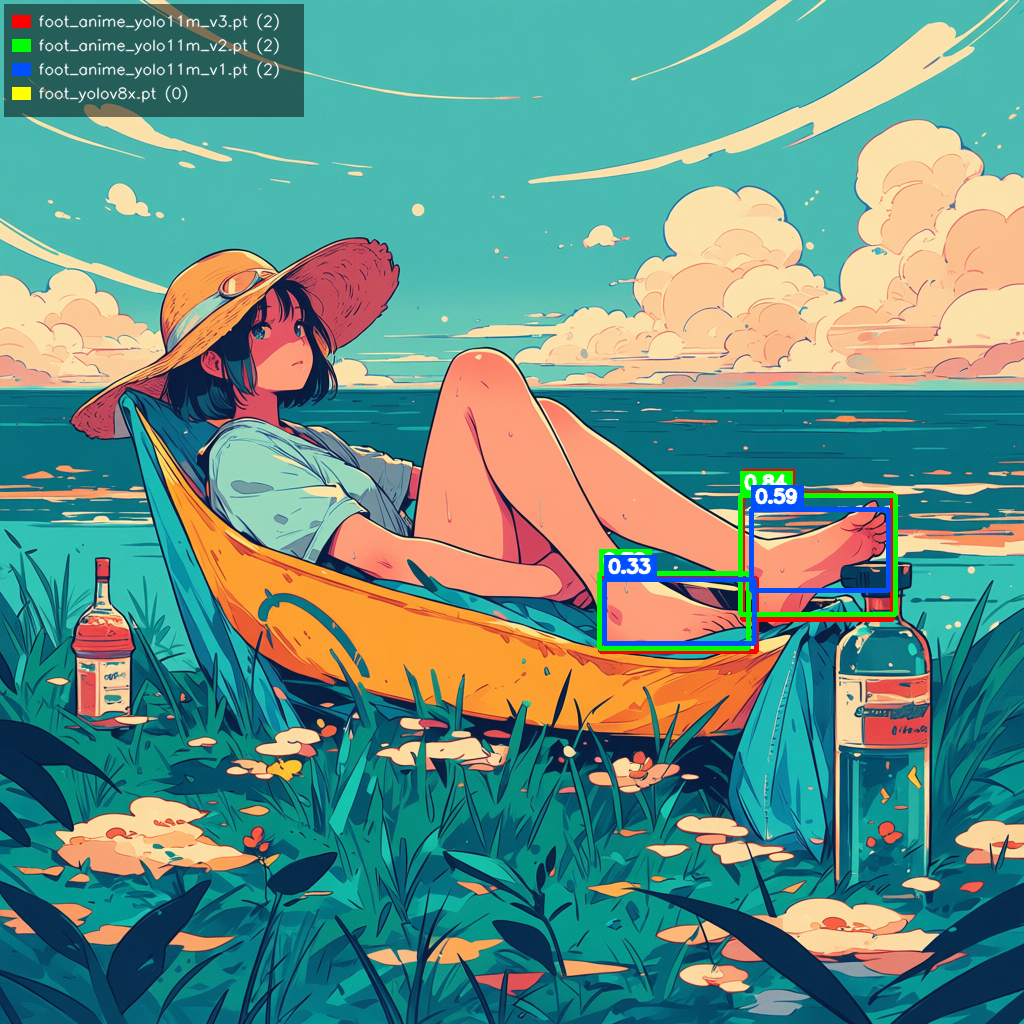
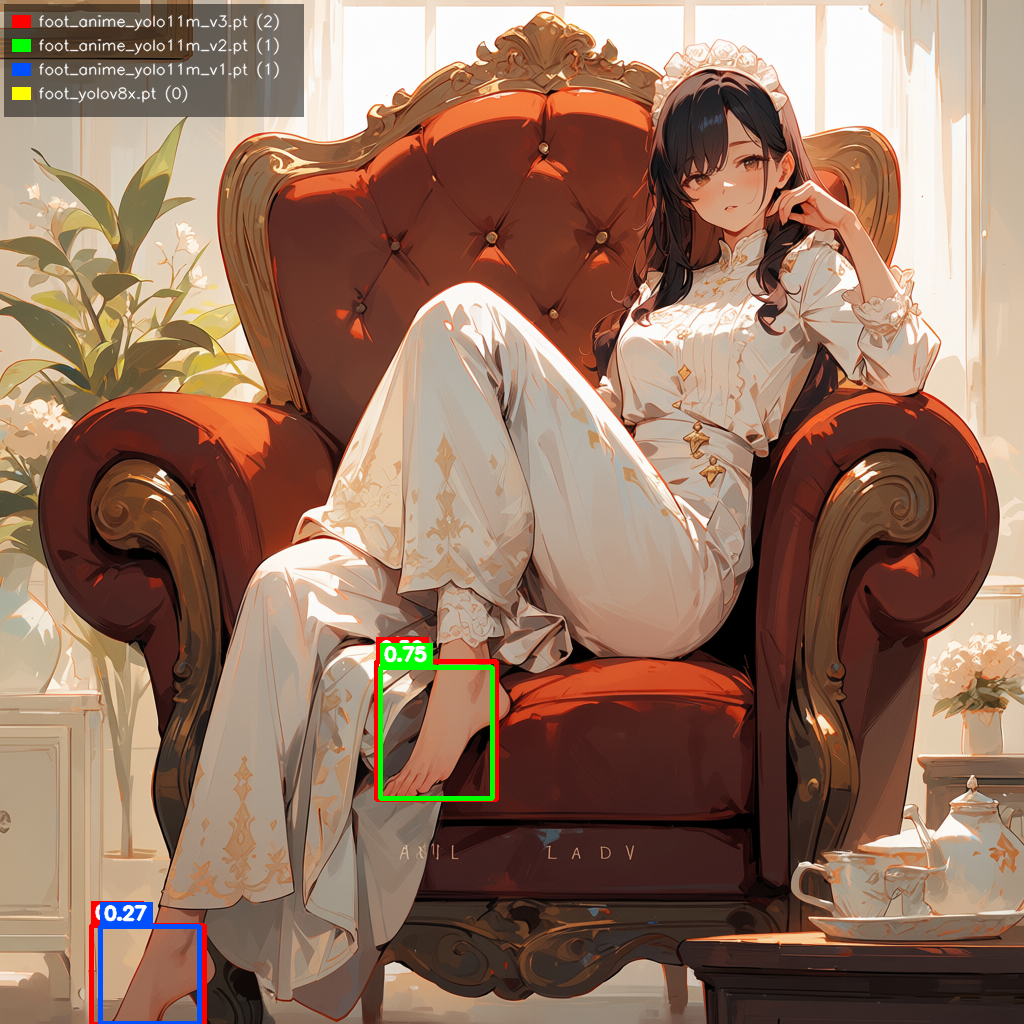
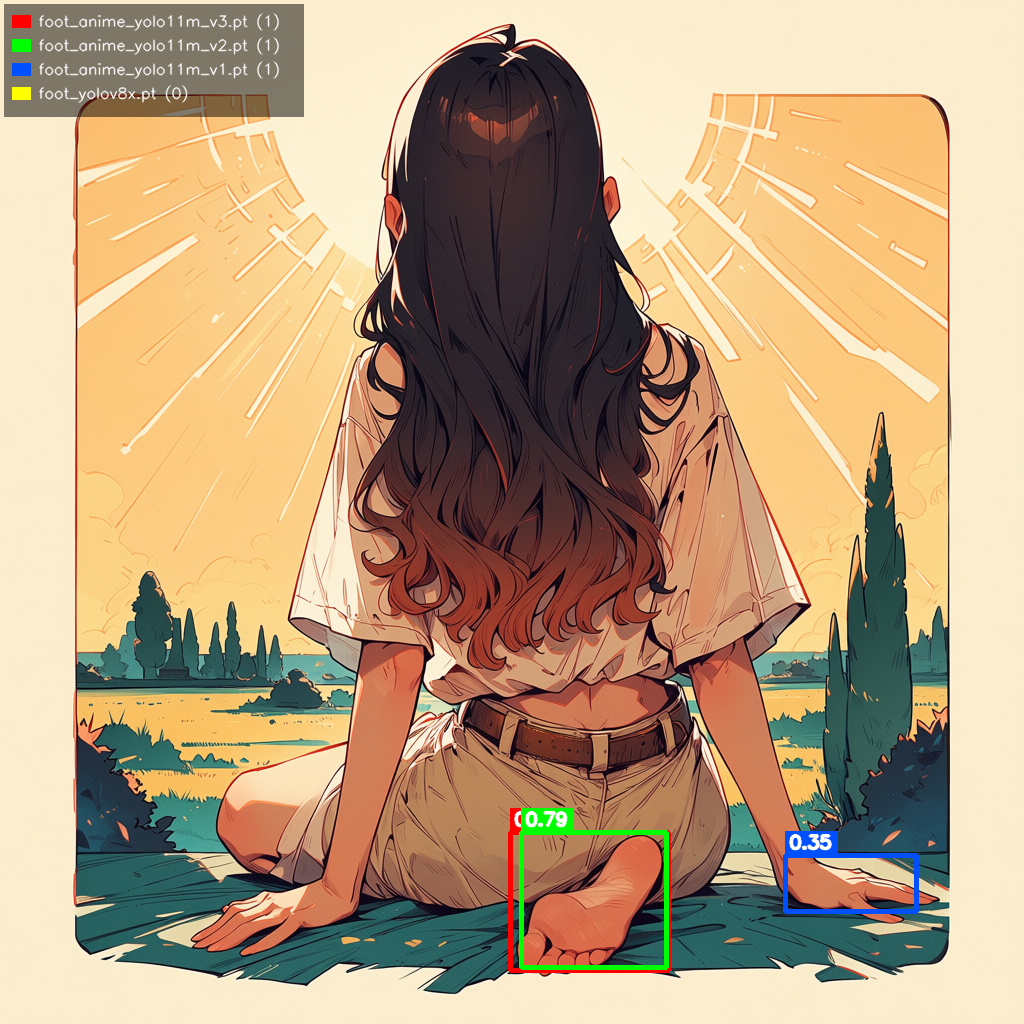
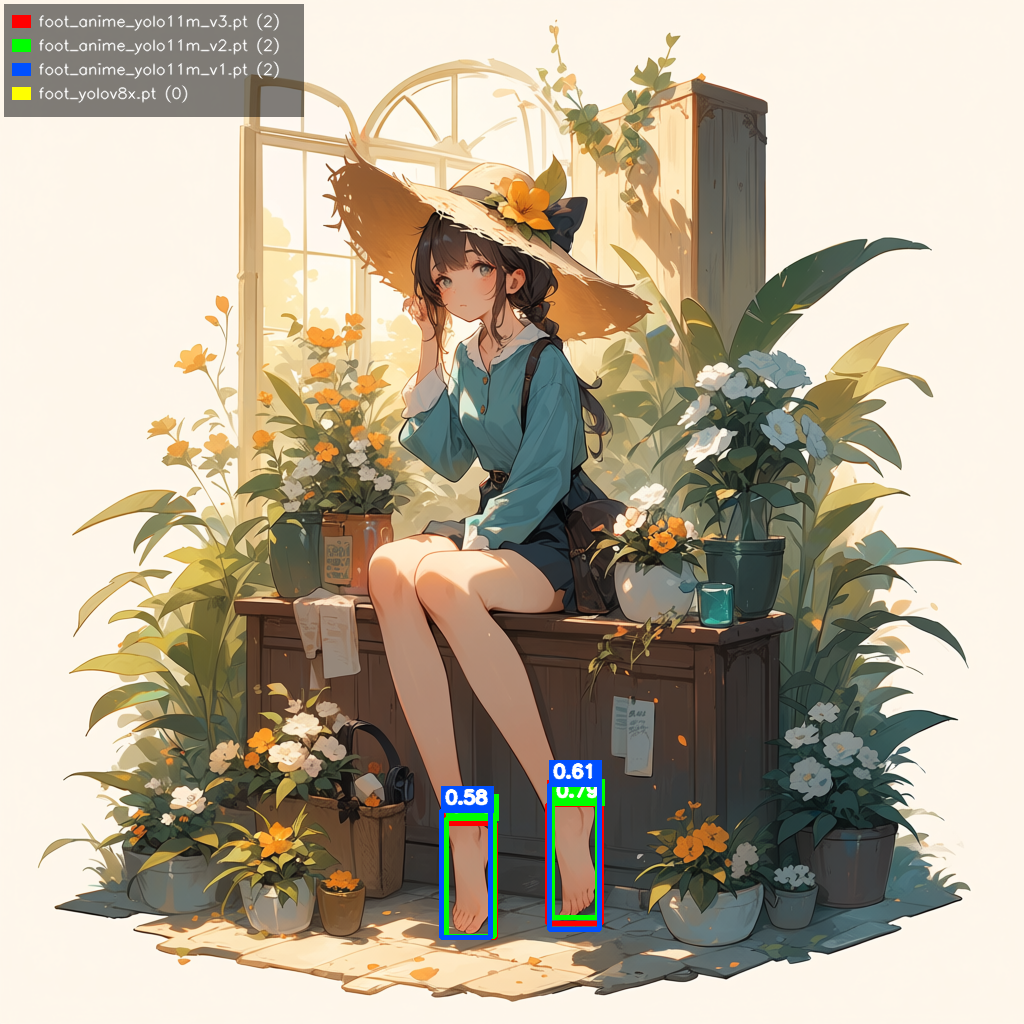
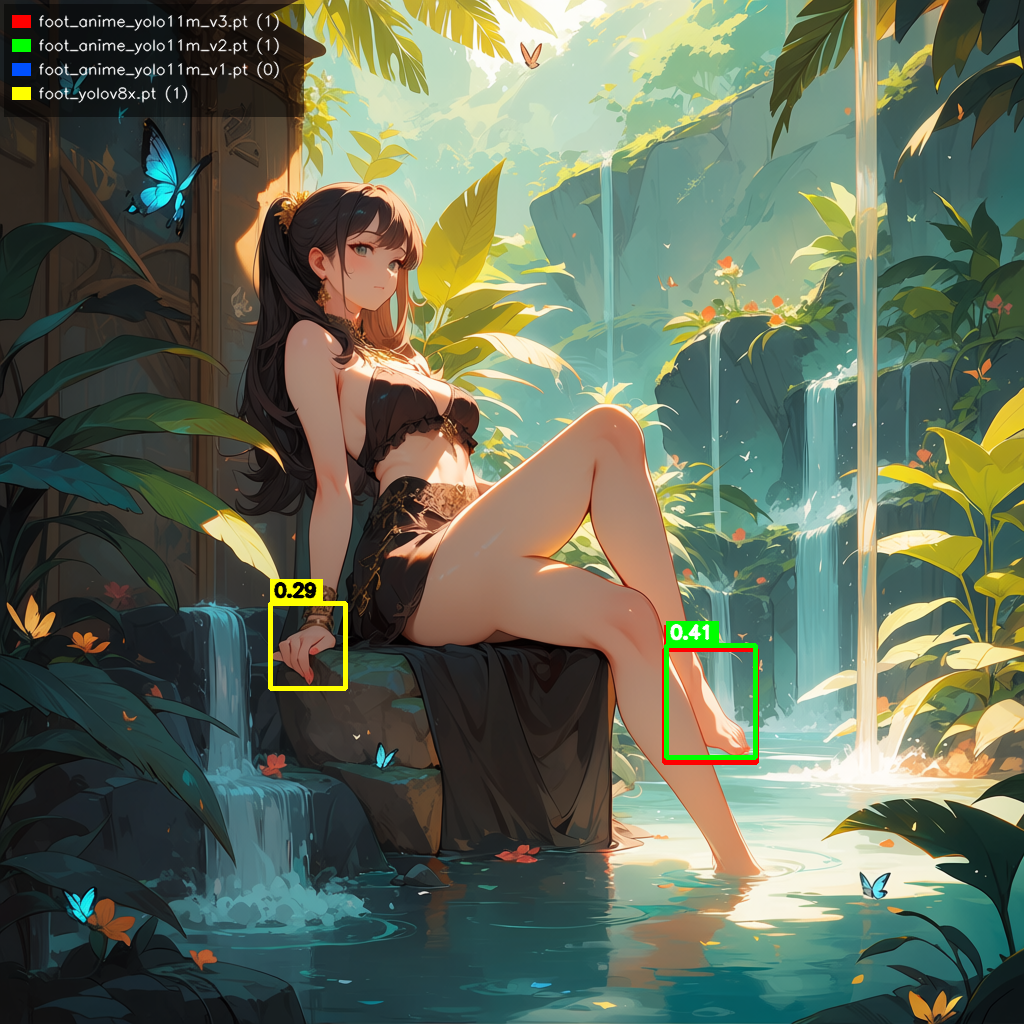
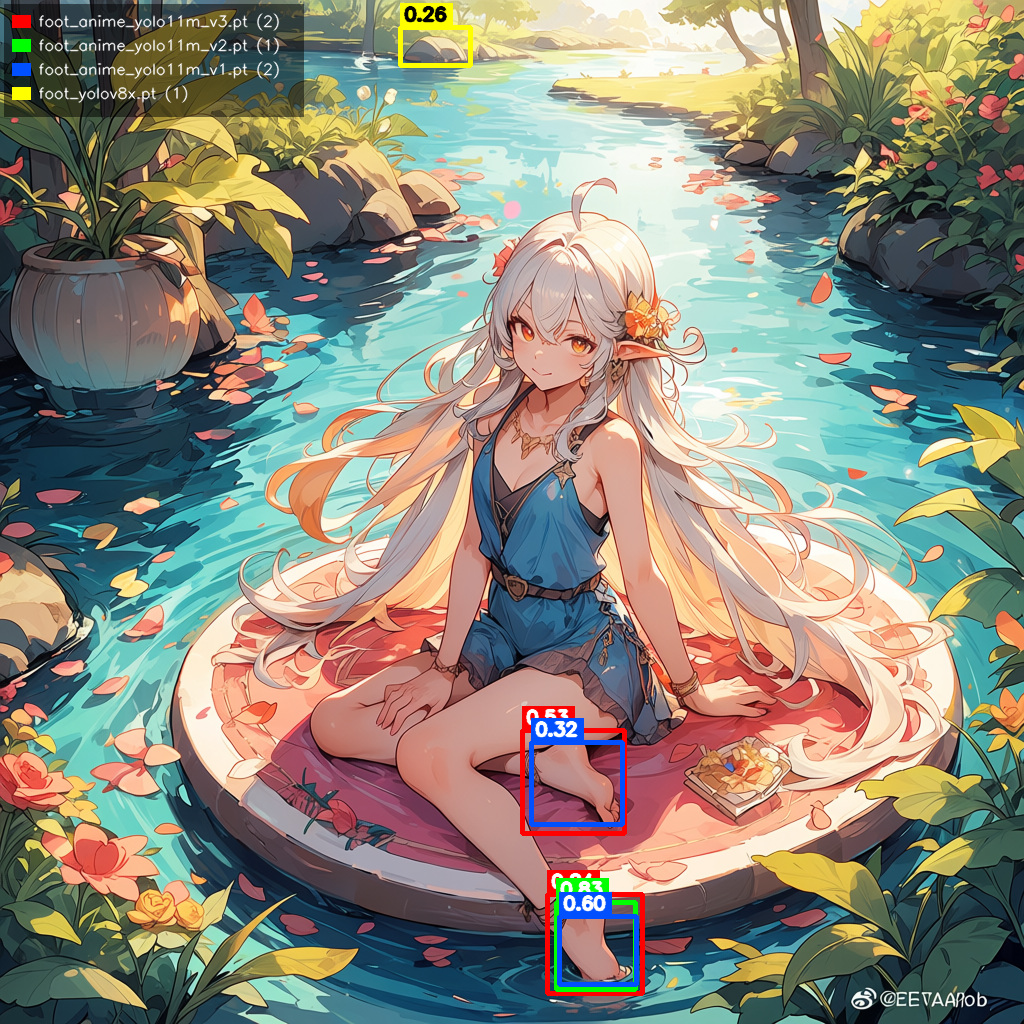
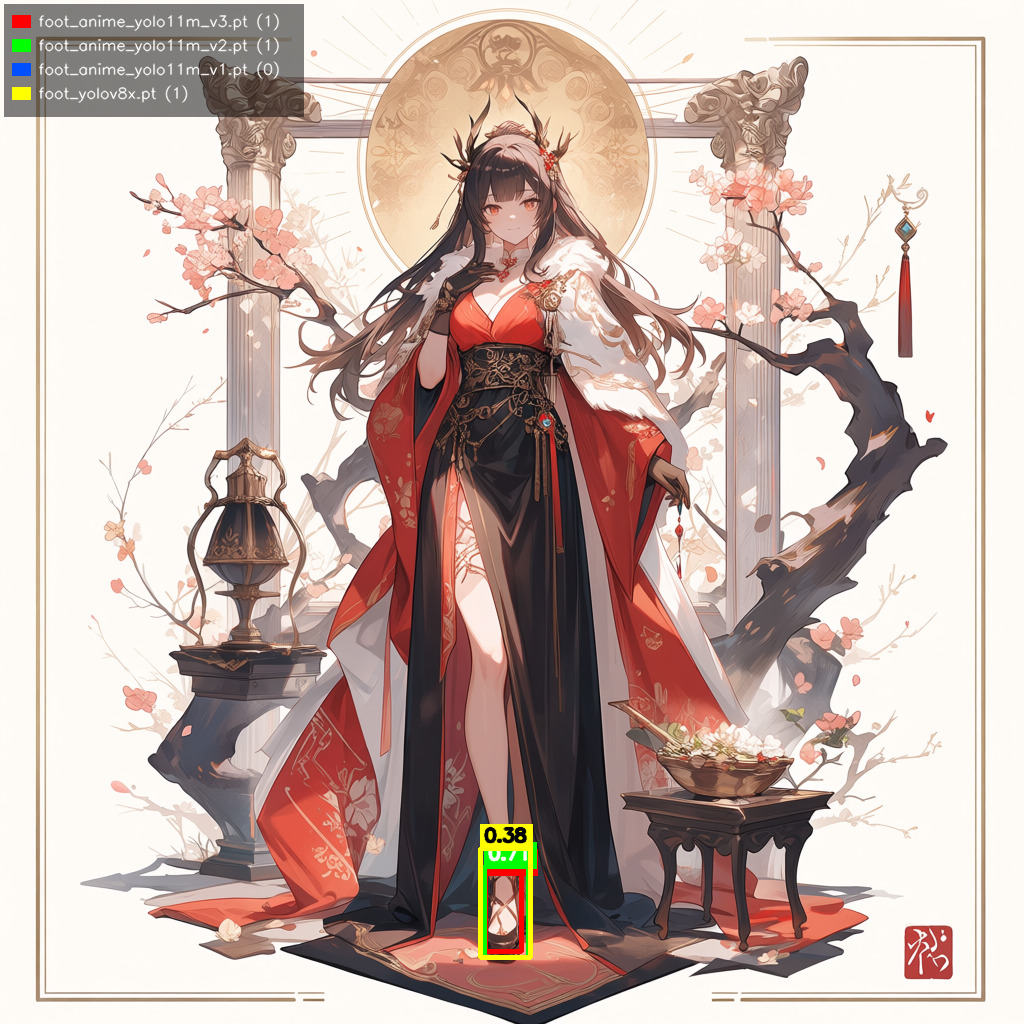
Ten images from the Anima pipeline, each run through all four detectors at once. Every model draws its boxes in its own color, with the confidence printed on the box and a per-image detection count next to each name in the legend.
- red: v3
- green: v2
- blue: v1
- yellow: generic YOLOv8x (reference, not part of this repo)
 |
 |
 |
 |
 |
 |
 |
 |
 |
 |
These track the benchmark. v3 and v2 usually agree and wrap the whole foot, v1 tends to cover only part of it or sit slightly off, and the generic YOLOv8x mostly misses or occasionally fires on a hand. Open-toe and partly hidden feet are where every model gets less reliable.
Usage
With Ultralytics:
from ultralytics import YOLO

model = YOLO("foot_anime_yolo11m_v3.pt")
results = model.predict("image.png", conf=0.3)   # 0.25 to 0.45 is a good range
for box in results[0].boxes.xyxy:
    print(box.tolist())
Download a single file from this repo:
from huggingface_hub import hf_hub_download
path = hf_hub_download("<repo-id>", "foot_anime_yolo11m_v3.pt")
In ComfyUI, put the file in ComfyUI/models/ultralytics/bbox/, load it with the Impact Pack's
UltralyticsDetectorProvider, and feed the bounding box into a detail or inpaint pass. A bbox threshold
near 0.45 is a sensible default.
Training data
Anime images from deepghs/danbooru2024, automatically labeled with DWPose whole-body keypoints (the foot
keypoints become padded boxes). v3 re-labels that corpus with v2 and keeps a box only when v2 is confident
or it lines up with the DWPose box. Training also mixes in ANFDet (a public-domain anime-foot dataset), a
few hundred hand-labeled images, and feet-free images as hard negatives to cut false positives. v3 was
trained on roughly 286k images. The earlier v1 and v2 used the smaller SFW subset
(deepghs/danbooru2024-sfw); v3 moved to the full deepghs/danbooru2024 corpus.
Intended use and limitations
This is meant for retouching AI-generated anime art, not for surveillance or identifying real people. The training images come from Danbooru and include NSFW-tagged content. The boxes are meant to feed a refiner rather than stand on their own. The models are tuned for anime and illustration and will not do well on photographs.
All versions were trained on bare anime feet. None were taught footwear as a target, so shoes, sandals, stockings, and similar cases sit outside the primary use case. They still detect feet in those images to some degree, and v3 generalizes to them noticeably better than v1 or v2, but bare feet stay the most reliable case. Open-toe footwear and sandals are the weakest.
License is AGPL-3.0, inherited from Ultralytics YOLO. If you serve these weights over a network, AGPL's source-availability terms apply.
Support
Building these means mining and labeling hundreds of thousands of images and renting GPUs to train on them, which takes real time and money. If the models are useful to you and you want to chip in, it is appreciated and never expected: https://ko-fi.com/claquasse
- Downloads last month
- 233
Model tree for Claquasse/foot_anime_yolo
Base model
Ultralytics/YOLO11Datasets used to train Claquasse/foot_anime_yolo
Evaluation results
- mAP@50 on Anime foot held-out (generated, 100 images / 185 feet)self-reported0.810
- mAP@50-95 on Anime foot held-out (generated, 100 images / 185 feet)self-reported0.590