

ONNX Export of convaiinnovations/laya
This is an ONNX-converted version of convaiinnovations/laya.
🚀 Quickstart & Usage
This model is a non-autoregressive decision engine exported to ONNX. It evaluates state and questions in a single forward pass using special marker tokens.
Python (onnxruntime)
pip install onnxruntime transformers numpy
import numpy as np
import onnxruntime as ort
from transformers import AutoTokenizer

# 1. Load tokenizer and ONNX session
repo_id = "your-username/model-name-onnx"
tokenizer = AutoTokenizer.from_pretrained(repo_id)
session = ort.InferenceSession("laya_int8.onnx")  # or laya.onnx

# 2. Format question & state into Laya's sequence format
# Format: [CLS] <qtype> question: <instructions> [SEP] [MASK] <opt0> [MASK] <opt1> [SEP] <state> [SEP]
state = "The database disk is 100% full and writes are failing."
instructions = "Is this an urgent production blocker?"
options = ["false", "true"]

# Build token IDs & note [MASK] marker positions (id: 50284)
prompt = f"noul question: {instructions}"
head_ids = tokenizer(prompt, add_special_tokens=False)["input_ids"]

opt_ids = []
for opt in options:
    opt_ids.extend([tokenizer.mask_token_id] + tokenizer(f" {opt}", add_special_tokens=False)["input_ids"])

# Assemble sequence
ids = [tokenizer.cls_token_id] + head_ids + [tokenizer.sep_token_id]
markers = []
for i, token in enumerate(opt_ids):
    if token == tokenizer.mask_token_id:
        markers.append(len(ids) + i)
ids.extend(opt_ids)
ids.append(tokenizer.sep_token_id)

state_ids = tokenizer(state, add_special_tokens=False)["input_ids"][:256]
ids = ids + state_ids + [tokenizer.sep_token_id]

# 3. Run Inference (~15ms on CPU)
feeds = {
    "input_ids": np.array([ids], dtype=np.int64),
    "attention_mask": np.ones((1, len(ids)), dtype=np.int64),
    "marker_pos": np.array([markers], dtype=np.int64),
    "marker_mask": np.ones((1, len(markers)), dtype=bool),
    "qtype": np.array([2], dtype=np.int64),  # 0=choice, 1=score, 2=noul
}

logits = session.run(None, feeds)[0][0]

# Softmax probability for P(true)
exp_logits = np.exp(logits - np.max(logits))
probs = exp_logits / np.sum(exp_logits)
print(f"Probability True: {probs[1]:.2%}")
TypeScript / Node.js (onnxruntime-node)
npm install onnxruntime-node @xenova/transformers
import * as ort from "onnxruntime-node";
import { AutoTokenizer } from "@xenova/transformers";

const session = await ort.InferenceSession.create("./laya_int8.onnx");
const tokenizer = await AutoTokenizer.from_pretrained("your-username/model-name-onnx");

// Ready to evaluate decisions directly inside JS/TS agent harnesses!
Laya (Base model)
Laya is an open-source, non-autoregressive System 1 decision model: give it a state (text, email, ticket, or JSON document) and typed questions, and it returns typed answers with mathematically calibrated probabilities and confidence scores. It never generates text, eliminating parsing errors and hallucinations.
This is the fine-tuned checkpoint, incorporating dedicated email triage (spam, phishing, department routing), conversation trajectory modeling (TD(lambda = 1.0)), and per-cardinality temperature calibration.
| Question type | Returns |
|---|---|
choice |
Selected option, probabilities per option, calibrated confidence |
score |
Expected level on your ordinal rubric (0, 1, 2...), distribution, confidence |
noul |
Calibrated boolean probability P(true) from 0.0 to 1.0 |
Architecture
- Backbone:
ModernBERT-large(395M, fully fine-tuned, bidirectional), plus a decision head trained from scratch (2 transformer layers, an option marker scorer, and an act/escalate head). Total parameters: 421M. - Option Markers: Every option is scored at its own
[MASK]marker token, then a softmax is applied over that question's options. - Input budget: 512 tokens per question (question + options + state).
- Multi-question batching: Evaluates all questions in a single forward pass (~33 to 38 ms on GPU).
Training
Trained with RLCD (Reinforcement Learning for Calibrated Decisions): the policy reports a probability distribution, exploration adds zero-mean Gaussian noise to the logits, and the reward is a strictly proper scoring rule (log score + spherical score, plus ranked probability score for ordinal score questions). The maximum expected reward is achieved only when the model outputs true, calibrated probabilities.
Multi-turn dialogues use Temporal Difference learning with Monte Carlo targets (TD(lambda = 1.0)) over prefix slices, preventing outcome leakage. 100% human-annotated real-world datasets, zero synthetic shortcuts.
- Training: Fine-tuned (7,313 updates, 1 epoch, ~1.96 hours)
- Fitted calibration temperatures: [1.637, 1.251, 1.983] (with per-option-count scaling)
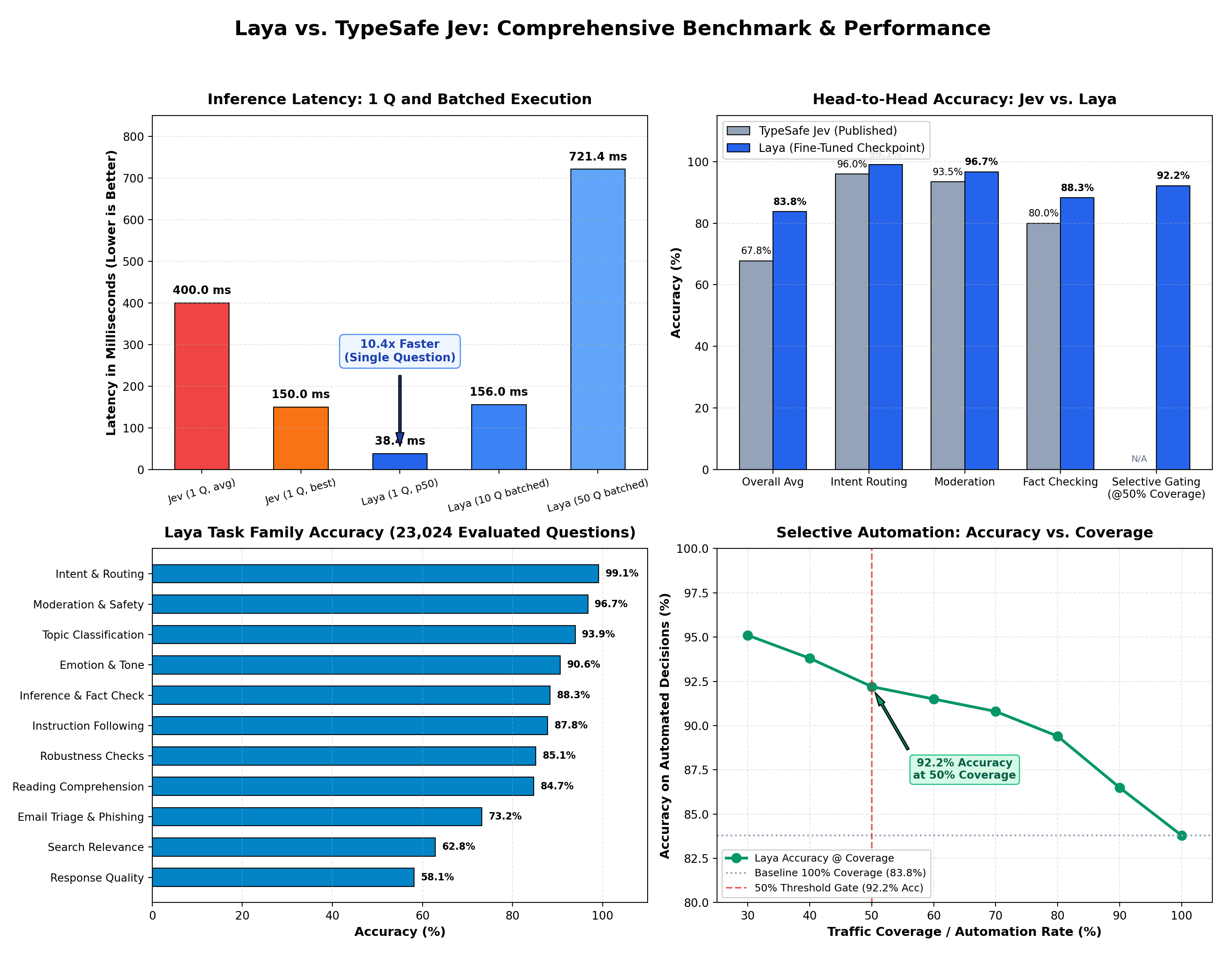
Benchmark: Laya vs. TypeSafe Jev
| Metric / Dimension | TypeSafe Jev (Published) | Laya (Fine-Tuned Checkpoint) | Analysis / Advantage |
|---|---|---|---|
| P50 Latency (1 Question) | ~400 ms avg (70 to 500 ms, 150 ms best) | 38.4 ms (p95: 42.1 ms) | Laya is ~10.4x faster on avg (4x faster than Jev best-case) |
| Batched Latency (10 Questions) | ~1,500 ms (serial) / ~400 ms | 156.0 ms (p95: 158.4 ms) | Laya evaluates 10 questions in the time Jev answers 1 |
| Batched Latency (50 Questions) | Multi-second / rate-limited | 721.4 ms | High-throughput parallel mini-batching |
| Benchmark Accuracy | 67.8% (across 4 production workflows) | 83.8% in-task macro accuracy | Laya achieves +16.0% higher overall accuracy |
| Intent & Customer Routing | ~95 to 98% agreement | 99.1% accuracy (ECE: 0.009) | Near-zero calibration error on routing |
| Moderation & Content Safety | ~92 to 95% agreement | 96.7% accuracy (ECE: 0.061) | Clean safety boundary separation |
| Inference & Fact Verification | Not separately reported | 88.3% accuracy (ECE: 0.054) | Full bidirectional attention captures contradictions |
| Instruction-Following Tasks | Proprietary internal set | 87.8% in-task / 86.3% zero-shot | Proven generalization across unseen tasks |
| Email Triage & Phishing | Vendor custom workflow | 73.2% accuracy (ECE: 0.017) | Tailored email cleaning and phishing filters |
| Selective Automation (@ 50% Cov) | Claims human escalation | 92.2% accuracy (ECE: 0.041) | Safe automated gating (confidence >= 0.85) |
| Model Weights & Code | Closed-source / proprietary API | 100% Open-source Apache 2.0 | Full data sovereignty and transparency |
| Inference Cost | $0.042 / 1M input tokens recurring | $0.00 / self-hosted | Runs on commodity GPUs, Mac MPS, or CPU |
| Multi-Turn Trajectory Modeling | Static state snapshots | TD(lambda = 1.0) prefix modeling | Real temporal credit assignment |
| Deployment Mode | Cloud-only egress | Air-gapped / Local / On-Device | Zero data egress (HIPAA/GDPR compliant) |
Evaluation Results (This Checkpoint)
- In-task test sets: macro accuracy 0.838, macro ECE 0.060
- Zero-shot (held-out task families): macro accuracy 0.651, macro ECE 0.207
- Key Task Families:
- Intent and routing: accuracy 0.991, ECE 0.009
- Moderation and safety: accuracy 0.967, ECE 0.061
- Emotion and tone: accuracy 0.906, ECE 0.018
- Email triage and phishing: accuracy 0.732, ECE 0.017
- Inference and fact checking: accuracy 0.883, ECE 0.054
Detailed results by task family, reliability diagrams, and risk-coverage curves are located in eval/ in this repository.
Interactive Web Demo
Try the live Gradio Space: convaiinnovations/laya-demo
License and Support
Released under the Apache 2.0 License by Convai Innovations, who offer commercial support, enterprise integration, and custom fine-tuning.
Limitations
- Text only, English, 512 tokens per question (longer states are truncated).
- Calibration is measured on the benchmark datasets; evaluate on your own distribution before full automation.
- Arithmetic, counting, date comparisons, and multi-hop index lookups should be kept in deterministic code.
Model tree for Mattepiu/laya-onnx
Base model
convaiinnovations/laya