


DeepCancer — Explainable AI for Breast Histopathology
Collection
DeepCancer is an explainable AI research project for breast histopathology image classification, developed by TankDev.
This collection brings togethe • 1 item • Updated
DeepCancer is a research-oriented deep learning system for breast cancer classification from histopathological images.
The proposed architecture combines Swin Transformer and ConvNeXt in a hybrid model designed to capture both local tissue features and global contextual information.
DeepCancer is a research-oriented deep learning system for breast cancer classification from histopathological images.
The proposed architecture combines Swin Transformer and ConvNeXt in a hybrid model designed to capture both local tissue features and global contextual information.
The research investigates two classification tasks:
DeepCancer was developed as part of the research study “Histopathological Breast Cancer Classification Using a Hybrid Swin Transformer and ConvNeXt Architecture” by Murat Onur Kaderoğlu and Emre Şatır.
Project website: https://deepcancer.org
Publication: https://doi.org/10.5281/zenodo.18138734


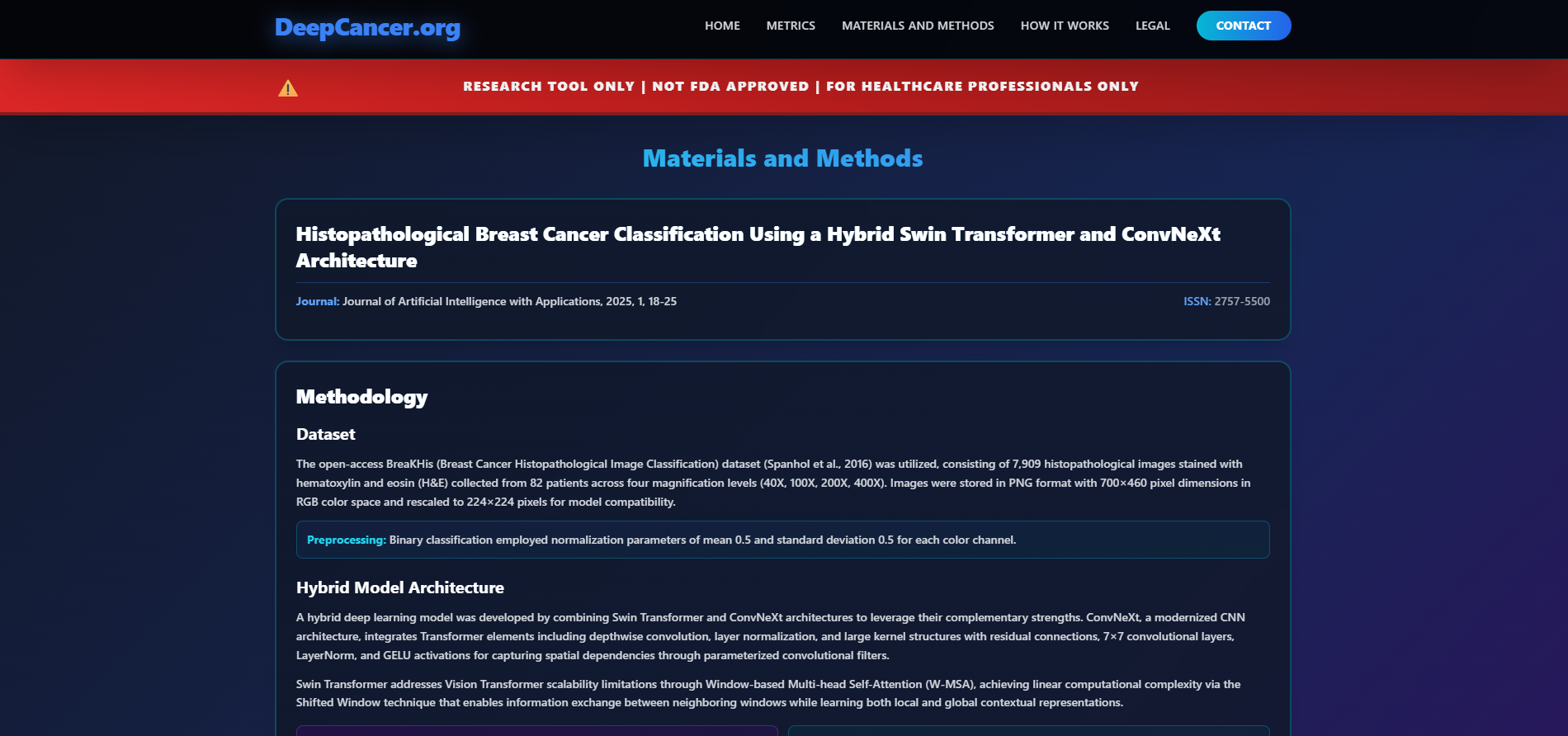

The images above show the DeepCancer research prototype and its user-facing workflow.
DeepCancer combines two complementary computer vision architectures:
The hybrid architecture is designed to combine the local feature extraction capabilities of convolutional neural networks with the global contextual modeling capabilities of vision transformers.
The system was implemented using PyTorch.
The research was conducted using the open-access BreaKHis (Breast Cancer Histopathological Image Classification) dataset.
BreaKHis contains 7,909 H&E-stained histopathological images from 82 patients, acquired at four magnification levels:
The original images have a resolution of 700 × 460 pixels and were resized to 224 × 224 pixels for model processing.
The BreaKHis dataset and its images are not redistributed through this repository.
The binary model distinguishes between:
The multiclass model distinguishes between eight histopathological tumor subtypes.
Benign:
Malignant:
Training was performed using PyTorch in a Google Colab environment with an NVIDIA A100 GPU.
The models were trained for 20 epochs using the Adam optimizer and Cross-Entropy Loss.
For binary classification, a batch size of 32 and a constant learning rate were used. The multiclass configuration used StepLR scheduling.
Early stopping was applied when validation loss ceased to improve.
The following experimental results are reported in the associated publication.
| Metric | Result |
|---|---|
| Accuracy | 98.86% |
| Precision | 99.07% |
| Recall | 99.25% |
| F1 Score | 99.16% |
| Metric | Result |
|---|---|
| Accuracy | 93.49% |
| Precision | 93.46% |
| Recall | 93.49% |
| F1 Score | 93.43% |
These results represent experimental performance on the BreaKHis dataset under the evaluation methodology described in the associated publication.
They should not be interpreted as independently validated clinical performance.
DeepCancer incorporates Grad-CAM (Gradient-weighted Class Activation Mapping) visualization to provide visual information about image regions contributing to model predictions.
The research prototype includes a desktop application supporting image input, model prediction, Grad-CAM visualization, offline operation, and CPU fallback.
DeepCancer is intended for artificial intelligence research, histopathological image classification research, explainable AI experimentation, academic evaluation, and educational use.
The reported models were trained and evaluated using a single public dataset.
Performance on BreaKHis does not establish generalization to images from other institutions, scanners, staining protocols, tissue preparation procedures, patient populations, or clinical workflows.
Further multi-institutional and prospective clinical validation is required before real-world clinical deployment.
DeepCancer is a research and educational system and is not intended for standalone clinical diagnosis, treatment decisions, or autonomous medical decision-making.
Model predictions must not replace evaluation by qualified healthcare professionals.
This Hugging Face repository serves as public technical documentation for the DeepCancer research project.
Model weights, including trained .pth files, are not publicly distributed through this repository.
Training data and BreaKHis dataset images are also not redistributed through this repository.
Histopathological Breast Cancer Classification Using a Hybrid Swin Transformer and ConvNeXt Architecture
Authors: Murat Onur Kaderoğlu, Emre Şatır
Journal: Journal of Artificial Intelligence with Applications
Year: 2025
DOI: https://doi.org/10.5281/zenodo.18138734
DeepCancer: https://deepcancer.org
DeepCancer is presented on Hugging Face by TankDev, a software engineering and applied AI organization focused on custom software, artificial intelligence, process automation, and system integration.
TankDev: https://tankdev.tech