---
base_model:
- Qwen/Qwen3.5-4B
- Qwen/Qwen3.5-9B
library_name: transformers
language:
- en
- zh
tags:
- decision-model
- dynamic-depth
- structured-output
---
# APUS-OpenJev-v1




Technical Report
**Decision models with selectable compute depth.**
[Model weights](https://huggingface.co/apus-ailab/APUS-OpenJev-v1/tree/main) · [Architecture](ARCHITECTURE.md) · [Evaluation data](https://huggingface.co/datasets/gump2049/xDAN-openJet-Eval-Frozen80-20260921)
## 1. Introduction
We introduce **APUS-OpenJev-v1**, a family of decision models for browser agents and business workflows. Given a task, context, and candidate actions, the model returns a scored choice that an application can execute. The family provides 4B and 9B variants with a common decision interface.
**Architecture.** A shared language-model backbone supports multiple compute budgets. Task definitions and candidate meanings arrive through natural language, allowing the same model to handle different decision spaces. Applications select `effort="low"` or `effort="high"` through the included runtime.
**Joint post-training.** Decision learning is coordinated across computation depths. Both execution paths learn from reference decisions, while the complete path supplies a distribution-level learning signal for the shorter path. This trains useful early decisions rather than relying on an untrained intermediate representation. The [architecture guide](ARCHITECTURE.md) explains the design and its trade-offs.
**Decision-oriented inference.** The runtime scores candidate labels and maps them back to application actions. This removes the need to generate a structured answer token by token for bounded-choice tasks. Choose `effort="low"` or `effort="high"` to balance compute cost and decision quality.
On our frozen 80-question development panel, **APUS-OpenJev 9B achieves 85.0% accuracy**, compared with **82.5% for the Jev API**. Its historical local reference implementation records **77.76 ms median model-forward latency**. Accuracy and latency are reported with their evaluation settings below.
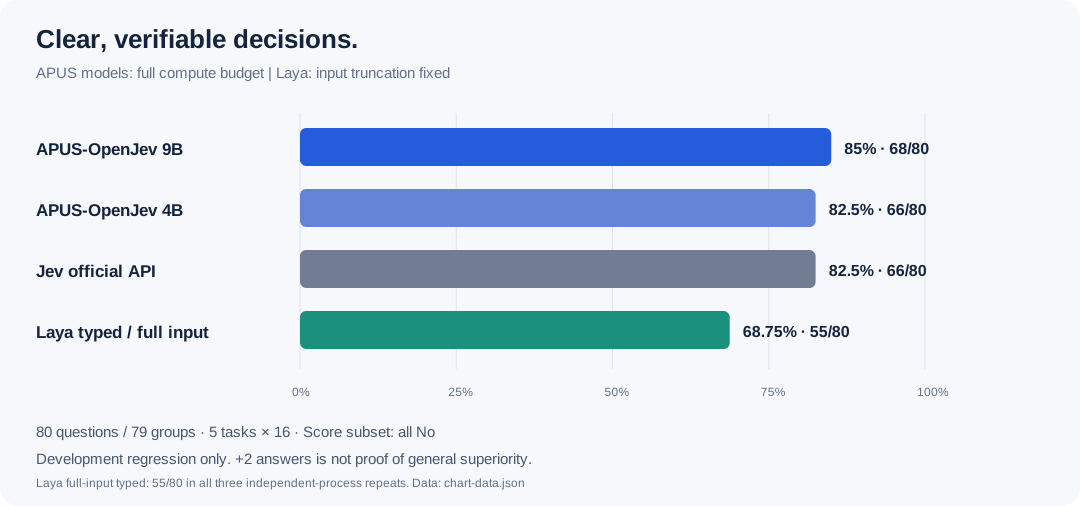
*Figure 1. Same-panel decision accuracy. APUS results use the full compute budget; Laya uses its higher-scoring complete-input configuration after truncation was corrected.*
## 2. Evaluation Results
### Decision quality
| Model | Correct / total | Accuracy |
| --- | ---: | ---: |
| **APUS-OpenJev 9B** | **68 /80** | **85.00%** |
| APUS-OpenJev 4B | 66 /80 | 82.50% |
| Jev API | 66 /80 | 82.50% |
| Laya · typed configuration, complete input | 55 /80 | 68.75% |
All models are compared on the same frozen question identities and reference labels. Laya's complete-input typed configuration reproduces 55/80 across three runs; its complete-input English configuration scores 54/80. Repetition establishes consistency on these questions, not additional independent evidence. The two-question advantage over Jev is a panel result and does not establish broad or statistically significant superiority.
### Results by task
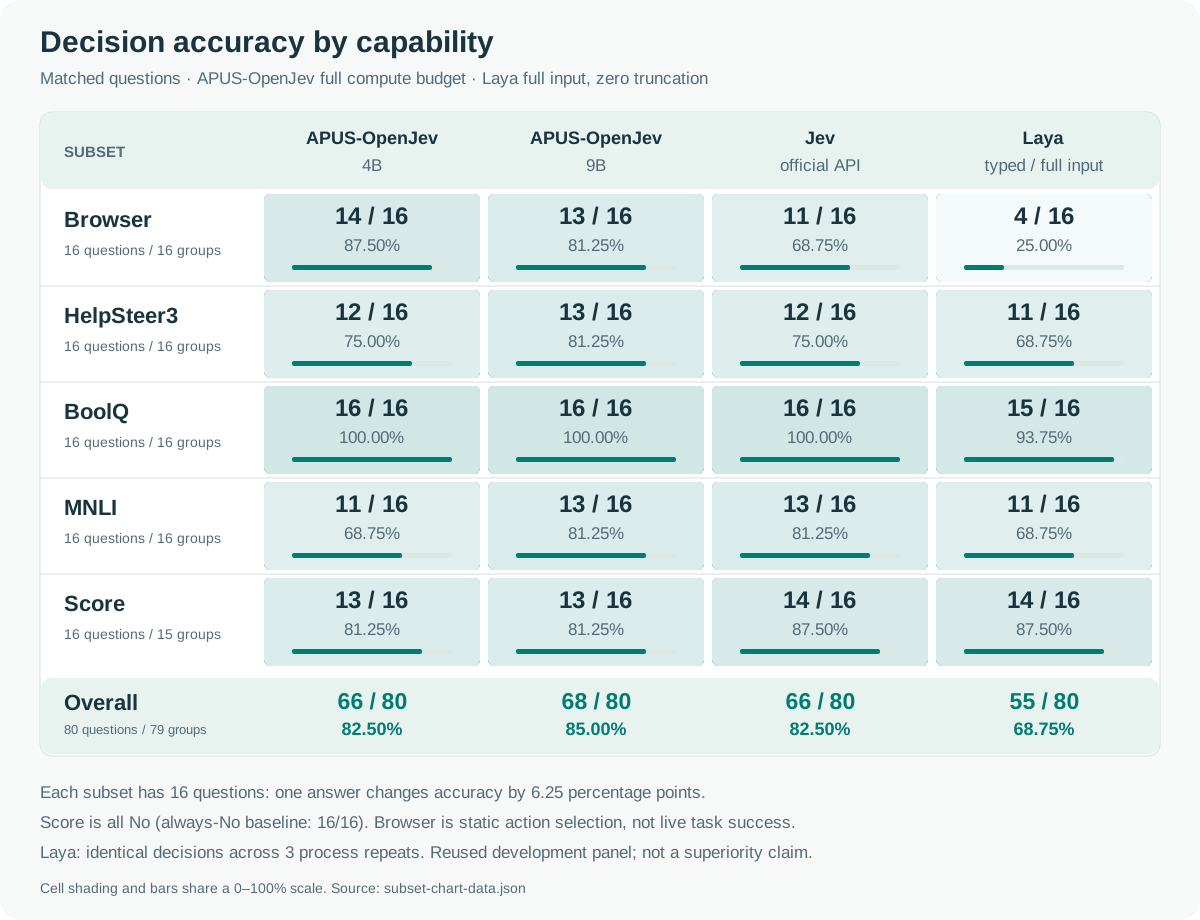
*Figure 2. Correct answers and accuracy for each task family. APUS models use the full compute budget; Laya uses the complete-input typed configuration. Each family contains 16 questions, so one answer changes accuracy by 6.25 percentage points.*
The 4B model leads this panel's Browser subset, while 9B's gains come from principle-based judgments and natural language inference. Laya's corrected Browser result is 4/16. The task breakdown and source hashes are recorded in [subset-chart-data.json](subset-chart-data.json).
### Response latency
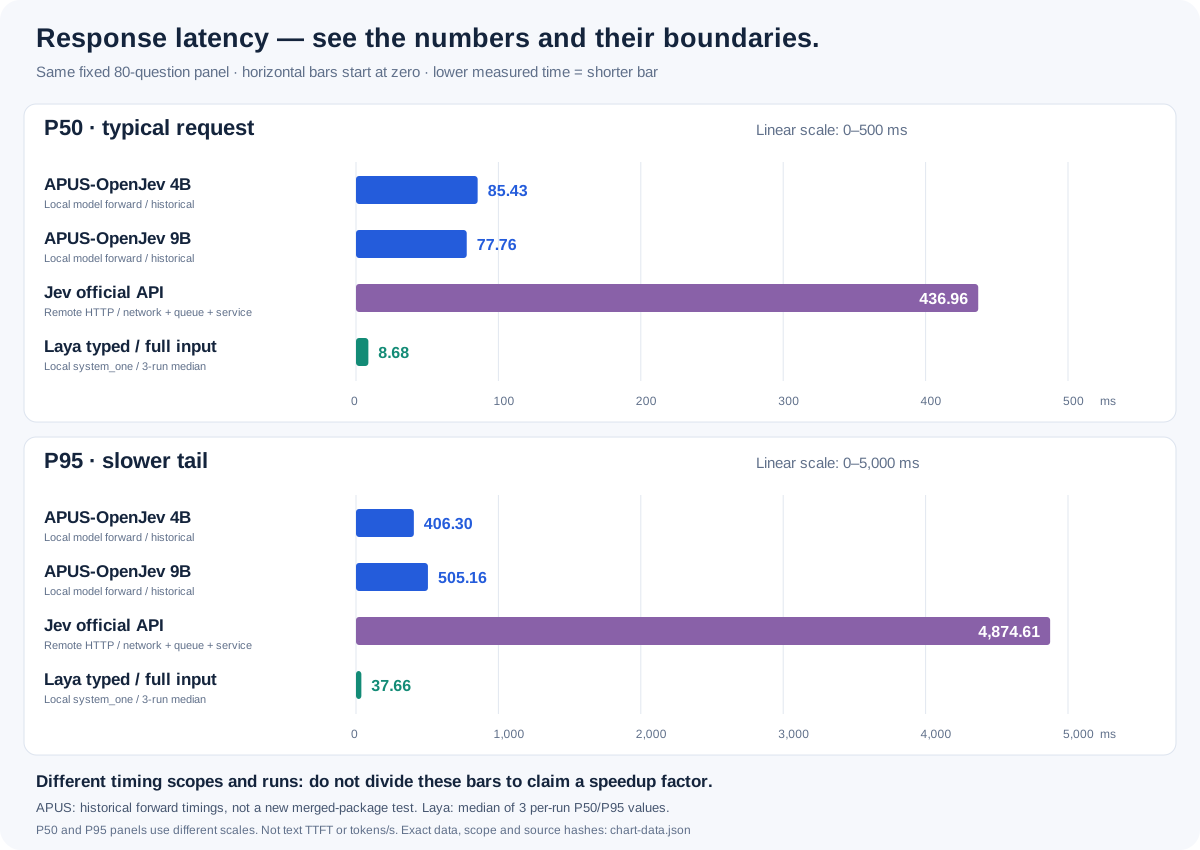
*Figure 3. Latency observations with explicit measurement boundaries. P50 and P95 use separately labeled linear scales. These measurements are not streaming first-token latency or text-generation throughput.*
| Measured path | P50 | P95 | Timing boundary |
| --- | ---: | ---: | --- |
| APUS-OpenJev 9B reference | 77.76 ms | 505.16 ms | Local model forward |
| APUS-OpenJev 4B reference | 85.43 ms | 406.30 ms | Local model forward |
| Laya typed · complete input | 8.68 ms | 37.66 ms | Local `system_one`, including tokenization and output processing |
| Jev API | 436.96 ms | 4874.61 ms | Complete public HTTP response |
APUS figures come from the historical RTX PRO 6000 reference implementation, not a new end-to-end test of this merged release. Laya's measured local path is faster; the displayed statistics are the medians of three per-run P50/P95 values. Public API times include network, queuing, and service overhead, so their ratio to a local forward time is not a model speedup. Exact values and aggregation are recorded in [chart-data.json](chart-data.json).
## 3. Evaluation Set
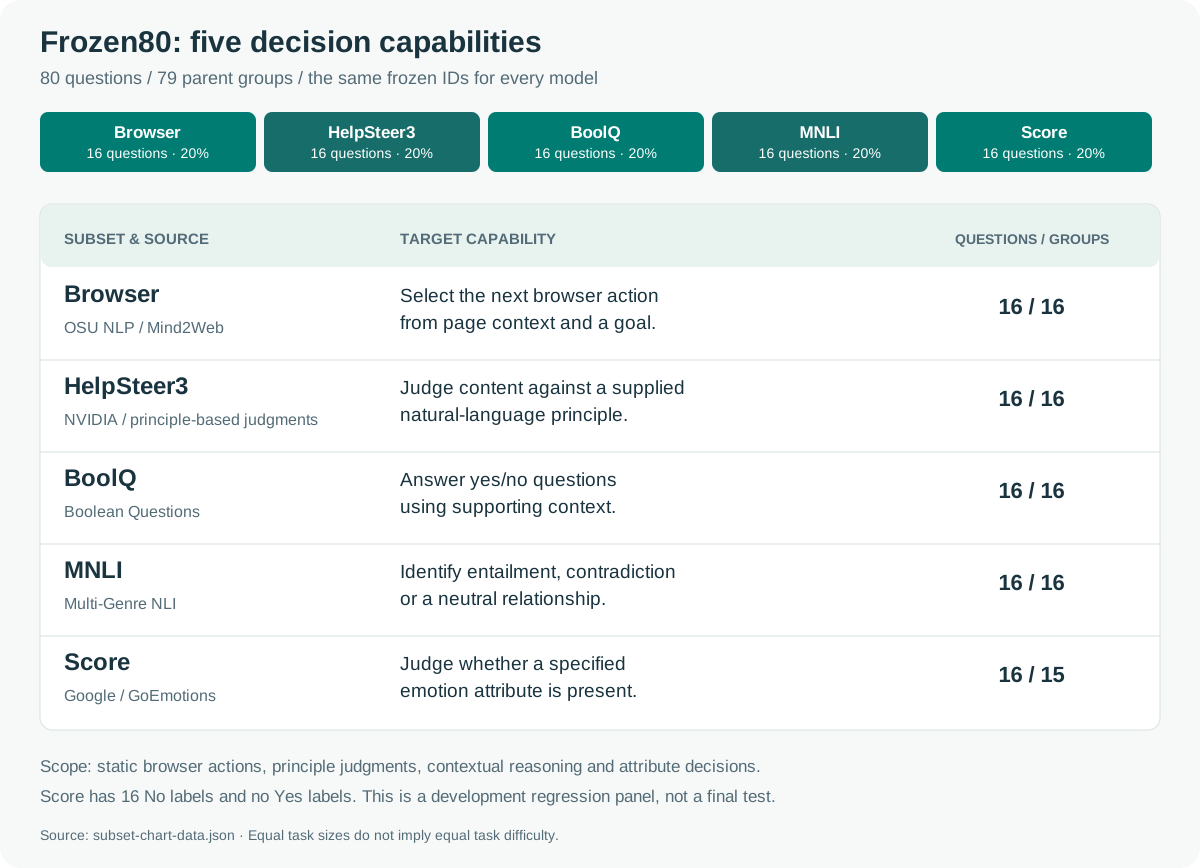
*Figure 4. Dataset composition, source datasets, and target capabilities. Parent groups identify related examples; equal question counts do not imply equal task difficulty or production traffic.*
| Task family | Questions | Decision evaluated |
| --- | ---: | --- |
| Browser / Mind2Web | 16 | Select an action from a static page state |
| HelpSteer3 | 16 | Check a response against a supplied principle |
| BoolQ | 16 | Answer a binary question from evidence |
| MNLI | 16 | Distinguish entailment, neutral, and contradiction |
| Score / GoEmotions | 16 | Judge whether an individual attribute applies |
The panel contains **80 questions from 79 parent groups** and is released as `validation`. It has informed development and model selection. All 16 Score labels are No, so an always-No strategy scores 100% on that subset; these results cannot establish positive-case Score performance. Browser evaluation covers offline action selection, not complete website tasks.
The [dataset](https://huggingface.co/datasets/gump2049/xDAN-openJet-Eval-Frozen80-20260921) includes JSONL/Parquet, frozen identifiers, provenance, schema documentation, and verification code. It is a separate private repository with its own access permissions.
## 4. Decision Encoding
A request carries the task, supporting context, and 2–16 candidate descriptions. The runtime assigns request-local short labels, evaluates the legal candidate set, and returns the selected candidate ID with relative scores. Application code assembles the response. Candidate meanings can change between requests without adding a fixed business-category classifier.
A legal output can still be the wrong decision. Candidate probabilities are not calibrated confidence, and business thresholds require validation. See the [runtime contract](9B-3000/RUNTIME.md) for the supported request format.
## 5. Minimal Inference
The repository is a model-family bundle. Choose a subdirectory containing complete BF16 weights and the reference runtime:
| Variant | Model directory | Suggested use |
| --- | --- | --- |
| **9B** | `9B-3000/` | Quality-focused evaluation |
| **4B** | `4B-5949/` | Smaller parameter footprint |
An additional 9B research variant is listed in the [artifact manifest](bundle-manifest.json). Load a model subdirectory, not the repository root.
Use a CUDA-capable PyTorch environment. Select the model directory to download:
```bash
python -m pip install huggingface_hub
hf auth login
hf download apus-ailab/APUS-OpenJev-v1 \
--include "9B-3000/*" --local-dir ./APUS-OpenJev-v1
cd ./APUS-OpenJev-v1/9B-3000
python -m pip install -r requirements.txt
python examples.py . --device cuda:0 --effort high
```
For 4B, download `4B-5949/*` and enter that directory. The included runtime implements the budget control; ordinary Transformers loading does not enable it automatically. Text generation should use `high`. See [inference documentation](9B-3000/RUNTIME.md) and [examples](9B-3000/examples.py).
## 6. Reproducing the Evaluation
Use the fixed dataset revision `f15c828a1d926912f28bf5a8bf1e83f9c6b45c72`, preserve question and candidate order, and record the model revision, runtime, dtype, and compute budget. Keep reference labels out of the model input. Report decision accuracy separately from latency, and state precisely where timing starts and ends.
The release records fixed source revisions and per-file hashes. Model files were downloaded and verified, with GPU checks on the source packages; this family bundle preserves those model bytes. Subsequent model-card changes do not represent new training or evaluation. Detailed merge results and diagnostic examples remain in the [9B evaluation records](9B-3000/merged-evaluation.json) and [4B evaluation records](4B-5949/merged-evaluation.json). BF16 merging changed some candidate probabilities, so calibration and routing thresholds must be revalidated.
## 7. License
Original APUS-OpenJev-v1 code and documentation contributed in this release are licensed under the [MIT License](LICENSE). Qwen-derived model weights and inherited code retain their applicable [Apache 2.0 license and notices](9B-3000/LICENSE); see the [license scope](LICENSE_NOTICES.md) for all variants. Dataset licenses are documented separately.
## 8. Citation
```bibtex
@misc{apusopenjev2026,
title = {APUS-OpenJev-v1: Decision Models with Selectable Compute Depth},
author = {gumpcheng and zhangxu and {APUS AI-LAB}},
year = {2026},
url = {https://huggingface.co/apus-ailab/APUS-OpenJev-v1}
}
```
## 9. Contact
Visit the [APUS official website](https://www.apusai.com) or [APUS AI Lab on Hugging Face](https://huggingface.co/apus-ailab). For model questions and feedback, open a discussion in this model repository's [Community tab](https://huggingface.co/apus-ailab/APUS-OpenJev-v1/discussions).
**Authors:** gumpcheng ([https://huggingface.co/xDAN2099](https://huggingface.co/xDAN2099)), zhangxu, [APUS AI-LAB](https://github.com/APUS-AI-Lab).