


language:
  - ru
license: other
license_name: yo-cpt-ru
license_link: LICENSE.md
configs:
  - config_name: default
    data_files:
      - split: train
        path: data/*.parquet
task_categories:
  - text-to-speech
  - automatic-speech-recognition
  - audio-classification
pretty_name: YO-CPT-ru
size_categories:
  - 1M<n<10M
tags:
  - speech
  - tts
  - asr
  - speaker-verification
  - turn-detection
  - russian
YO-CPT-ru
YouTube-Oriented dataset for Continual Pre-Training (Russian). A large, heavily quality-filtered corpus of Russian speech mined from YouTube (via YODAS2) and processed into clean, single-speaker, TTS-grade utterances. Every utterance ships with an ensemble-verified transcription, a punctuated/denormalized and stress-marked text variant, word-level forced alignment, within- and cross-video speaker identities, an audio-quality (MOS) score, and a speaker persona built from the voice and, where available, the speaker's on-screen face.
- ~1.63M utterances · ~6,052 hours, single-speaker chunks, 24 kHz mono
- Primary use — continual pre-training (CPT) of TTS models: a corpus scaled and filtered for the large-scale pre-training stage of TTS training — TTS-grade audio (denoised, loudness-normalized, edge-clean, force-aligned) with rich text and speaker conditioning.
- Also suitable for ASR (ensemble-agreed transcripts), Speaker Verification (within/cross-video speaker ids), and Turn-Detection (single-speaker segmentation + word/pause timings).
Audio is embedded (HF Audio feature). Shards hold 10 source YODAS2 archives each
(<part>-<bucket>.parquet); shard_map.tsv maps every shard back to its source archives.
Pipeline
Three stages take raw YouTube audio to the finished corpus:
YODAS2  —  raw YouTube audio (Russian)   ·   ~43,610 hours
   │
   ▼
STAGE 1 · ASR mining
   VAD chunking (Silero) → speaker consistency (VoxBlink2) → quality MOS ≥ 3.0 (DistillMOS)
   → ASR ensemble (Whisper-large-v3-turbo · GigaAM v3 RNNT · Vosk) → WER cross-check + ROVER
   │
   ▼  clean single-speaker utterances + ensemble-verified text   ·   9,135 h · 2.53M utts
STAGE 2 · TTS processing
   anti-spoofing (Spectra-0) → enhancement (ClearVoice MossFormer2) → loudness norm + clip guard
   → edge check + recrop (re-ASR reconcile) → forced alignment (wav2vec2-BERT, + [pause])
   │
   ▼  TTS-grade audio + word/pause alignment   ·   6,052 h · 1.63M utts
STAGE 3 · Metadata enrichment
   stress (RUAccent) · denorm + punctuation (GPT-4.1-mini)
   speaker persona:  face (TalkNet → LVFace) + face description (Qwen3.5-Flash) + voice (librosa + ECAPA gender)  →  spk_desc
   │
   ▼
YO-CPT-ru  ·  1.63M utterances  ·  6,052 hours
Stage 1 — ASR mining
Turns full-length YouTube audio into clean, transcribed, single-speaker utterances.
- VAD chunking — Silero VAD segments each full-length video into utterance-length pieces; the maximum segment length is randomized per file so cut points don't land on a fixed grid, and over-long / over-short segments are dropped.
- Speaker consistency — VoxBlink2 (ResNet34) speaker embeddings are computed over sliding windows, and a chunk is discarded entirely if it contains speech from more than one speaker; the same check also drops non-speech (silence / noise) chunks.
- Audio quality — DistillMOS no-reference MOS estimation; chunks below MOS 3.0 (noisy, reverberant, low-fidelity) are discarded.
- ASR ensemble — three deliberately different systems transcribe every chunk: a custom Whisper-large-v3-turbo fine-tuned for ru (attention encoder–decoder), GigaAM v3 RNNT (transducer), and Vosk (Kaldi-style). Architectural diversity makes correlated errors unlikely, so agreement is a strong signal of correctness.
- Cross-validation + ROVER — pairwise WER is computed between the three hypotheses; chunks without close agreement between at least two systems are dropped. On tight agreement the transcription is trusted as-is; on moderate disagreement the three hypotheses are aggregated by ROVER word-level voting — where combining several recognizers is expected to improve the final transcription — yielding high-precision transcripts.
Stage 2 — TTS processing
Turns transcribed utterances into TTS-grade audio with word-level alignment.
- Anti-spoofing — runs first in this stage, on the audio before enhancement, which could otherwise mask synthesis artifacts. YouTube contains synthetic and TTS-generated speech, which must be filtered out of a TTS corpus; a Spectra-0 spoof detector scores each chunk and aggregates per video, dropping likely-synthetic speech so downstream models learn from genuine human voice only.
- Speech enhancement — ClearVoice
MossFormer2_SE_48Kdenoises and dereverberates audio, removing background music and noise while preserving the target speaker. - Loudness normalization + clipping guard — loudness is normalized to a consistent target level with peak limiting across the corpus; chunks with too high a clipped-sample ratio are rejected outright (enhancement cannot recover clipped audio).
- VAD edge check + recrop — TTS is sensitive to boundaries, so speech must not run into the segment edges. The source audio is often noisy, so the initial VAD boundaries are imprecise — after enhancement they can be refined. A second VAD pass trims each clip to the nearest internal silence boundary (or discards it if that's impossible), after which the recropped audio is re-transcribed and reconciled with the original transcription to ensure that trimming has not altered the content.
- Forced alignment — a custom wav2vec2-BERT CTC model
produces word-level start/end timings, inserting explicit
[pause]tags at internal silences. This provides thetext_alignmentrequired by TTS models for duration modeling.
Stage 3 — Metadata enrichment
One stage, three branches: word stress, denormalized/punctuated text, and a speaker persona built from both the on-screen face and the voice signal.
- Stress — RUAccent
turbo3.1(omograph model + dictionary) places Russian word-stress marks; the marks are carried intotext_denormandtext_alignment. - Denormalization + punctuation — OpenAI
gpt-4.1-minirestores casing/punctuation and denormalizes the raw ASR text →text_denorm. - Speaker persona — a static per-speaker profile from face + voice. The identity design is based on
voice locally, faces globally: a voice reliably separates speakers within one video, while a face
is what re-identifies the same person across different videos.
- Voice → local id — VoxBlink2 (ResNet34) embeddings cluster
the speakers within each video →
local_spk_id. - Face → global id — TalkNet selects the active-speaker
(actually-talking) face, LVFace embeds it, and these are
clustered across videos into a
global_face_id, which becomes the speaker's cross-videoglobal_spk_id(nullfor audio-only speakers with no validated face). - Audio signal — gender via an ECAPA-TDNN voice classifier; librosa features: median F0 → pitch, spectral centroid → brightness, spectral flatness → breathiness, words/sec → rate.
- Visual description — head-and-shoulders crops of the speaker are described by Qwen3.5-Flash (gender, age, nationality, appearance, style).
- Fuse — face demographics (if real and live) + voice traits → structured fields plus a natural
spk_desc.
- Voice → local id — VoxBlink2 (ResNet34) embeddings cluster
the speakers within each video →
Implementation details
Speech enhancement. ClearVoice MossFormer2 was chosen over two alternatives on a benchmark subset sampled from the corpus. Automatic metrics: WER between Whisper transcripts of the original vs the enhanced clip, and speaker similarity via VoxBlink2 embeddings. The last two columns report manual listening evaluations — how much noise the model removes and how natural the enhanced audio sounds:
| model | RTF ↓ | WER vs orig ↓ | speaker sim ↑ | denoising (manual) | output quality (manual) |
|---|---|---|---|---|---|
| ClearVoice MossFormer2 (chosen) | 0.016 | 0.003 | 0.976 | good | good |
| Resemble Enhance | 0.025 | 0.005 | 0.979 | average | good |
| Sidon v0.1 | 0.024 | 0.016 | 0.724 | best | average |
Anti-spoofing. Spectra-0 scores each chunk (higher = more likely genuine). The distribution has two obvious centers — a bonafide mode near +5 and a low-scoring mode near −6:
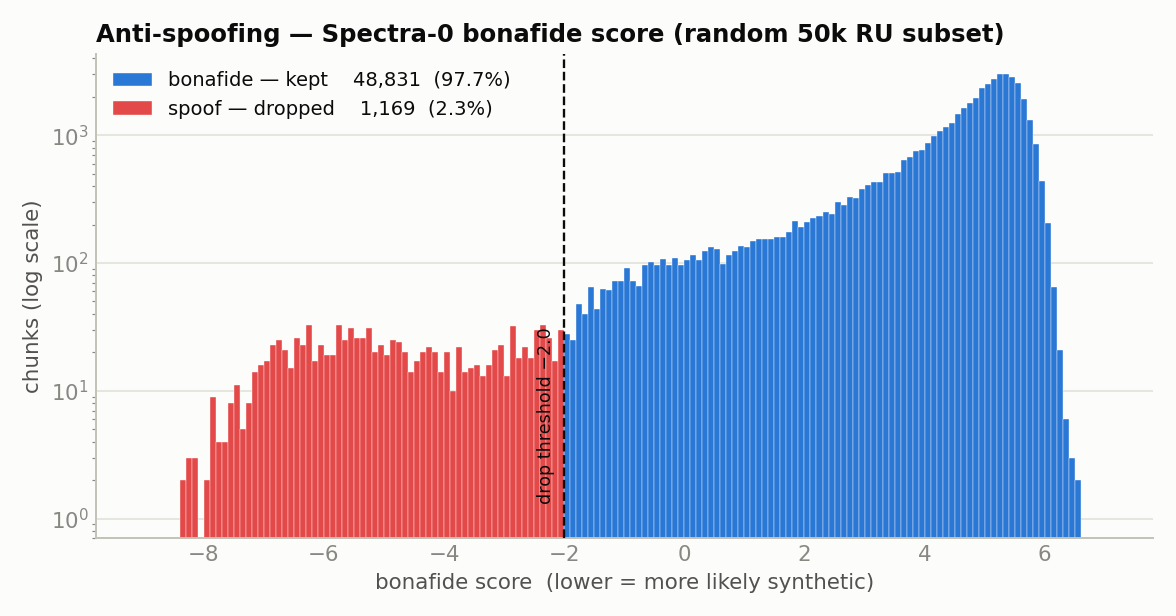
The drop threshold (−2.0) was chosen by manually auditioning chunks scoring in the −3 to −1 range; ~2.3 % of chunks fall below it and are dropped.
Face validation. Matching a face to a voice is error-prone: a frame may contain several faces (co-hosts, panels, audiences), and channels often show posters or static photos of someone other than the speaker. A face is therefore attached to a speaker only after passing every step of this funnel:
- 137,082 — speakers total;
- 121,268 — with a processable video clip;
- 50,219 (41 %) — with a confidently talking on-screen face: TalkNet-ASD active-speaker detection accepts a face only if its lip motion is synchronized with the audio;
- 48,085 — after face-embedding quality checks;
- 45,845 (33 %) — after the realness check (drops cartoons, posters, static photos).
Only these 45,845 local speakers get the face-derived fields (image_desc, global_spk_id); everyone else
stays audio-only.
Speakers. Two levels of annotation.
local_spk_id — unique within a single video: 137,082 within-video speakers, obtained by
agglomerative clustering (AHC, average linkage) of VoxBlink2 voice embeddings within each video. Because
utterances containing more than one speaker were filtered out upstream (Stage 1), within-video speaker
labelling is reliable.
global_spk_id — the same person linked across videos. Matching speakers across a large number of
videos is a much harder problem than clustering within one video, and doing it from voice alone would
introduce a substantial error rate. We therefore link identities through the face modality, and only when
the speaking person's identity could be established on screen: the 45,845 face-validated speakers
collapse into 17,598 global identities, of which 2,349 appear in at least 3 videos.
Data format
from datasets import load_dataset
ds = load_dataset("NCSpeech/YO-CPT-ru", split="train", streaming=True)
A sample record:
{
  "utt_id": "o_FOkvR3oaM_0_469",
  "text": "я бесконечно благодарен за тот опыт и возможность",
  "text_denorm": "Я бескон+ечно благод+арен з+а тот +опыт и возм+ожность.",
  "text_alignment": "[pause0.2](0.00,0.18) я(0.18,0.38) бескон[+]ечно(0.52,1.08) благод[+]арен(1.10,1.60) з[+]а(1.62,1.80) тот(1.82,2.10) [+]опыт(2.18,2.48) и(2.50,2.58) возм[+]ожность(2.60,3.18) [pause0.2](3.18,3.38)",
  "duration": 4.89,
  "local_spk_id": "o_FOkvR3oaM__spk4",
  "global_spk_id": "spk_15827",
  "lang": "ru",
  "spk_desc": {
    "audio_only": false,
    "audio_desc": {
      "gender": "male",
      "f0_hz": 122.6,
      "pitch": "low",
      "rate": "very slow",
      "brightness": "bright",
      "breathiness": "slightly-breathy",
      "text": "male voice: low pitch, bright, slightly-breathy, very slow pace; speaks Russian"
    },
    "image_desc": {
      "gender": "male",
      "age": "20s",
      "nationality": "Slavic/Russian/European",
      "appearance": "dark hair, dark eyes, rectangular glasses, light stubble/beard, headset",
      "style": "casual black t-shirt, tech gear -> informal, tech-savvy persona",
      "impression": "young tech reviewer or streamer",
      "text": "Slavic/Russian/European male (20s). casual black t-shirt, tech gear -> informal, tech-savvy persona"
    }
  },
  "mos_score": 3.456
}
Each record has the following fields:
| field | type | description |
|---|---|---|
audio |
Audio (24 kHz) | waveform (embedded WAV bytes) |
utt_id |
string | utterance id <video>_<channel>_<chunk> |
text |
string | normalized ASR transcription — lowercase, unpunctuated (ensemble/ROVER) |
text_denorm |
string | denormalized + punctuated text with stress marks (GPT-4.1-mini + RUAccent) |
text_alignment |
string | word-level forced alignment, [pause] tags at internal silences |
duration |
float32 | duration, seconds |
local_spk_id |
string | within-video speaker id (voice clustering) |
global_spk_id |
string | cross-video identity from face clustering; null if audio-only |
lang |
string | language (ru) |
spk_desc |
string | speaker persona — JSON, see below |
mos_score |
float32 | DistillMOS quality score |
spk_desc format
| field | type | description |
|---|---|---|
audio_only |
bool | true → no validated face; persona is voice-only |
audio_desc |
object | voice-derived (always present) |
audio_desc.gender |
str | male / female (voice-based classifier) |
audio_desc.f0_hz |
float | median fundamental frequency (Hz) |
audio_desc.pitch |
str | low / mid / high |
audio_desc.rate |
str | speaking rate — slow / moderate / fast |
audio_desc.brightness |
str | spectral brightness (e.g. dark / bright) |
audio_desc.breathiness |
str | voice quality (e.g. clear/modal, breathy) |
audio_desc.text |
str | natural-language voice summary |
image_desc |
object | null | face-derived; null when audio_only |
image_desc.gender |
str | apparent gender from the face |
image_desc.age |
str | apparent age range (e.g. 20s, 30-45) |
image_desc.nationality |
str | apparent nationality (from a shared multilingual prompt) |
image_desc.appearance |
str | free-text appearance |
image_desc.style |
str | free-text style / grooming |
image_desc.impression |
str | free-text overall impression |
image_desc.text |
str | natural-language face summary |
Audio-only speakers carry "audio_only": true and "image_desc": null.
Bias, Risks, and Limitations
- Automatic annotation. Every label is model-generated and not human-verified — human involvement was limited to tuning the pipeline's hyperparameters (e.g. filter thresholds) — so minor errors are expected: occasional inaccuracies in transcriptions, in text processing (punctuation, stress marks, alignment timings), and in speaker metadata. A segment kept as single-speaker may still contain brief intrusions of a second voice where one speaker clearly predominates.
- Visual persona is fragment-scoped. The face-derived description (
spk_desc.image_desc) is inferred from a few frames of a single video clip. It reflects only how the person appears in that fragment and may not represent them in general — appearance, styling, and context can differ across videos, and the cross-video identity is based on the face, not on a full profile of the person. - Persona attributes are apparent, not factual. All demographic fields in
spk_descare automatic estimates. They describe how the speaker sounds or looks in that fragment, can be wrong, and must not be treated as facts about the person. - Source representativeness. The corpus mirrors the distribution of Russian-language YouTube content: some speakers, accents, domains, and recording conditions are over- or under-represented, and recurring presenters contribute disproportionately many utterances.
- Recovered source IDs. Building the face/video modality required the original YouTube video IDs (to fetch each clip), which YODAS2 does not expose directly — we recovered the source IDs for our own processing; see espnet/yodas2 discussion #2 for context.
License
YO-CPT-ru is a derived dataset: beyond attribution, the authors impose no restrictions of their own — users are responsible for complying with the upstream licenses below.
Contribution of the authors. The annotations and the compilation of the corpus are released under CC BY 4.0 — attribution required, commercial use allowed.
Upstream components. The source audio comes from YODAS2, collected exclusively from YouTube videos published under a Creative Commons license; the recordings remain the intellectual property of their original creators (see Contact for removal requests). The released audio and metadata are produced by the following components:
| component | released output | license |
|---|---|---|
| YODAS2 (source recordings) | audio |
CC BY 3.0 |
| Silero VAD | — (segmentation only) | MIT |
| VoxBlink2 ResNet34 | local_spk_id |
not stated (trained on CC BY-NC-SA 4.0 data) |
| DistillMOS | mos_score |
MIT |
| Whisper-large-v3-turbo (custom) | text (ensemble) |
MIT |
| GigaAM v3 RNNT | text (ensemble) |
MIT |
| Vosk | text (ensemble) |
Apache-2.0 |
| Spectra-0 | — (spoof filter only) | Apache-2.0 |
| ClearVoice MossFormer2_SE_48K | audio (enhanced waveform) |
Apache-2.0 |
| wav2vec2-BERT (custom CTC) | text_alignment |
MIT |
| RUAccent turbo3.1 | stress marks in text_denorm / text_alignment |
MIT |
| voice-gender-classifier (ECAPA-TDNN) | spk_desc.audio_desc.gender |
MIT |
OpenAI gpt-4.1-mini (API) |
text_denorm |
OpenAI ToS |
| TalkNet-ASD | — (face selection only) | MIT |
| LVFace | global_spk_id |
code MIT; weights: non-commercial research only |
| Qwen3.5-Flash (API) | spk_desc.image_desc |
Alibaba Cloud API ToS |
Contact
For questions about the dataset, or to request removal of your material (as a rights holder or as a person appearing in the recordings), contact us at aleksei.gusev@ncspeech.org.
Citation
If you use this dataset, please cite it as follows.
@misc{yocptru2026,
  title        = {YO-CPT-ru: A YouTube-Oriented Russian Speech Corpus for Continual Pre-Training},
  author       = {{NCSpeech team}},
  year         = {2026},
  howpublished = {Hugging Face Hub},
  url          = {https://huggingface.co/datasets/NCSpeech/YO-CPT-ru}
}