
Datasets:

pretty_name: Organic Solar Cell Molecule Property Prediction
license: other
task_categories:
  - graph-ml
tags:
  - chemistry
  - organic-solar-cells
  - molecular-property-prediction
  - photovoltaics
  - tabular
  - graph-machine-learning
  - ringformer
language:
  - en
Organic Solar Cell Molecule Property Prediction
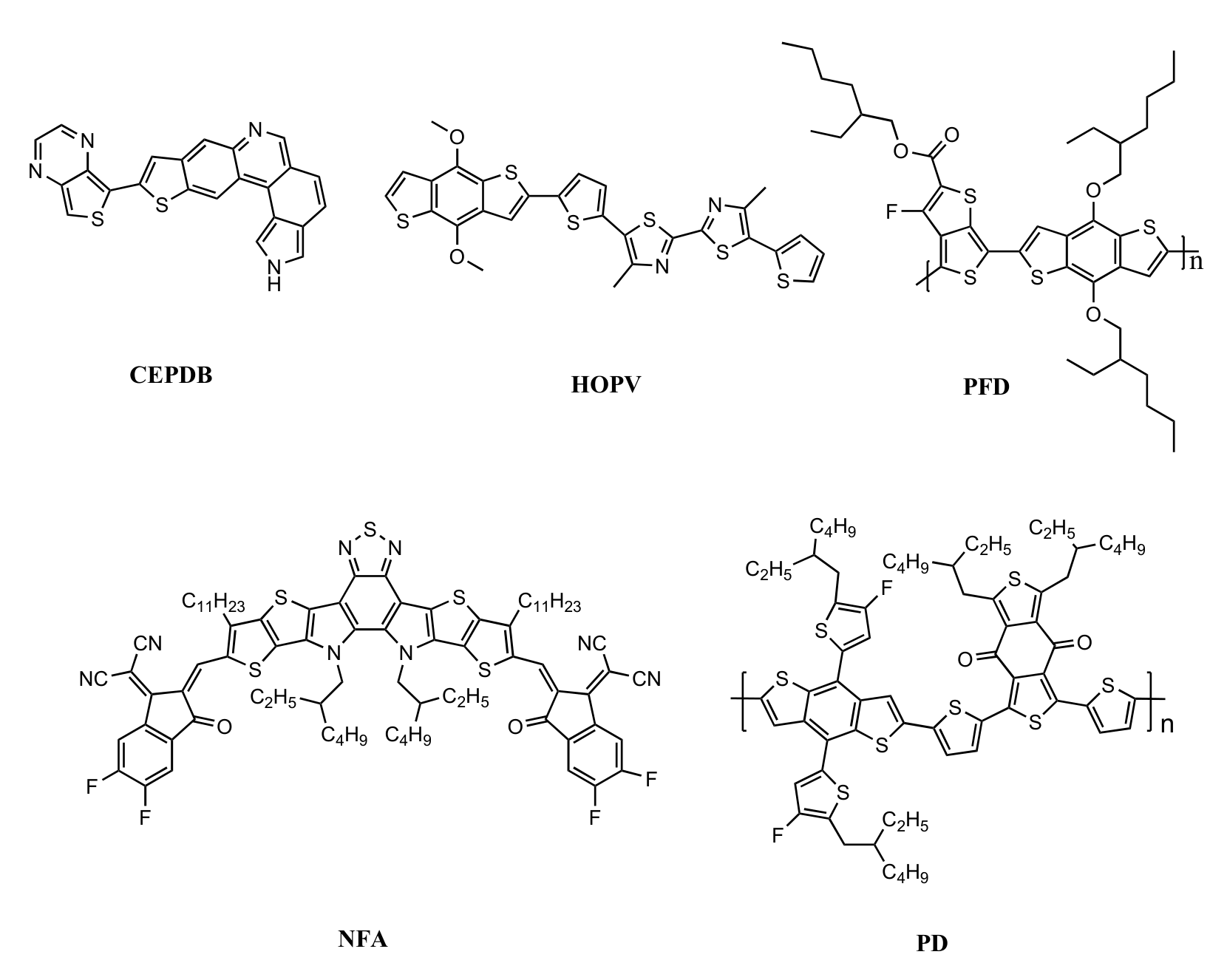
Summary
This Hugging Face dataset repository publishes raw CSV tables for organic solar cell (OSC) molecule/device property prediction, used in the paper:
“RingFormer: A Ring-Enhanced Graph Transformer for Organic Solar Cell Property Prediction” (AAAI 2025).
It includes five datasets: CEPDB, HOPV, PFD, NFA, and PD.
Files in this repo
CEPDB.csvHOPV.csvPFD.csvNFA.csvPD.csv
Important
- This repository contains raw/tabular CSV files only.
- The processed ring-graph data and the code to generate it are provided in the RingFormer GitHub repository:
https://github.com/TommyDzh/RingFormer
Dataset Overview
| DATASET | #GRAPHS | AVG. # NODES | AVG. # EDGES | AVG. # RINGS |
|---|---|---|---|---|
| CEPDB | 2.2M | 27.6 | 33.3 | 6.7 |
| HOPV | 350 | 42.7 | 49.3 | 7.5 |
| PFD | 1055 | 77.1 | 84.2 | 8.2 |
| NFA | 654 | 118.2 | 133.0 | 15.8 |
| PD | 277 | 80.7 | 88.2 | 8.5 |
Schema (Columns)
CEPDB.csv
Header:
smiles, PCE (%), Voc (V), Jsc, HOMO (eV), LUMO (eV)
smiles: molecule SMILESPCE (%): power conversion efficiency (percent)Voc (V): open-circuit voltage (volts)Jsc: short-circuit current density (unit as provided in the original file; commonly mA/cm²)HOMO (eV): HOMO energy level (eV; typically negative)LUMO (eV): LUMO energy level (eV; typically negative)
HOPV.csv
Header:
smiles,doi,inchlKEY,construction,architecture,complement,HOMO,LUMO,electrochemical_gap,optical_gap,PCE,V_OC,J_SC,fill_factor
smiles: molecule SMILESdoi: reference DOIinchlKEY: InChIKey (kept as-is from the original file, including spelling)construction: material category (e.g., polymer)architecture: device architecture (e.g., bulk)complement: complementary material (e.g., PC61BM/PC71BM)HOMO,LUMO: energy levels (commonly in eV; values typically negative)electrochemical_gap,optical_gap: gap-related quantities (commonly in eV)PCE: power conversion efficiency (commonly %)V_OC: open-circuit voltage (commonly V)J_SC: short-circuit current density (commonly mA/cm²; see original file for units)fill_factor: fill factor (raw data may store it in percent-like values)
Missing values can appear as nan.
PFD.csv
Header:
Nickname,PCE_max(%),PCE_ave(%),Voc,Jsc,FF,Mw,Mn,PDI,Monomer,HOMO,LUMO,bandgap,SMILES
Nickname: material/polymer nicknamePCE_max(%),PCE_ave(%): max/average PCE (percent)Voc,Jsc,FF: device metricsMw,Mn,PDI: molecular weight related fieldsMonomer: monomer-related field (kept as-is)HOMO,LUMO,bandgap: electronic propertiesSMILES: structure SMILES
NFA.csv and PD.csv
Both share the same header (kept exactly as in the original CSV, including quotes/hyphens):
PCE_max(%),PCE_ave(%),Jsc(mA/cm2),FF,Voc(V),HOMO_n(eV),'-LUMO_n(eV),Eg_n(eV),n(SMILES),M (g/mol),HOMO_n(eV),'-LUMO_n(eV),Eg_n(eV),p(SMILES),Mw (kg/mol),Mn(kg/mol),PDI
This can be interpreted as a paired-material record (n / p) with device performance:
PCE_max(%),PCE_ave(%),Jsc(mA/cm2),FF,Voc(V): device performance- First group (
... n(SMILES)): n-side material properties and SMILES M (g/mol): molecular mass field (unit in header)- Second group (
... p(SMILES)): p-side material properties and SMILES
(column names are not renamed in the raw file) Mw (kg/mol),Mn(kg/mol),PDI: molecular-weight related fields (units in headers)
How to Use
This repository provides raw CSVs. Example:
import pandas as pd

df_cepdb = pd.read_csv("CEPDB.csv")
df_hopv = pd.read_csv("HOPV.csv")
df_pfd  = pd.read_csv("PFD.csv")
df_nfa  = pd.read_csv("NFA.csv")
df_pd   = pd.read_csv("PD.csv")
For ring-graph construction and training, use the scripts in the RingFormer GitHub repository (e.g., generate_ring_graphs.py, train.py as described in the upstream README).
Citation
If you use this dataset, please cite:
@inproceedings{ding2025ringformer,
  title={RingFormer: a ring-enhanced graph transformer for organic solar cell property prediction},
  author={Ding, Zhihao and Zhang, Ting and Li, Yiran and Shi, Jieming and Zhang, Chen Jason},
  booktitle={Proceedings of the AAAI Conference on Artificial Intelligence},
  volume={39},
  number={1},
  pages={155--163},
  year={2025}
}
License
This repository republishes the original CSV tables used by RingFormer for reproducibility and re-processing. Please refer to the upstream RingFormer GitHub repository for licensing/usage terms of the data. If the upstream repository does not clearly specify a license for the data, please verify compliance before downstream use.