
Datasets:

ViH Varnamala
A multilingual Indic speech corpus for codec, ASR, and TTS research — built for the dialects, accents, and acoustic conditions that production voice models actually meet in the wild. Open for research and commercial use under CC BY 4.0.
Varnamala (वर्णमाला — "the alphabet") is a public research slice released by ViH Research Labs, the frontier-models division of ViH Metaverse Pvt. Ltd. It is drawn from the same 30,000+ hour multilingual corpus that powers our neural audio codec and speech model programme (Doc. VIH/LAB/2026/002).
The thesis: a codec is only as honest as its dialects
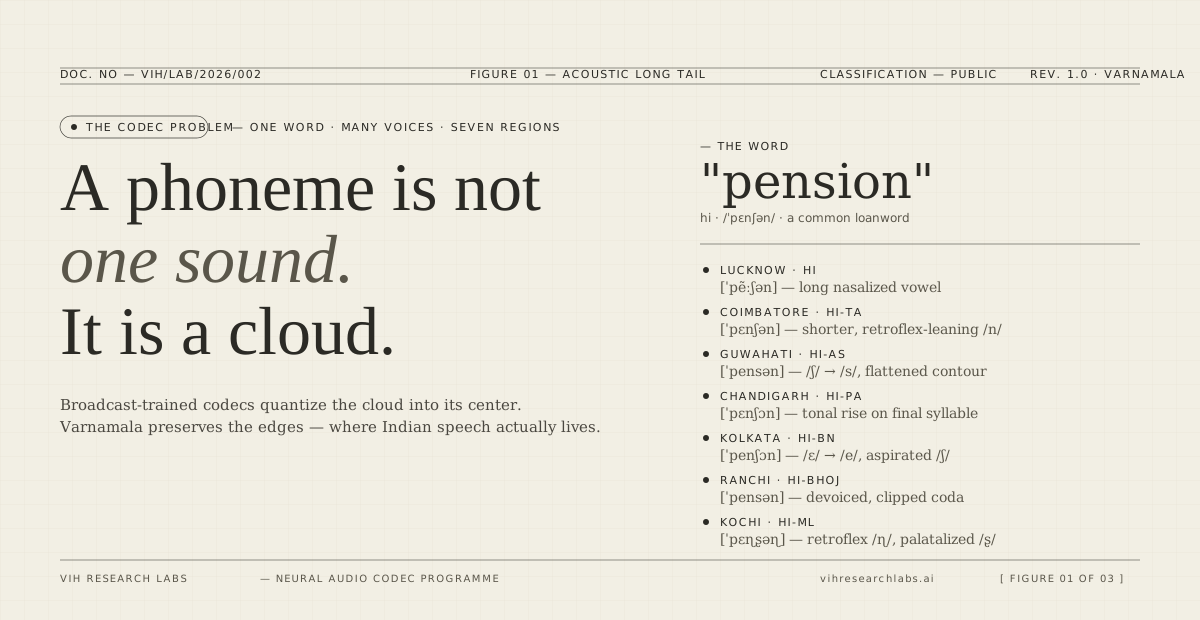
Most neural audio codecs in production were trained on broadcast-quality audio in a narrow set of languages. They learned one "correct" way to pronounce each phoneme, and everything outside that distribution — a Malayali speaker's /ɖ/, a Bhojpuri-inflected Hindi /sh/→/s/, the nasalized vowels of Bengali, the retroflex cluster in Tamil, Punjabi tonal contours creeping into Hinglish — gets quantized into the nearest codebook entry the codec has seen. The voice that comes out the other side sounds almost right. Which is worse than sounding wrong.
India does not have "an accent." India has forty-odd major dialects layered on twenty-two scheduled languages, each with regional pronunciations that a telephony-trained codec treats as noise. The same Hindi word — say, "pension" — is pronounced with markedly different vowel length, retroflex emphasis, and pitch contour by a speaker from Lucknow, Ranchi, Coimbatore, Guwahati, or Chandigarh. For a customer on a voicebot, the codec's honesty about that variation is the difference between "the system understands me" and "the system is broken."
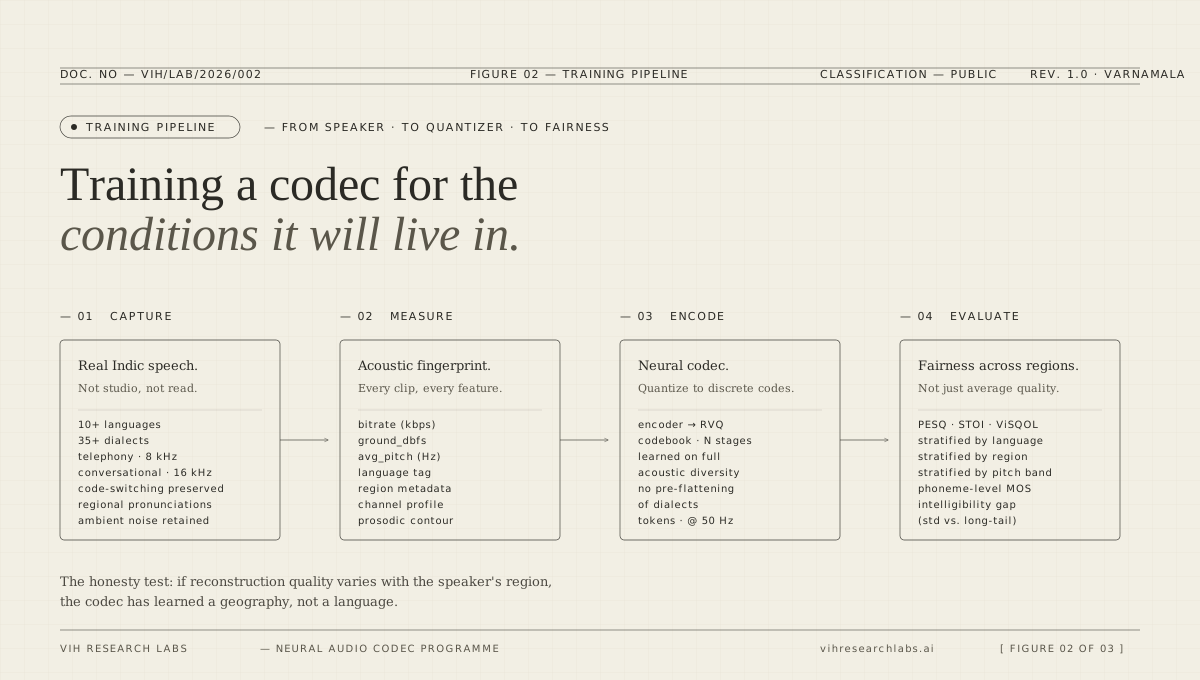
Varnamala is designed to capture that variation, not smooth it out. Every sample carries the regional, channel, and prosodic fingerprints that matter for real Indic speech.
Dataset composition
- 50,464 audio–transcript pairs, ~8.89 GB
- Languages: Hindi, English, Hinglish (romanized Latin script), Tamil, Telugu, Bengali, Malayalam, and additional Indic languages
- Sampling rate: 16 kHz mono
- Format: Parquet (audio + metadata in a single row)
- Utterance length: short-form, primarily 1–10 seconds — representative of conversational and call-center turns
- Dialectal coverage: regional pronunciations, accented English-over-Indic, and code-switching preserved in source transcription
Fields
| Column | Type | Description |
|---|---|---|
audio |
audio (16 kHz) | The raw audio waveform |
audio_name |
string | Stable identifier for the clip |
language |
string | ISO-style language code (hi, en, ta, te, bn, ml, hi-Latn for Hinglish, etc.) |
transcript |
string | Verbatim transcript in the native script (or Latin script for Hinglish) |
bitrate |
float64 | Encoded bitrate of the source clip (kbps) |
ground_dbfs |
float64 | Noise-floor loudness in dBFS — useful for channel and SNR stratification |
avg_pitch |
float64 | Mean fundamental frequency (Hz) across the utterance |
Why this matters for codecs, ASR, and TTS

A codec trained only on Delhi-standard Hindi will reconstruct a Kolkata speaker's Hindi as "almost Delhi Hindi with artifacts." An ASR system trained on clean read speech will transcribe a Chennai call-center Hinglish utterance with confident hallucinations. A TTS system trained on one voice artist will produce output that every Indian listener hears as "the Hindi-film voice" regardless of the script it's reading.
Varnamala surfaces three failure modes that the included avg_pitch, ground_dbfs, and bitrate metadata let you study directly:
- Phonetic realization drift — the same grapheme maps to different phones depending on region (retroflex strength, aspiration, vowel length, nasalization). A fair codec's quantization error should not correlate with region.
- Prosodic mismatch — Indian languages carry information in pitch contour and rhythm that broadcast-trained codecs compress aggressively. The
avg_pitchfield lets researchers slice the corpus by F0 range and measure reconstruction fidelity across it. - Channel-plus-accent compounding — telephony compression hurts all speech, but it hurts accented speech disproportionately. Artifacts in the first pass become misidentified phones in the second.
ground_dbfsandbitratemake that compounding measurable.
Intended uses
- Neural audio codec training and evaluation at telephony and conversational bandwidths, especially for Indic phonetic inventories and regional dialects that are underrepresented in existing codebooks
- Multilingual and code-switching ASR, including Hindi↔English mid-sentence switching and romanized Hinglish recognition
- Text-to-speech and voice cloning where target prosody (
avg_pitch) and channel conditions (ground_dbfs,bitrate) matter - Dialect and accent robustness evaluation — slicing by region or pitch to quantify fairness of model reconstructions
- Language identification and code-switch detection across seven+ Indic languages
- Voicebot and IVR system benchmarking under realistic acoustic conditions
What makes this corpus different
- Dialectal variation is preserved, not cleaned. Pronunciations are transcribed as spoken. Regional drift is a feature, not an error.
- Code-switching is a first-class citizen. Hinglish (
hi-Latn) is tagged and transcribed as its own register, not forced into either Hindi or English. - Acoustic metadata is included per utterance. You can filter or stratify by pitch, noise floor, or bitrate without re-computing features.
- Indic language breadth — seven+ languages in one corpus, at a size sufficient for fine-tuning and evaluation splits.
- Drawn from a larger 30,000-hour programme. Varnamala is the open slice; the distributional characteristics are inherited from a much larger production-oriented corpus.
Access
This dataset is gated to prevent misuse (e.g., unconsented voice cloning). Access requests are typically approved within 1–2 business days for researchers, students, and engineers with a stated use case. Once granted, you are free to use the data under the terms below.
License
Released under CC BY 4.0 (Creative Commons Attribution 4.0 International).
You are free to share, adapt, and build upon this dataset for any purpose, including commercial use, with attribution. Please cite ViH Research Labs and link back to this dataset page. See creativecommons.org/licenses/by/4.0 for the full license text.
For partnerships
Ethical considerations and limitations
- This Release will help to understand that in realtime there are multiple weirdo dialects for the same word or sentence from multiple region & (About Data) consent from the voice artist ,the user chunks from in-house data collection while doing multiple experiments.
- Speaker consent and anonymization: speaker identities are not released;
audio_nameis an opaque identifier. The corpus is not intended for speaker identification or re-identification research. - Domain bias: a significant portion of the corpus reflects customer-service and conversational settings. Models trained solely on Varnamala may not generalize to broadcast, formal, or long-form narration without additional data.
- Dialect coverage is uneven: Varnamala covers multiple languages, but within each language, regional dialect representation is not guaranteed to be uniform. Benchmark with this in mind — uneven coverage is a known limitation, not a claim of completeness.
- Hinglish transcription conventions follow romanized-spelling norms common in Indian messaging; spelling is not standardized across speakers.
- Voice cloning of identifiable individuals: although CC BY 4.0 permits derivative works, users remain responsible for complying with applicable laws around voice likeness, consent, and biometric data. Building systems that impersonate specific individuals without their consent is out of scope for this release.
Citation
@dataset{vih_varnamala_2026,
  author       = {{ViH Research Labs}},
  title        = {{ViH Varnamala: A Multilingual Indic Speech Corpus for Codec, ASR, and TTS Research}},
  year         = {2026},
  publisher    = {Hugging Face},
  version      = {1.0},
  url          = {https://huggingface.co/datasets/ViH-research-labs/ViH-Varnamala},
  note         = {Public slice of the ViH Neural Audio Codec Programme (VIH/LAB/2026/002)}
}
Maintainers and contact
- Organization: ViH Research Labs — Research & Frontier Models, ViH Metaverse Pvt. Ltd.
- Programme: Neural Audio Codecs · Speech Models (Doc. VIH/LAB/2026/002)
- Website: vihresearchlabs.ai
- Contact:
rishabh.sing@vihmessenger.com - Community: the Hugging Face Community tab on this dataset
We are Hiring Passionate Researchers who love to work around Acquistic Models,Tokenization & building something from the ground on top of good Open Source.
Varnamala is released as part of ViH Research Labs' commitment to the open study of the dialects, accents, and acoustic conditions that production voice models actually inhabit.
- Downloads last month
- 3