

The dataset viewer is not available for this split.
Error code:   StreamingRowsError
Exception:    CastError
Message:      Couldn't cast
hotelId: int64
hotelName: string
source: string
hotelStars: int64
hotelAddress: string
overallRating: double
ratingLabel: string
subRatings: list<item: string>
  child 0, item: string
reviewsCount: int64
reviewsInSample: int64
ownerResponseRateInSample: double
recommendRate: double
negativeReviewsCount: int64
topReviewerProvinces: list<item: string>
  child 0, item: string
subtitle: string
description: string
id: string
keywords: list<item: string>
  child 0, item: string
licenses: list<item: struct<name: string>>
  child 0, item: struct<name: string>
      child 0, name: string
title: string
to
{'title': Value('string'), 'id': Value('string'), 'subtitle': Value('string'), 'description': Value('string'), 'licenses': List({'name': Value('string')}), 'keywords': List(Value('string'))}
because column names don't match
Traceback:    Traceback (most recent call last):
                File "/src/services/worker/src/worker/utils.py", line 147, in get_rows_or_raise
                  return get_rows(
                      dataset=dataset,
                  ...<4 lines>...
                      column_names=column_names,
                  )
                File "/src/libs/libcommon/src/libcommon/utils.py", line 272, in decorator
                  return func(*args, **kwargs)
                File "/src/services/worker/src/worker/utils.py", line 127, in get_rows
                  rows_plus_one = list(itertools.islice(safe_iter(ds, dataset=dataset), rows_max_number + 1))
                File "/src/services/worker/src/worker/utils.py", line 478, in safe_iter
                  yield from ds.decode(False) if ds.features else ds
                File "/usr/local/lib/python3.14/site-packages/datasets/iterable_dataset.py", line 2818, in __iter__
                  for key, example in ex_iterable:
                                      ^^^^^^^^^^^
                File "/usr/local/lib/python3.14/site-packages/datasets/iterable_dataset.py", line 2355, in __iter__
                  for key, pa_table in self._iter_arrow():
                                       ~~~~~~~~~~~~~~~~^^
                File "/usr/local/lib/python3.14/site-packages/datasets/iterable_dataset.py", line 2380, in _iter_arrow
                  for key, pa_table in self.ex_iterable._iter_arrow():
                                       ~~~~~~~~~~~~~~~~~~~~~~~~~~~~^^
                File "/usr/local/lib/python3.14/site-packages/datasets/iterable_dataset.py", line 536, in _iter_arrow
                  for key, pa_table in iterator:
                                       ^^^^^^^^
                File "/usr/local/lib/python3.14/site-packages/datasets/iterable_dataset.py", line 419, in _iter_arrow
                  for key, pa_table in self.generate_tables_fn(**gen_kwags):
                                       ~~~~~~~~~~~~~~~~~~~~~~~^^^^^^^^^^^^^
                File "/usr/local/lib/python3.14/site-packages/datasets/packaged_modules/json/json.py", line 343, in _generate_tables
                  self._cast_table(pa_table, json_field_paths=json_field_paths),
                  ~~~~~~~~~~~~~~~~^^^^^^^^^^^^^^^^^^^^^^^^^^^^^^^^^^^^^^^^^^^^^
                File "/usr/local/lib/python3.14/site-packages/datasets/packaged_modules/json/json.py", line 132, in _cast_table
                  pa_table = table_cast(pa_table, self.info.features.arrow_schema)
                File "/usr/local/lib/python3.14/site-packages/datasets/table.py", line 2369, in table_cast
                  return cast_table_to_schema(table, schema)
                File "/usr/local/lib/python3.14/site-packages/datasets/table.py", line 2297, in cast_table_to_schema
                  raise CastError(
                  ...<3 lines>...
                  )
              datasets.table.CastError: Couldn't cast
              hotelId: int64
              hotelName: string
              source: string
              hotelStars: int64
              hotelAddress: string
              overallRating: double
              ratingLabel: string
              subRatings: list<item: string>
                child 0, item: string
              reviewsCount: int64
              reviewsInSample: int64
              ownerResponseRateInSample: double
              recommendRate: double
              negativeReviewsCount: int64
              topReviewerProvinces: list<item: string>
                child 0, item: string
              subtitle: string
              description: string
              id: string
              keywords: list<item: string>
                child 0, item: string
              licenses: list<item: struct<name: string>>
                child 0, item: struct<name: string>
                    child 0, name: string
              title: string
              to
              {'title': Value('string'), 'id': Value('string'), 'subtitle': Value('string'), 'description': Value('string'), 'licenses': List({'name': Value('string')}), 'keywords': List(Value('string'))}
              because column names don't match
Need help to make the dataset viewer work? Make sure to review how to configure the dataset viewer, and open a discussion for direct support.
Trip.com & Ctrip (携程) Hotel Reviews — Sample (2026)
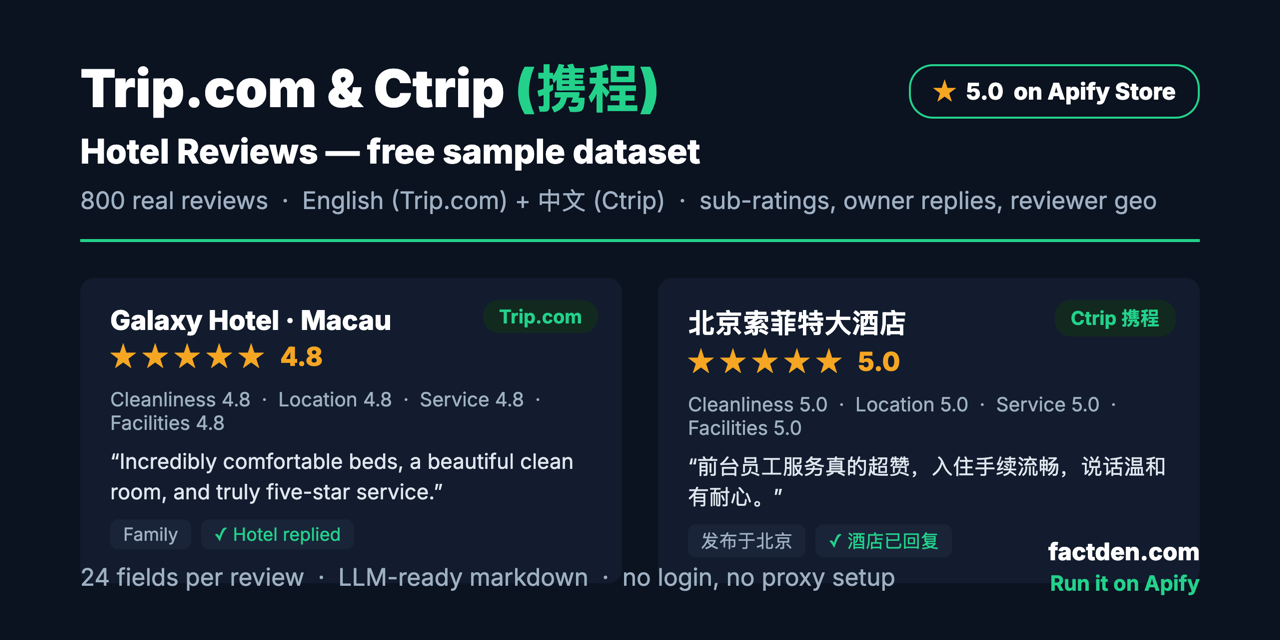
A clean, ready-to-analyze sample of 800 public hotel reviews across four hotels, captured in both locales:
200 international reviews from Trip.com (Galaxy Hotel, Macau) and 600 Chinese-language reviews from Ctrip /
携程 (Sofitel Beijing, New York Hilton Midtown, and a luxury Hangzhou hotel). Each review carries per-dimension
sub-ratings, hotel owner responses, the reviewer's Chinese province of origin (Ctrip), travel type, and an
LLM-ready markdownContent field.
Extracted with the Trip.com & Ctrip Reviews Scraper on Apify. This is a curated sample — run the actor for any hotel on either platform, at any scale.
Files
| File | Rows | What |
|---|---|---|
reviews.csv / reviews.json / reviews.jsonl |
800 | One row per review, 23 fields |
hotel_summary.csv / hotel_summary.json |
4 | Per-hotel metadata + aggregates (rating, sub-ratings, owner-response rate, top reviewer provinces) |
.jsonl suits ML/RAG loading; .csv suits spreadsheets/Kaggle; .json for general use. In JSON/JSONL the
reviewer and ownerResponse fields are nested objects and subRatings is an array; in CSV they are
flattened to reviewer_* / ownerResponse_* columns and subRatings is joined into one cell (e.g.
Cleanliness: 4.8; Location: 4.8; Service: 4.8; Facilities: 4.8).
What makes this interesting
One platform, two audiences. Ctrip (携程) carries the Chinese-domestic guest voice; Trip.com carries the international one. The same actor reads both, so you can compare how each audience rates and what they care about.
Chinese guests reviewing a New York hotel. The New York Hilton Midtown rows are 200 Chinese-language Ctrip
reviews of a US property — including 40 reviews posted from the USA (reviewer.ipLocation = 发布于美国). It is
also the lowest-rated hotel in the set (4.0/5, with Service 3.9 and Facilities 3.7), a useful contrast to the 4.6–4.8
ratings elsewhere.
Owner-response culture varies sharply. In this sample, Galaxy Macau replied to 100% of reviews and the Beijing
and Hangzhou hotels to ~99% — but the New York Hilton replied to 0% of its Ctrip reviews. ownerResponse (and
ownerResponseRateInSample in the hotel summary) make that visible.
Province-level Chinese geography. reviewer.ipLocation is populated on 87% of Ctrip rows. Top origins in this
sample: Zhejiang, Beijing, Shanghai, USA, Guangdong — province-level segmentation no English-only scraper exposes.
| Hotel | Source | Avg rating | Owner-response rate (sample) | Top reviewer origins |
|---|---|---|---|---|
| Galaxy Hotel, Macau | Trip.com | 4.8 | 100% | (Trip.com has no IP location) |
| Sofitel Beijing | Ctrip | 4.6 | 99% | Beijing, Guangdong, Liaoning |
| New York Hilton Midtown | Ctrip | 4.0 | 0% | USA, Shanghai, Beijing |
| Hangzhou (luxury) | Ctrip | 4.7 | 99% | Zhejiang, Shanghai, Jiangsu |
Reviews span 2023-06 → 2026-06. Travel mix skews business on Ctrip (商务出差) and family on Trip.com.
Field dictionary (reviews)
| Field | Type | Notes |
|---|---|---|
reviewId |
string | Unique review id |
hotelId / hotelName / hotelUrl |
int / string / string | Hotel identity (id is shared across Trip.com & Ctrip) |
source |
string | trip (Trip.com) or ctrip (Ctrip / 携程) |
submittedAt / checkInMonth |
string | Submission time (hotel-local, naive ISO) / check-in month YYYY-MM |
reviewer |
object | { name, lifetimeReviews, tier, isAnonymous, ipLocation } — ipLocation is the Chinese province (Ctrip only); CSV: reviewer_* columns |
travelType |
string | Business / Family / Couple / Solo / Friends / Other (localized on Ctrip) |
roomName |
string | Room type booked |
language |
string | ISO code of the original review text |
overallRating / ratingLabel |
number / string | 0–5 rating + localized tier label |
subRatings |
array | Labeled sub-ratings, e.g. ["Cleanliness: 4.8", "Location: 4.8", ...]; CSV: one joined cell |
reviewText / reviewTextTranslated / isMachineTranslated |
string / string / bool | Original text, platform machine-translation (when present), and the flag |
recommends |
bool | Whether the guest recommends the hotel |
usefulCount / imagesCount / hasVideo |
int / int / bool | Engagement + media signals |
ownerResponse |
object | null | { text, date } hotel-management reply, or null; CSV: ownerResponse_* columns |
markdownContent |
string | LLM-ready self-contained markdown block — drop straight into a RAG pipeline |
hotel_summary adds per hotel: hotelStars, hotelAddress, aggregate overallRating + subRatings,
reviewsCount, reviewsInSample, ownerResponseRateInSample, recommendRate, negativeReviewsCount,
topReviewerProvinces.
Fields intentionally omitted (kept clean)
The actor's full schema also emits extractedAt (scrape timestamp), dropped here for signal. Everything else from the
live output is preserved. Full schema: the actor's developer
repo.
Methodology
- Collected from publicly accessible Trip.com and Ctrip hotel-review pages via the Trip.com & Ctrip Reviews Scraper.
- 200 reviews per hotel, most-recent first. Sample date: 2026-06. No rows synthesized; values are real public reviews.
Source & usage
The reviews are public content authored by Trip.com / Ctrip users; all trademarks and content belong to their
respective owners. This sample is shared for research, education, and demonstration of structured review
extraction. It is not affiliated with or endorsed by Trip.com Group, Ctrip, or any hotel. Chinese-language text and
reviewer.ipLocation are reproduced as published; ensure your downstream use complies with GDPR, China's PIPL, and
other applicable regulations. Verify any conclusions against the linked hotel pages.
Get the full data
This is a 4-hotel, 800-row sample. To pull reviews for any Trip.com or Ctrip hotel — all fields, sub-ratings, owner responses, province-level origin, and LLM-ready markdown — run the actor:
▶ Trip.com & Ctrip Reviews Scraper on Apify →
Also mirrored on Kaggle. More free tools and samples at factden.com.
- Downloads last month
- 59