---
annotations_creators: []
language:
- en
language_creators: []
license: []
multilinguality:
- monolingual
pretty_name: 'adaption-english-multilingual-translation-pairs'
size_categories:
- 1K
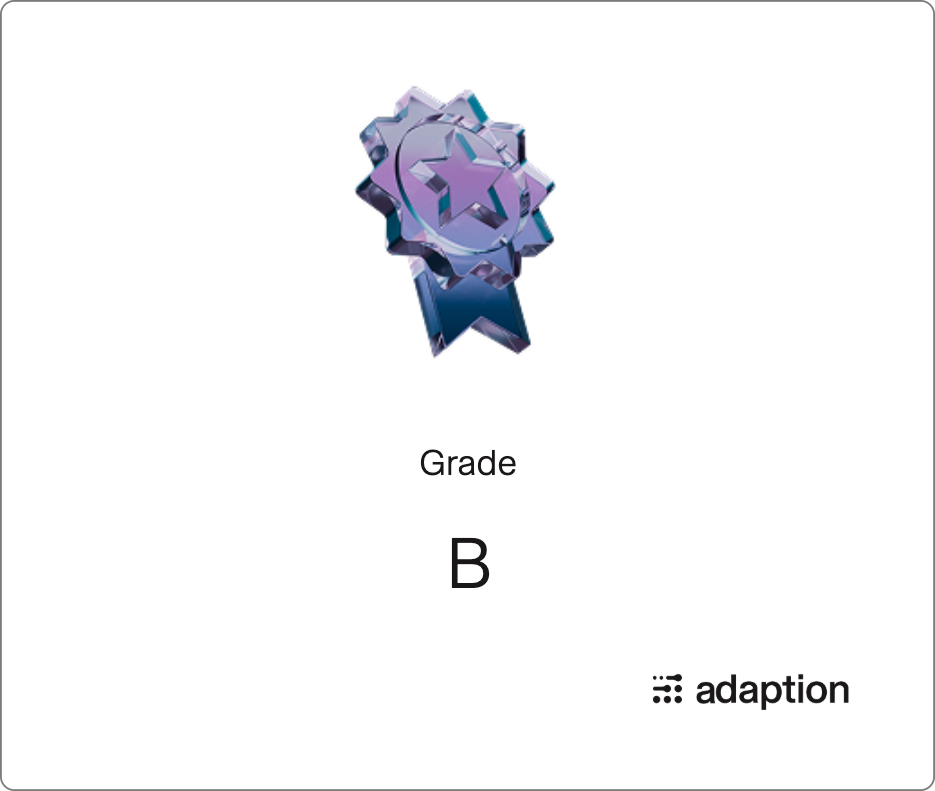
- **Grade Improvement:**
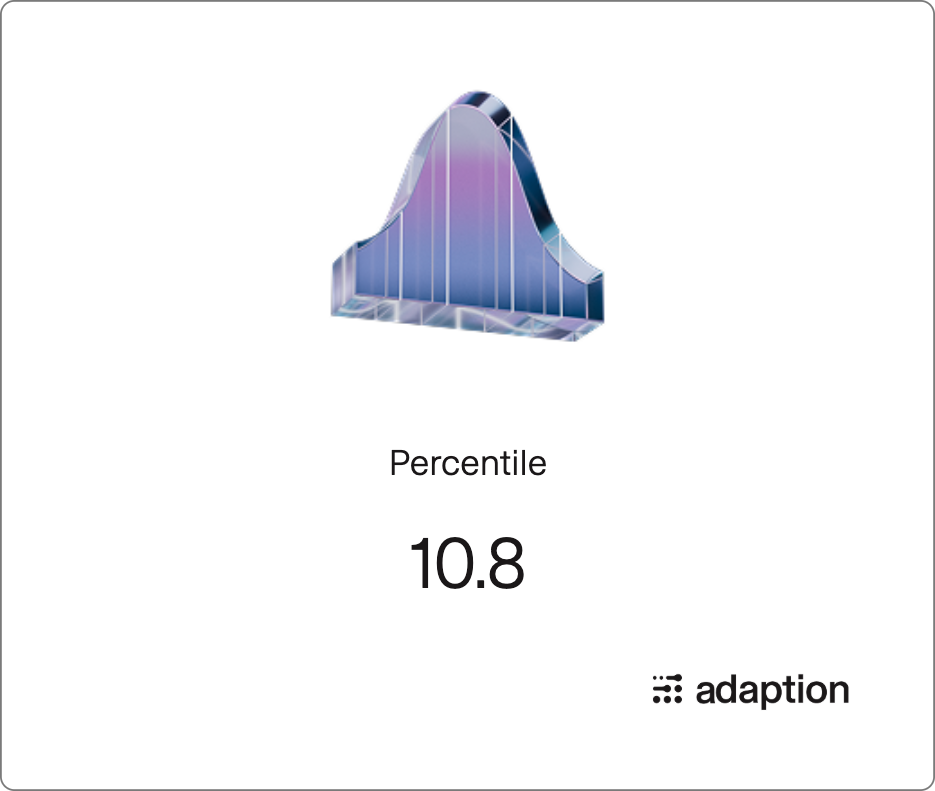
- **Percentile Chart:**
## Structure
Every prompt follows one template:
```
Translate from to :
```
99.8% of rows parse against that template. The completion is the translation
alone, on a single line.
## Language distribution
Parsed from the generated prompts themselves rather than taken from metadata:
| Direction | Rows |
|---|---|
| English → Hindi | 243 |
| English → Spanish | 229 |
| English → Tamil | 214 |
| English → French | 211 |
| English → Swahili | 98 |
| Other (German, Gujarati, Odia) | 5 |
995 of 1,000 rows are in one of the five requested directions. Note that Swahili
is roughly half as well represented as the other four, so the set is usable but
not balanced — sample accordingly if balance matters to you.
## What was verified, and what was not
**Verified.** Prompt template conformance, the declared language direction of
every row, and — for the non-Latin targets — that the completion is actually
written in the expected script rather than in English or transliteration.
**Not verified: whether the translations are correct.** No fluent speaker
reviewed this data, and no automatic translation-quality metric was run. A row
can be in the right language, in the right script, and still be a poor or wrong
translation. Nothing here evidences otherwise.
That distinction matters most for Swahili and Tamil, where a downstream user is
least likely to catch a bad translation by eye, and which are also the two
directions where a synthetic generator is most likely to struggle. Treat this
dataset as structurally sound and semantically unaudited.
## Suggested use
Reasonable: instruction-format training where the shape of the task matters,
prompt-template experiments, multilingual formatting work, or as a seed set to be
quality-filtered with a translation metric or human review.
Not recommended: any use where translation accuracy is load-bearing, without
running your own quality pass first.
## Limitations
- Translation quality unaudited (see above).
- English → X only. No reverse directions.
- Unbalanced across the five target languages.
- Source sentences were requested at 8–25 words across conversational, news,
technical and idiomatic registers; register balance was not verified.
- 5 rows fall outside the requested language set.
- No per-row language column is included in the platform export; the direction
must be parsed from the prompt string.
## Provenance
- Generated with Adaption's *Invent a Dataset* feature, September 2026.
- Platform dataset ID: `2fd05389-fa7a-4893-9d14-0ef618dae773`
- Rows are unmodified platform output.
- Requested specification: sentence-level translation pairs, prompts of the form
`Translate from to : `, with the
language pair drawn from English to Spanish, French, Hindi, Swahili or Tamil.
## Citation
```bibtex
@misc{anbalagan2026translationpairs,
title = {adaption-english-multilingual-translation-pairs},
author = {Anbalagan, Vinod},
year = {2026},
note = {Generated with Adaption Adaptive Data; structure and language direction verified, translation quality unaudited},
url = {https://huggingface.co/datasets/vinod-anbalagan/adaption-english-multilingual-translation-pairs}
}
```
 - **Percentile Chart:**
 ## Structure
Every prompt follows one template:
```
Translate from
## Structure
Every prompt follows one template:
```
Translate from