


Ultralytics YOLO26: Unified Real-Time End-to-End Vision Models
Paper • 2606.03748 • Published • 23




YOLO26's dense depth-estimation head, repurposed to output 3-channel RGB instead of 1-channel depth. YOLO26 already ships a depth-estimation head, itself a dense, full-resolution regression task; this model swaps that head for an RGB one and asks whether the decoder's inductive bias, tuned for real-time detection speed and then adapted once for depth, transfers to single-image deraining any better than a classification-pretrained backbone repurposed as a UNet encoder (ClearView's ResNet-UNet family). Trained and evaluated on ClearView's mixed-domain recipe and 10-test-set protocol, for numbers directly comparable to ClearView's own model zoo, not a separate benchmark. See Model Comparison below for how this scale specifically does against that baseline.
Best PSNR/SSIM of the two released scales (30.95 avg, 9 rain-only sets), still fast (92.2 qps). The default choice unless a smaller footprint than its 12.13M params is required, in which case use n.
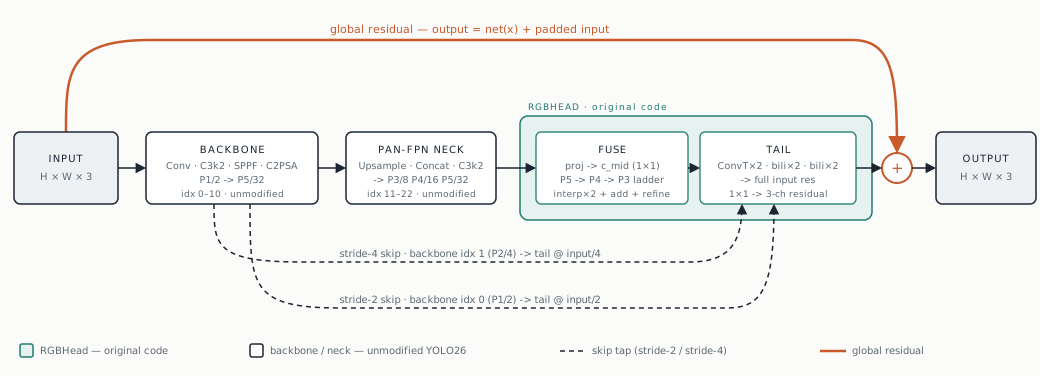
Backbone and PAN-FPN neck are unmodified YOLO26. RGBHead replaces the 1-channel depth head with a 3-channel restoration head: full input-resolution output, two skip connections from the stride-2/4 backbone layers into the decoder tail, a global residual (predict a correction, add it to the input), and LayerNorm in the head's own conv blocks while the backbone/neck stay on BatchNorm (folds into conv at TensorRT export; keeps Ultralytics' full YOLO26 pretrained zoo loadable). Full write-up and the RGBHead-internals figure: github.com/dronefreak/yolo26-rgb#architecture.
pip install git+https://github.com/dronefreak/yolo26-rgb.git
import torch
from yolo26_rgb import YOLO26RGB

model = YOLO26RGB.from_pretrained("dronefreak/yolo26-rgb-s")  # downloads yolo26s-rgb.pt, returns eval mode

# image_tensor: (1, 3, H, W) float in [0, 1]. The output is a residual added to the
# input (NAFNet/Restormer-style), not bounded to [0, 1] - clamp it before saving.
output = model(image_tensor).clamp(0, 1)
Full image-to-PNG example (load an image, run, write the result): see the main repo README.
5 sources combined via ClearView's --mix-config (recipe), oversampling the real-world sources 2x:
| Source | Type | Weight | Pairs |
|---|---|---|---|
| Rain13K [1] | Synthetic | 1.0 | 13,711 |
| DDN-Data / Rain1400 [4] | Synthetic | 1.0 | 12,600 |
| SPA-Data [5] | Real-world | 2.0 | 6,385 |
| RealRain-1k-H [6] | Real-world | 2.0 | 784 |
| RealRain-1k-L [6] | Real-world | 2.0 | 784 |
~62% synthetic / ~38% real by effective sampling weight (before oversampling: ~77%/23% by raw pair count).
Checkpoint selection uses a separate blended validation set (recipe): SPA-Data val (capped to 150 of 1,000 pairs so it can't dominate), RealRain-1k-H/L validation (112 each), and Rain100L (100) as a synthetic sanity anchor.
Full per-dataset breakdown across all 6 tracked metrics, computed on each source's own held-out test/eval split (not the blended validation set used for checkpoint selection during training).
| Test Set | Domain | PSNR | SSIM | MAE | MSE | Rain Removal Rate | NIQE |
|---|---|---|---|---|---|---|---|
| SPA-Data_val [5] | Real-world | 38.66 | 0.966 | 0.0065 | 0.00036 | 0.323 | 8.93 |
| Rain100L [2] | Synthetic | 30.41 | 0.893 | 0.0185 | 0.00118 | 0.171 | 19.60 |
| Rain100H [2] | Synthetic | 23.10 | 0.566 | 0.0540 | 0.00553 | 0.423 | 54.59 |
| Test100 [3] | Synthetic | 26.03 | 0.775 | 0.0443 | 0.00397 | 0.322 | 17.31 |
| Test1200 [3] | Synthetic | 29.01 | 0.814 | 0.0314 | 0.00220 | 0.293 | 13.21 |
| Test2800 [4] | Synthetic | 29.97 | 0.861 | 0.0240 | 0.00112 | 0.290 | 761.51 |
| DDN-Data [4] | Synthetic | 30.24 | 0.866 | 0.0234 | 0.00107 | 0.280 | 1223.47 |
| RealRain-1k-H [6] | Real-world | 34.19 | 0.911 | 0.0139 | 0.00074 | 0.535 | 9.37 |
| RealRain-1k-L [6] | Real-world | 36.92 | 0.950 | 0.0098 | 0.00041 | 0.498 | 7.77 |
| AllWeather (rain+fog) [7] | Cross-domain (stress) | 13.54 | 0.566 | 0.1918 | 0.05658 | 0.067 | 273.51 |
| Average (10 sets) | 29.21 | 0.8167 | |||||
| Average (9 rain-only) | 30.95 |
Metric definitions:
1 - (residual after) / (residual before). 1.0 means perfect rain removal, 0.0 means no change, negative means the model added more high-frequency error than it removed. Higher is better.AllWeather (rain+fog) is an explicit out-of-domain stress test, fog was not in the training mix and this model is not expected to handle it well; excluded from the 9-rain-only average above, same convention ClearView itself uses to rank its own model zoo.
How this model compares to ClearView's model zoo and the other released yolo26-rgb scale (this row in bold), ranked by average PSNR across the 9 rain-only test sets, same test sets and evaluation protocol for every model. The three deployment columns are TensorRT 11.2.1, fp16, 1920x1080 (padded to 1088x1920), batch size 1, on an RTX 4070 SUPER (12GB), CUDA 12.8, cuDNN 9.8.0, Ubuntu 24.04.4 LTS; ClearView baseline figures are its own published benchmark on the identical GPU/TensorRT version.
| Rank | Model | Params | Avg PSNR (9 rain-only) | Engine (fp16) | Latency (fp16) | Throughput (fp16) |
|---|---|---|---|---|---|---|
| 1 | Restormer [8] | 15.3M | 35.10 | OOM* | OOM* | OOM* |
| 2 | NAFNet (Large) [10] | 116M | 34.16 | 3.86 GB | 1938.4 ms | 0.52 qps |
| 3 | NAFNet (Mid) [10] | 14.3M | 33.97 | 1.85 GB | 305.4 ms | 3.3 qps |
| 4 | Restormer-Small [8] | 2.3M | 31.98 | 7.2 GB | 211.2 ms | 4.7 qps |
| 5 | UNet (Vanilla) [9] | 21.5M | 31.74 | 44 MB | 36.6 ms | 27.3 qps |
| 6 | NAFNet (Small) [10] | 1.1M | 31.15 | 911 MB | 37.2 ms | 26.9 qps |
| - | yolo26_rgb_s | 12.13M | 30.95 | 1.53 GB | 10.85 ms | 92.2 qps |
| - | yolo26_rgb_n | 5.25M | 30.83 | 1.27 GB | 9.20 ms | 108.6 qps |
| 7 | ResNet50-UNet [11] | 73.3M | 30.63 | 315 MB | 30.2 ms | 33.1 qps |
| 8 | ResNet34-UNet [11] | 24.5M | 30.45 | 217 MB | 10.5 ms | 94.9 qps |
| 9 | ResNet18-UNet [11] | 14.4M | 30.23 | 197 MB | 9.07 ms | 110.3 qps |
* Restormer's full-size checkpoint doesn't survive TensorRT conversion at this resolution: ONNX export itself OOMs at fp32 (over 12GB during tracing), and even at fp16 the TensorRT build fails, needing roughly 14.4GB of activation/scratch memory to fuse its attention path on a 12GB card.
Good for: real-time or edge-constrained deraining where a compact, TensorRT-exportable backbone matters; research into whether depth-pretrained detection/segmentation backbones transfer to restoration tasks better than classification-pretrained ones.
Limitations: deraining is partial, not complete, residual streaks survive up close, worse on dense rain over flat/low-texture backgrounds; AllWeather (rain+fog) is a stark outlier (~13.5 dB vs. 22+ dB on every other test set), an explicit out-of-domain stress test, not representative of typical performance; trails Restormer/NAFNet by a wide margin on PSNR, those are accuracy-maximizing architectures with no real-time constraint, never the target this project was built to beat, see ClearView's ResNet-UNet family for the comparison that is.
AGPL-3.0, inherited from depending on AGPL-licensed Ultralytics YOLO26 source (Ultralytics requires the entire derivative work, including training your own model from scratch, to stay AGPL-3.0 or use their Enterprise license, see their licensing page). This includes AGPL's network-use clause (section 13): if you run this model as part of a network-accessible service, you're obligated to offer that service's complete corresponding source to its users, not just link back here. Not affiliated with or endorsed by Ultralytics, this repurposes their published architecture for a different task, no claim of ownership over the original YOLO26 design.
@software{saksena2026yolo26rgb,
  author = {Saksena, Saumya Kumaar},
  title = {yolo26-rgb: YOLO26's depth head repurposed for RGB image restoration},
  year = {2026},
  url = {https://github.com/dronefreak/yolo26-rgb}
}
Architecture and datasets this model builds on:
Full bibtex for the YOLO26 architecture: main repo README. ClearView's own citation: its README.
Saumya Kumaar Saksena, GitHub Issues