---
license: apache-2.0
language:
- en
- zh
library_name: transformers
pipeline_tag: any-to-any
tags:
- multimodal
- audio
- video
- speech
- streaming
- full-duplex
- long-video
- custom-code
---

Realtime-Venus
A full-duplex interaction system with asynchronous delegation
English | 简体中文







Realtime-Venus supports proactive audio-visual interaction, asynchronous delegation, and interruption-aware full-duplex dialogue.
## 1. 🧭 Overview
This repository hosts two checkpoints of the
[Realtime-Venus](https://realtime-venus.github.io/) system:
- **Realtime-Venus-Omni** (`Realtime-Venus-Omni/`): the 9B audio-visual
interaction model. It continuously watches and listens, decides whether and
when to respond, and generates text and speech on a shared causal timeline.
Adapted from MiniCPM-o 4.5, it supports proactive interaction, semantic
interruption handling, and training-free long-video memory.
- **Realtime-Venus-Audio** (`Realtime-Venus-Audio/`): the audio-focused
checkpoint on the same streaming backbone, for audio understanding and
audio-driven conversation with text or speech output.
Both directories contain model weights and custom Hugging Face Transformers
code. The asynchronous Realtime-Venus-Harness and its external tool
integrations live in the
[GitHub repository](https://github.com/inclusionAI/Realtime-Venus).
## 2. ✨ Highlights
- **Native full-duplex conversation:** keeps perceiving while speaking and
distinguishes backchannels, interruptions, corrections, and redirections.
- **Omni-Proactive interaction:** continuously processes temporally aligned
video and audio, and initiates a response when an event warrants it — without
waiting for a user prompt.
- **Delegation:** emits in-stream `` requests on the shared causal
timeline and consumes asynchronous backend results the same way, so external
tasks never block the ongoing conversation. (Executing requests requires the
Realtime-Venus-Harness runtime, available in the
[GitHub repository](https://github.com/inclusionAI/Realtime-Venus).)
- **Training-free long-video Memory:** archives visually informative moments,
retrieves query-relevant and non-redundant evidence, and reassembles the
corresponding audio-visual context — no additional training required.
- **Text and speech output:** generates response text together with native
speech through the bundled Token2wav resources and a reference voice.
## 3. 📋 Model Details
| Item | Realtime-Venus-Omni | Realtime-Venus-Audio |
| --- | --- | --- |
| Parameters | 9B | 9B |
| Base architecture | MiniCPM-o 4.5 / Omni-Flow | MiniCPM-o 4.5 / Omni-Flow |
| Visual encoder | SigLIP2 | not used at inference |
| Audio encoder | Whisper-Medium | Whisper-Medium |
| Language backbone | Qwen3-8B | Qwen3-8B |
| Speech generation | Discrete S3 speech tokens with a streaming flow-matching decoder | same decoder, enabled in full-duplex mode |
| Inputs | Video/images, audio, and text | Audio and text |
| Outputs | Text and optional speech waveform | Text and speech waveform |
| Context length | 40,960 tokens | 40,960 tokens |
| Weight dtype | BF16 | BF16 |
## 4. 📊 Evaluation
All values are reported in the
[Realtime-Venus technical report](https://arxiv.org/pdf/2609.13814).
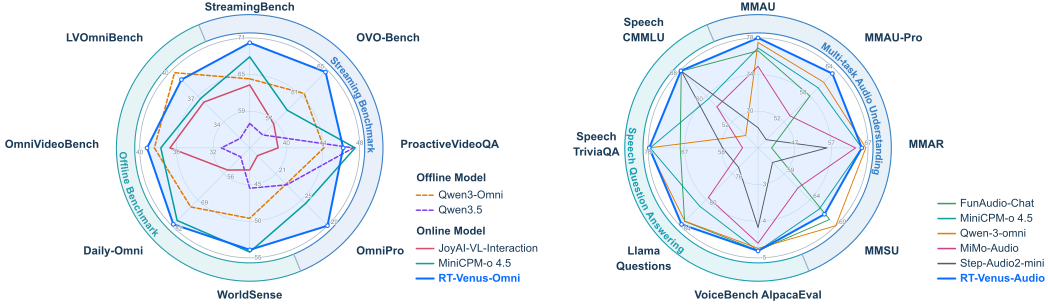
Figure 1. Video and audio understanding results from the paper.
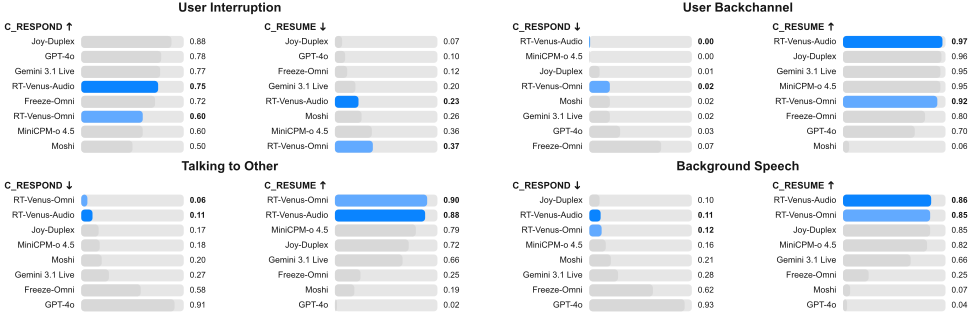
Figure 2. Full-duplex interaction results from the paper.
## 5. 🗂️ Repository Layout
```text
.
├── Realtime-Venus-Omni/ # Audio-visual full-duplex checkpoint
│ ├── model-*.safetensors # Sharded model weights
│ ├── config.json, *.py # Model config and custom Transformers code
│ ├── realtime_venus_omni_memory.py # Public Memory entry point
│ ├── memory_adapter/ # Chat and Duplex Memory runtime
│ ├── assets/ # Reference voice, Token2wav, demo videos
│ └── requirements.txt
├── Realtime-Venus-Audio/ # Audio-focused checkpoint
│ ├── model-*.safetensors # Sharded model weights
│ ├── config.json, *.py # Model config and custom Transformers code
│ └── assets/ # Reference voice, Token2wav, demo audio
├── assets/ # Brand resources (logo)
├── config.yaml # Model names and download directory mapping
├── download_models.py # Unified Omni / Audio / all downloader
├── README.md
├── README_zh.md
└── LICENSE
```
The examples below write generated media to `output/`. Use a new filename or a
new output directory when repeating an experiment.
## 6. 🛠️ Installation
Running the inference examples requires Python 3.10, CUDA, and FFmpeg. First,
install the download dependencies and fetch the unified downloader from this
Hugging Face repository:
```bash
python -m pip install 'huggingface_hub>=0.34' 'PyYAML>=6.0'
hf download inclusionAI/Realtime-Venus download_models.py --local-dir .
```
Then choose the models to download:
| `--model` | Download |
| --- | --- |
| `omni` | Realtime-Venus-Omni for audio-visual interaction |
| `audio` | Realtime-Venus-Audio for audio understanding and conversation |
| `all` | Both models |
For example, download both models into the current directory:
```bash
python download_models.py --model all --local-dir .
```
Use `--model omni` or `--model audio` to download only the model you need.
The downloader reads this repository's root `config.yaml` and downloads each
selected model's complete directory, including weights, custom code, and
assets. It saves a download manifest and uses the Hugging Face Hub's standard
progress display and cache. Each download uses one repository revision.
Install the inference dependencies after downloading. For Omni or `all`:
```bash
python -m pip install -r Realtime-Venus-Omni/requirements.txt
```
Audio uses the same published dependency list; it does not have a separate
`requirements.txt`. If you downloaded only Audio, fetch that small file first
without downloading the Omni weights:
```bash
hf download inclusionAI/Realtime-Venus Realtime-Venus-Omni/requirements.txt --local-dir .
python -m pip install -r Realtime-Venus-Omni/requirements.txt
```
To download from Python instead, run this once from the directory containing
`download_models.py`. It uses the same downloader as the command above:
```python
from download_models import download_models
paths = download_models(model="omni", local_dir=".") # "omni", "audio", or "all"
model_dir = paths["omni"] # pathlib.Path; use paths["audio"] for Audio
```
The inference examples below load the downloaded local model directories. Run
them from the same directory; all asset and output paths are relative to it.
As an independent alternative, the ModelScope CLI (installed separately) can
download the entire mirror repository:
```bash
modelscope download --model inclusionAI/Realtime-Venus --local_dir .
```
This mirror command is separate from the Hugging Face downloader above.
## 7. 🎙️ Realtime-Venus-Omni Usages
Runnable standalone versions of these examples live in the
[Omni cookbook](https://github.com/inclusionAI/Realtime-Venus/tree/main/frontend/Realtime-Venus-Omni)
on GitHub.
### 7.1 🧱 Model Initialization
The examples below share the following model initialization; run each
example in a fresh Python process.
Chat and Duplex automatically load the default reference voice.
Click to show Omni model loading code.
```python
from pathlib import Path
import torch
from transformers import AutoModel, set_seed
Path("output").mkdir(exist_ok=True)
set_seed(42)
print("Loading model ...")
model = AutoModel.from_pretrained(
"./Realtime-Venus-Omni", # or an absolute path to the sub-directory
trust_remote_code=True,
local_files_only=True,
attn_implementation="sdpa",
torch_dtype=torch.bfloat16,
)
model.eval().cuda()
print("Model loaded.")
```
### 7.2 🔊 Duplex Omni Mode
`model = model.as_duplex()` switches the model to full-duplex streaming:
`prepare()` initializes the session, then each second of input is handled by
one `streaming_prefill()` + `streaming_generate()` pair, and `as_simplex()`
switches back to offline mode. Set `MAX_NUM_FRAMES` before importing
`minicpmo.utils`, otherwise videos longer than 64 seconds are truncated to the
default frame cap.
Subtitle font note: Duplex examples burn the response text into the output
video through FFmpeg/libass, which resolves fonts via fontconfig. Rendering
non-Latin responses (e.g. Chinese) requires a CJK-capable font on the system,
otherwise those glyphs show up as empty boxes. On any Linux distribution,
install one without root and refresh the font cache:
```bash
mkdir -p ~/.local/share/fonts
curl --fail --location --retry 3 \
--output ~/.local/share/fonts/NotoSansCJKsc-Regular.otf \
https://raw.githubusercontent.com/notofonts/noto-cjk/main/Sans/OTF/SimplifiedChinese/NotoSansCJKsc-Regular.otf
fc-cache -f
```
Package-manager equivalents: `apt install -y fonts-noto-cjk` (Debian/Ubuntu) or
`yum install -y cjkuni-ukai-fonts cjkuni-uming-fonts` (RHEL/Alibaba Cloud Linux).
No code changes are needed.
#### 7.2.1 Duplex Chat
Stream the demo video second by second and inject text questions at the seconds
given by `question_times` (paired with `questions`). The model listens
continuously and speaks when it answers.
Click to show the Duplex Chat code.
```python
import os
os.environ["MAX_NUM_FRAMES"] = "100000"
from minicpmo.utils import get_video_frame_audio_segments, generate_duplex_video
model = model.as_duplex() # switch to full-duplex streaming
model.prepare()
video_path = "Realtime-Venus-Omni/assets/sample_1_real.mp4"
# each question is injected at the corresponding second
question_times = [60, 128]
questions = [
"What do you see in the video so far?",
"What is the color of the cooler labeled PRIME near the team bench?",
]
question_plan = dict(zip(question_times, questions))
print(f"Extracting per-second audio and frames from {video_path} ...")
frames, audios, _ = get_video_frame_audio_segments(
video_path, stack_frames=1, use_ffmpeg=True, adjust_audio_length=True
)
print(f"Streaming {len(audios)} seconds; questions are injected at {question_times}.")
results, output_audio = [], []
for second, (frame, audio) in enumerate(zip(frames, audios), start=1):
model.streaming_prefill(
audio_waveform=audio,
frame_list=[frame] if frame is not None else None,
text_list=[question_plan[second]] if second in question_plan else None,
)
result = model.streaming_generate()
print(
f"[{second}/{len(audios)}]",
"listen..." if result["is_listen"] else f"speak> {result['text']}",
flush=True,
)
results.append({"chunk_idx": second - 1, **result})
if result["audio_waveform"] is not None:
output_audio.append((second - 1, result["audio_waveform"]))
model = model.as_simplex()
print("Muxing the spoken responses into the output video ...")
generate_duplex_video(
video_path=video_path,
output_video_path="output/duplex_chat.mp4",
results_log=results,
timed_output_audio=output_audio,
)
```
#### 7.2.2 Speech-In Duplex Chat
Same as above, except the question is spoken and already mixed into the video's
audio track (at ~3 s, asking for an alert when the water boils), so no text is
injected — the model must hear it.
Click to show the Speech-In Duplex Chat code.
```python
import os
os.environ["MAX_NUM_FRAMES"] = "100000"
from minicpmo.utils import get_video_frame_audio_segments, generate_duplex_video
model = model.as_duplex() # switch to full-duplex streaming
model.prepare()
video_path = "Realtime-Venus-Omni/assets/speech_in.mp4"
print(f"Extracting per-second audio and frames from {video_path} ...")
frames, audios, _ = get_video_frame_audio_segments(
video_path, stack_frames=1, use_ffmpeg=True, adjust_audio_length=True
)
print(f"Streaming {len(audios)} seconds; the spoken question is already in the audio track.")
results, output_audio = [], []
for second, (frame, audio) in enumerate(zip(frames, audios), start=1):
model.streaming_prefill(
audio_waveform=audio,
frame_list=[frame] if frame is not None else None,
)
result = model.streaming_generate()
print(
f"[{second}/{len(audios)}]",
"listen..." if result["is_listen"] else result["text"],
flush=True,
)
results.append({"chunk_idx": second - 1, **result})
if result["audio_waveform"] is not None:
output_audio.append((second - 1, result["audio_waveform"]))
model = model.as_simplex()
print("Muxing the spoken responses into the output video ...")
generate_duplex_video(
video_path=video_path,
output_video_path="output/duplex_speech_in_chat.mp4",
results_log=results,
timed_output_audio=output_audio,
)
```
#### 7.2.3 Memory Duplex Chat
`model.use_memory(memory_minutes=40)` enables the long-video Memory before
entering duplex mode.
Click to show the Memory Duplex Chat code.
```python
import os
os.environ["MAX_NUM_FRAMES"] = "100000"
from minicpmo.utils import get_video_frame_audio_segments, generate_duplex_video
model.use_memory(memory_minutes=40) # enable long-video memory
model = model.as_duplex() # switch to full-duplex streaming
model.prepare()
video_path = "Realtime-Venus-Omni/assets/sample_1_real.mp4"
question = "What is the color of the cooler labeled PRIME near the team bench?"
print(f"Extracting per-second audio and frames from {video_path} ...")
frames, audios, _ = get_video_frame_audio_segments(
video_path, stack_frames=1, use_ffmpeg=True, adjust_audio_length=True
)
print(f"Streaming {len(audios)} seconds; the text question is injected at second 128.")
results, output_audio = [], []
for second, (frame, audio) in enumerate(zip(frames, audios), start=1):
model.streaming_prefill(
audio_waveform=audio,
frame_list=[frame] if frame is not None else None,
text_list=[question] if second == 128 else None,
)
result = model.streaming_generate()
print(
f"[{second}/{len(audios)}]",
"listen..." if result["is_listen"] else f"speak> {result['text']}",
flush=True,
)
results.append({"chunk_idx": second - 1, **result})
if result["audio_waveform"] is not None:
output_audio.append((second - 1, result["audio_waveform"]))
model = model.as_simplex()
print("Muxing the spoken responses into the output video ...")
generate_duplex_video(
video_path=video_path,
output_video_path="output/duplex_memory_chat.mp4",
results_log=results,
timed_output_audio=output_audio,
)
```
### 7.3 💬 Half-Duplex Omni Mode
`model.chat(...)` answers one turn at a time over the whole video.
`model.init_tts()` enables speech output.
#### 7.3.1 Offline Chat
Sampled frames, per-second audio, and the question go into a single `chat()`
call. The 128-frame cap (`MAX_NUM_FRAMES`) limits the visual load, while
`max_inp_length=32768` sets the input-token budget. Full audio is still
retained, so very long videos can exceed that budget even with frame sampling.
Click to show the Offline Chat code.
```python
import os
os.environ.setdefault("MAX_NUM_FRAMES", "128")
from minicpmo.utils import get_video_frame_audio_segments
model.init_tts() # enable speech output
video_path = "Realtime-Venus-Omni/assets/sample_1_real.mp4"
question = "What is the color of the cooler labeled PRIME near the team bench?"
print(f"Extracting audio and frames from {video_path} ...")
frames, audios, _ = get_video_frame_audio_segments(
video_path, stack_frames=1
)
content = []
for frame, audio in zip(frames, audios):
if frame is not None:
content.append(frame)
content.append(audio)
content.append(question)
print("Running chat inference ...")
response = model.chat(
msgs=[{"role": "user", "content": content}],
max_new_tokens=4096,
max_inp_length=32768,
do_sample=True,
temperature=0.7,
use_image_id=False,
max_slice_nums=1,
use_tts_template=True,
enable_thinking=False,
omni_mode=True,
generate_audio=True,
output_audio_path="output/offline_chat.wav",
)
print(response)
```
#### 7.3.2 Memory Offline Chat
`model.use_memory()` enables Memory before the chat call; retrieval selects up
to 96 historical frames plus 4 recent frames, each with ±1 s of audio.
Click to show the Memory Offline Chat code.
```python
import os
os.environ["MAX_NUM_FRAMES"] = "100000"
from minicpmo.utils import get_video_frame_audio_segments
model.use_memory() # enable long-video memory
model.init_tts() # enable speech output
video_path = "Realtime-Venus-Omni/assets/sample_1_real.mp4"
question = "What is the color of the cooler labeled PRIME near the team bench?"
print(f"Extracting audio and frames from {video_path} ...")
frames, audios, _ = get_video_frame_audio_segments(
video_path, stack_frames=1, use_ffmpeg=True, adjust_audio_length=True
)
content = []
for frame, audio in zip(frames, audios):
if frame is not None:
content.append(frame)
content.append(audio)
content.append(question)
print("Running chat inference ...")
response = model.chat(
msgs=[{"role": "user", "content": content}],
max_new_tokens=4096,
max_inp_length=32768,
do_sample=True,
temperature=0.7,
use_image_id=False,
max_slice_nums=1,
use_tts_template=True,
enable_thinking=False,
omni_mode=True,
generate_audio=True,
output_audio_path="output/offline_memory_chat.wav",
)
print(response)
```
## 8. 🎧 Realtime-Venus-Audio Usages
Runnable standalone versions of these examples live in the
[Audio cookbook](https://github.com/inclusionAI/Realtime-Venus/tree/main/frontend/Realtime-Venus-Audio)
on GitHub.
The Audio checkpoint runs audio-only inference in two ways: turn-based
`model.chat` (text response) and the full-duplex streaming API (spoken
response). Inputs are decoded as 16 kHz mono audio from any audio or video
file.
### 8.1 🧱 Model Initialization
Speech output is enabled with `init_tts=True` so the same `model` serves both
examples; use `init_tts=False` for text-only chat to load faster.
Click to show Audio model loading code.
```python
from pathlib import Path
import torch
from transformers import AutoModel, AutoTokenizer, set_seed
Path("output").mkdir(exist_ok=True)
set_seed(42)
print("Loading model ...")
tokenizer = AutoTokenizer.from_pretrained(
"./Realtime-Venus-Audio", trust_remote_code=True, local_files_only=True,
fix_mistral_regex=True,
)
model = AutoModel.from_pretrained(
"./Realtime-Venus-Audio",
trust_remote_code=True,
local_files_only=True,
attn_implementation="sdpa",
torch_dtype=torch.bfloat16,
init_vision=False, # audio-only usage
init_audio=True,
init_tts=True, # speech output; set False for text-only chat
).eval().cuda()
print("Model loaded.")
```
### 8.2 💭 Offline Chat
One deterministic turn over the full audio input: the audio (plus an optional
text instruction) goes into a single `model.chat()` call.
Click to show the Offline Chat code.
```python
import librosa
print("Loading audio ...")
audio, _ = librosa.load(
"Realtime-Venus-Audio/assets/case_offline.wav", sr=16000, mono=True
)
msgs = [
{"role": "system", "content": "You are a helpful assistant."},
{"role": "user", "content": [audio, "What is the speaker asking about?"]},
]
print("Running chat inference ...")
answer = model.chat(
msgs=msgs,
tokenizer=tokenizer,
do_sample=False,
max_new_tokens=2048,
enable_thinking=False,
use_tts_template=True,
generate_audio=False,
)
print(answer)
```
### 8.3 🎙️ Duplex Chat
`model.as_duplex(generate_audio=True)` switches to full-duplex streaming:
audio is fed second by second, the model listens continuously and speaks when
it answers. The example appends 10 s of trailing silence so the model can
finish its response after the input ends, and writes the generated speech to
`output/audio_full_duplex.wav`.
Click to show the Duplex Chat code.
```python
import librosa
import numpy as np
import soundfile as sf
duplex = model.as_duplex(generate_audio=True) # full-duplex with speech output
duplex.prepare(prompt_wav_path="Realtime-Venus-Audio/assets/HT_ref_audio.wav")
audio, _ = librosa.load(
"Realtime-Venus-Audio/assets/case_duplex.wav", sr=16000, mono=True
)
audio = np.concatenate([audio, np.zeros(10 * 16000, dtype=np.float32)])
chunk_samples = int(duplex.CHUNK_MS * duplex.SAMPLE_RATE / 1000)
total_chunks = max(1, (len(audio) + chunk_samples - 1) // chunk_samples)
timed_audio = []
for chunk_index in range(total_chunks):
chunk = audio[chunk_index * chunk_samples:(chunk_index + 1) * chunk_samples]
if len(chunk) < chunk_samples:
chunk = np.pad(chunk, (0, chunk_samples - len(chunk)))
duplex.streaming_prefill(audio_waveform=chunk)
result = duplex.streaming_generate(
max_new_speak_tokens_per_chunk=20,
decode_mode="sampling",
temperature=0.7,
top_k=20,
top_p=0.8,
listen_prob_scale=1.0,
)
state = "listen" if result["is_listen"] else f"speak> {result['text']}"
print(f"[{chunk_index + 1}/{total_chunks}] {state}", flush=True)
if result["audio_waveform"] is not None and not result["is_listen"]:
timed_audio.append((chunk_index, result["audio_waveform"]))
# stitch the generated speech on its original timeline (24 kHz)
sample_rate = 24000
total_samples = max(
t * sample_rate + len(np.asarray(w, dtype=np.float32).squeeze())
for t, w in timed_audio
)
output = np.zeros(total_samples, dtype=np.float32)
for t, waveform in timed_audio:
w = np.asarray(waveform, dtype=np.float32).squeeze()
output[t * sample_rate: t * sample_rate + len(w)] += w
sf.write("output/audio_full_duplex.wav", np.clip(output, -1.0, 1.0), sample_rate)
print("Saved generated speech to output/audio_full_duplex.wav")
```
## 9. 📝 Citation
If you find Realtime-Venus useful, please cite the technical report:
```bibtex
@article{zhao2026realtime,
title={{Realtime-Venus}: A full-duplex interaction system with asynchronous delegation},
author={{Venus Team(Ant Group), Tsinghua University}},
journal={arXiv preprint arXiv:2609.13814},
year={2026}
}
```
## 10. 📄 License
This repository includes an [Apache License 2.0](./LICENSE). Please also review
the licenses and acceptable-use terms of the upstream model, third-party
libraries, and any data used with this checkpoint.