


KVAE 2.0
Collection
KVAE 2.0 is a family of image and video tokenizers with a time compression ratio of 4 and spacial compression ratio of 8 and 16 • 3 items • Updated • 5
KVAE-Video 2.0 t4s16 is the higher-compression 4 x 16 x 16 video tokenizer in the KVAE 2.0 family. It is designed to provide the latent space for diffusion models, encoding videos into continuous 64-channel representations and reconstructing them with high fidelity. Its causal, fully convolutional architecture supports long videos through segment-wise processing with temporal caching.
| Model | Modality | Compression | Latent channels |
|---|---|---|---|
| KVAE-Image 2.0 | Image | 8 x 8 | 32 |
| KVAE-Video 2.0 t4s8 | Video | 4 x 8 x 8 | 16 |
| KVAE-Video 2.0 t4s16 | Video | 4 x 16 x 16 | 64 |
Run from the KVAE source repository root. The reference environment uses Python 3.11, PyTorch 2.8.0, and CUDA 12.8.
pip install -r requirements.txt
pip install --editable .
import torch

from data import VideoReader
from kvae import KVAEVideo

device = torch.device("cuda:0")
dtype = torch.bfloat16

model = (
    KVAEVideo.from_pretrained("kandinskylab/KVAE-3D-2.0-t4s16").eval().to(device=device, dtype=dtype)
)
reader = VideoReader(stream_pattern="*.png", input_norm="m11")
video = reader.read_video("path/to/video_frames")["frames"].unsqueeze(0)
video = video.to(device=device, dtype=dtype)

with torch.no_grad():
    latent = model.encode(video, seg_len=16).latent_dist.mode()
    reconstruction = model.decode(latent, seg_len=16).clip(-1, 1)
Temporal segments are processed through internal block caches. Do not interleave independent videos on the same model instance; use one KVAEVideo instance per concurrent stream.
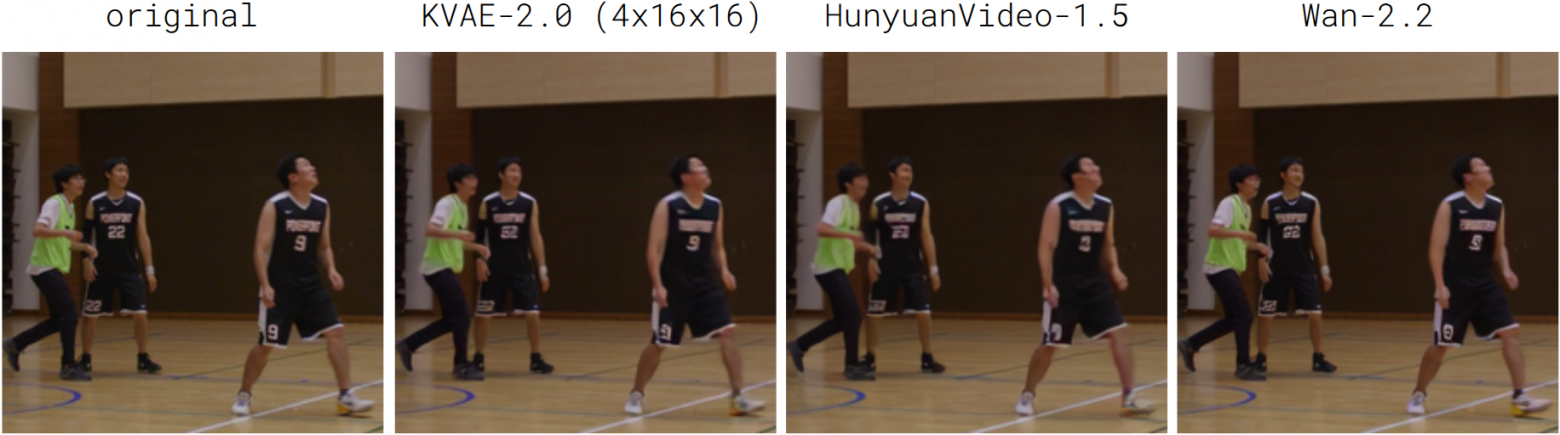
Reconstruction was evaluated on MCL-JCV at 720p and BVI-DVC. The compact table below reports MCL-JCV; all compared models use 4 x 16 x 16 compression. HunyuanVideo 1.5 uses tiling with its default parameters because of its full attention block.
| Model | PSNR↑ | SSIM↑ | LPIPS↓ |
|---|---|---|---|
| HunyuanVideo 1.5 | 34.4 | 0.89 | 0.073 |
| Wan 2.2 | 34.2 | 0.89 | 0.037 |
| KVAE-Video 2.0 t4s16 | 35.4 | 0.91 | 0.048 |
The latent spaces of KVAE-Video 2.0 t4s16 and HunyuanVideo 1.5 were also compared through side-by-side human evaluation under a fixed generative-model setup. Against HunyuanVideo 1.5, KVAE-Video 2.0 t4s16 achieved reported win rates of 56% for prompt adherence, 54% for visual quality, and 55% for semantic quality.
Columns from left to right: original video, KVAE-Video 2.0 t4s16, HunyuanVideo 1.5, and Wan 2.2.

@misc{kvae2026,
  title         = {KVAE: Family of Tokenizers for Multimodal Generative Models},
  author        = {Andrey Shutkin, Denis Parkhomenko, Ivan Kirillov,
                   Kirill Chernyshev, Kirill Malakhov, Ilia Vasiliev,
                   Ilia Trushkin, Valeriya Kobenko, David Chikovani,
                   Alexander Ivanov, Azat Saginbaev, Egor Silvestrov,
                   Ivan Mikheev, Konstantin Zakharov},
  year          = {2026},
  eprint        = {2608.05798},
  archivePrefix = {arXiv},
  primaryClass  = {cs.CV},
  url           = {https://arxiv.org/abs/2608.05798}
}