


FrameLite: Decision-Oriented Aesthetic Cropping with a Compact Vision-Language Model
Paper • 2610.17639 • Published
New official model repository: zlab-sjtu/FrameLite. Please use this repository for model downloads and updates. This location remains available for existing links.
Jianze Li1, Kai Liu1, Ziqing Zhang1, Weihang Zhang2,
Yong Guo1, Linghe Kong1, Yulun Zhang1,†
1 Shanghai Jiao Tong University
2 Institute of Media Technology and Experience Design, Huawei
† Corresponding author
Code · Paper · Demo · Supplementary Material

Aesthetic image cropping improves composition by balancing subjects, context, and image boundaries. Large vision–language models bring semantic knowledge to this task, but their scale limits lightweight photography assistance. We propose FrameLite, a compact cropping model built on Qwen3.5-0.8B. Our approach is motivated by the observation that a small model can generate better crops than its first answer suggests. We develop three-stage training to turn this potential into stronger direct predictions. Spatial and composition training establishes localization and framing preferences. Quality-Guided Online Supervision (QOS) then learns the highest-quality complete answers among the current policy's generated candidates. Greedy-Referenced Optimization (GRO) further refines the policy using positive and negative quality differences relative to its current greedy answer. Both online stages use annotation-derived feedback, while inference returns one coordinate answer without search or an external scorer. Experiments show that FrameLite outperforms the compared large-VLM croppers across public benchmarks with a substantially smaller backbone. Controlled studies confirm that selecting high-quality training answers improves the final model beyond online sampling alone.
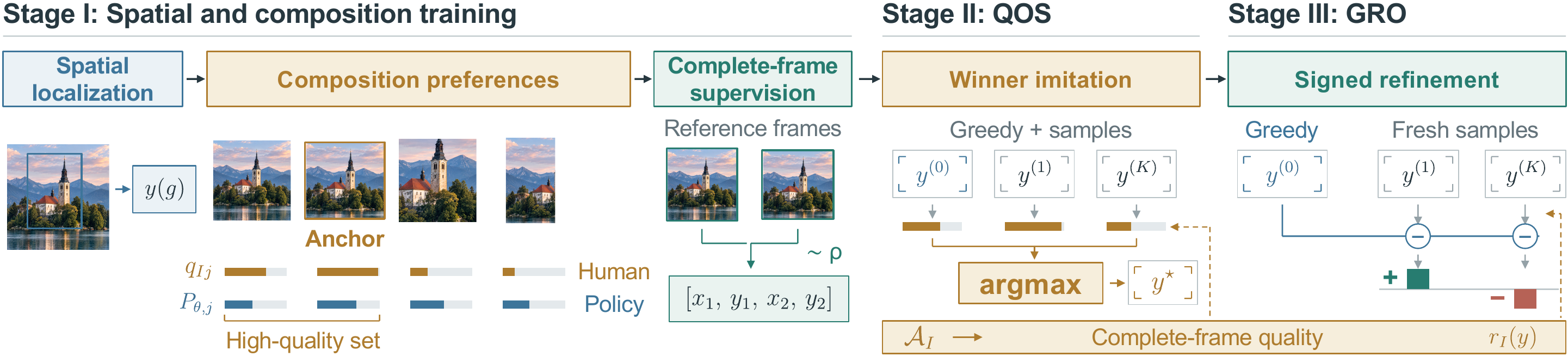
At inference, FrameLite directly predicts one normalized crop through greedy decoding. No candidate search, external scorer, retrieval database, or external API is needed.
| Model | Backbone | Weights |
|---|---|---|
| FrameLite | Qwen3.5-0.8B | 224 MB |
The FrameLite checkpoint contains the learned language LoRA and vision merger.
Download Qwen3.5-0.8B separately and
load both with the FrameLite API below.
Use Python 3.10 and a CUDA GPU with BF16 support.
git clone https://github.com/JianzeLi-114/FrameLite.git
cd FrameLite

python3.10 -m venv .venv
source .venv/bin/activate
python -m pip install --upgrade pip
python -m pip install torch==2.6.0 torchvision==0.21.0 \
  --index-url https://download.pytorch.org/whl/cu124
python -m pip install -r requirements.txt
Download the FrameLite weights and the Qwen backbone:
from huggingface_hub import snapshot_download

snapshot_download(
    repo_id="zlab-sjtu/FrameLite",
    local_dir="weights/framelite",
    allow_patterns=[
        "framelite.safetensors",
        "inference_config.json",
        "LICENSE",
        "NOTICE",
    ],
)

snapshot_download(
    repo_id="Qwen/Qwen3.5-0.8B",
    local_dir="weights/framelite/base",
)
The two downloads place the FrameLite checkpoint and Qwen backbone under weights/framelite/.
python infer.py \
  --image assets/examples/mountain_reflection/input.jpg \
  --weights weights/framelite \
  --output-dir outputs \
  --device cuda:0
The CLI saves predictions to outputs/predictions.jsonl and valid crops to outputs/crops/. To process a directory, pass its path to --image; add --recursive to include subdirectories.
from framelite import FrameLite, crop_image

model = FrameLite.from_pretrained("weights/framelite", device="cuda:0")
image_path = "path/to/image.jpg"
result = model.predict(image_path)

if result["valid"]:
    print(result["bbox_normalized"])  # [x1, y1, x2, y2] in [0, 1]
    crop_image(image_path, result["bbox_normalized"]).save("crop.png")
else:
    print(result["error"])
Coordinates refer to the original image, with the origin at its top-left corner. The model returns a single crop, for example {"crop":[0.1,0.05,0.9,0.95]}. This JSON illustrates the output format.
The following results are reported in the paper. The same final model produces one crop per image on all three benchmarks.
| GAICv2 Acc .85 ↑ | GAICv2 Acc .90 ↑ | FLMS IoU ↑ | FLMS BDE ↓ | FCDB IoU ↑ | FCDB BDE ↓ |
|---|---|---|---|---|---|
| 0.9140 | 0.8340 | 0.8679 | 0.0297 | 0.7124 | 0.0704 |
Acc denotes GAICv2 Acc1/5 at the specified IoU threshold. See the paper for the evaluation protocol and the supplementary material for additional analyses.
@article{li2026framelite,
  title={FrameLite: Decision-Oriented Aesthetic Cropping with a Compact Vision--Language Model},
  author={Li, Jianze and Liu, Kai and Zhang, Ziqing and Zhang, Weihang and Guo, Yong and Kong, Linghe and Zhang, Yulun},
  journal={arXiv preprint arXiv:2610.17639},
  year={2026}
}
FrameLite task weights and inference code are provided under the Apache License 2.0. The separately downloaded Qwen3.5-0.8B backbone is distributed by Qwen under the Apache License 2.0; see NOTICE and the upstream model card.
We thank the developers of Qwen, Transformers, and PEFT.
Correspondence: Yulun Zhang.