---
license: apache-2.0
library_name: timm
pipeline_tag: image-feature-extraction
tags:
- image-feature-extraction
- timm
- vision
- medical
- pathology
- histopathology
- whole-slide-image
---
# Prov-GigaPath-Flash
## A lightweight whole-slide foundation model for digital pathology
[[`Code`](https://github.com/prov-gigapath/prov-gigapath)] [[`Paper`](https://arxiv.org/abs/2607.18218)] [[`BibTeX`](#citation)]
Prov-GigaPath-Flash is a lightweight variant of [Prov-GigaPath](https://huggingface.co/prov-gigapath/prov-gigapath),
designed for faster and more memory-efficient tile- and slide-level inference and
finetuning while retaining the same two-stage GigaPath design.
## Model Family
| Model | Description | Paper | License |
| :----------------------------------------------------------------------------- | :----------------------------------------------- | :---------------------------------------------------------: | :--------: |
| [**GigaPath**](https://huggingface.co/prov-gigapath/prov-gigapath) | Whole-slide foundation model | [Nature (2024)](https://doi.org/10.1038/s41586-024-07441-w) | Apache-2.0 |
| [**GigaPath-Flash**](https://huggingface.co/prov-gigapath/prov-gigapath-flash) | Efficient whole-slide foundation model | [arXiv (2026)](https://arxiv.org/abs/2607.18218) | Apache-2.0 |
| [**GigaTIME**](https://huggingface.co/prov-gigatime/GigaTIME) | Spatial proteomics prediction from H&E | [Cell (2026)](https://doi.org/10.1016/j.cell.2025.11.016) | Apache-2.0 |
| [**GigaTIME-Flash**](https://huggingface.co/prov-gigatime/gigatime-flash) | Efficient spatial proteomics prediction from H&E | [arXiv (2026)](https://arxiv.org/abs/2607.18218) | Apache-2.0 |
## Model Overview
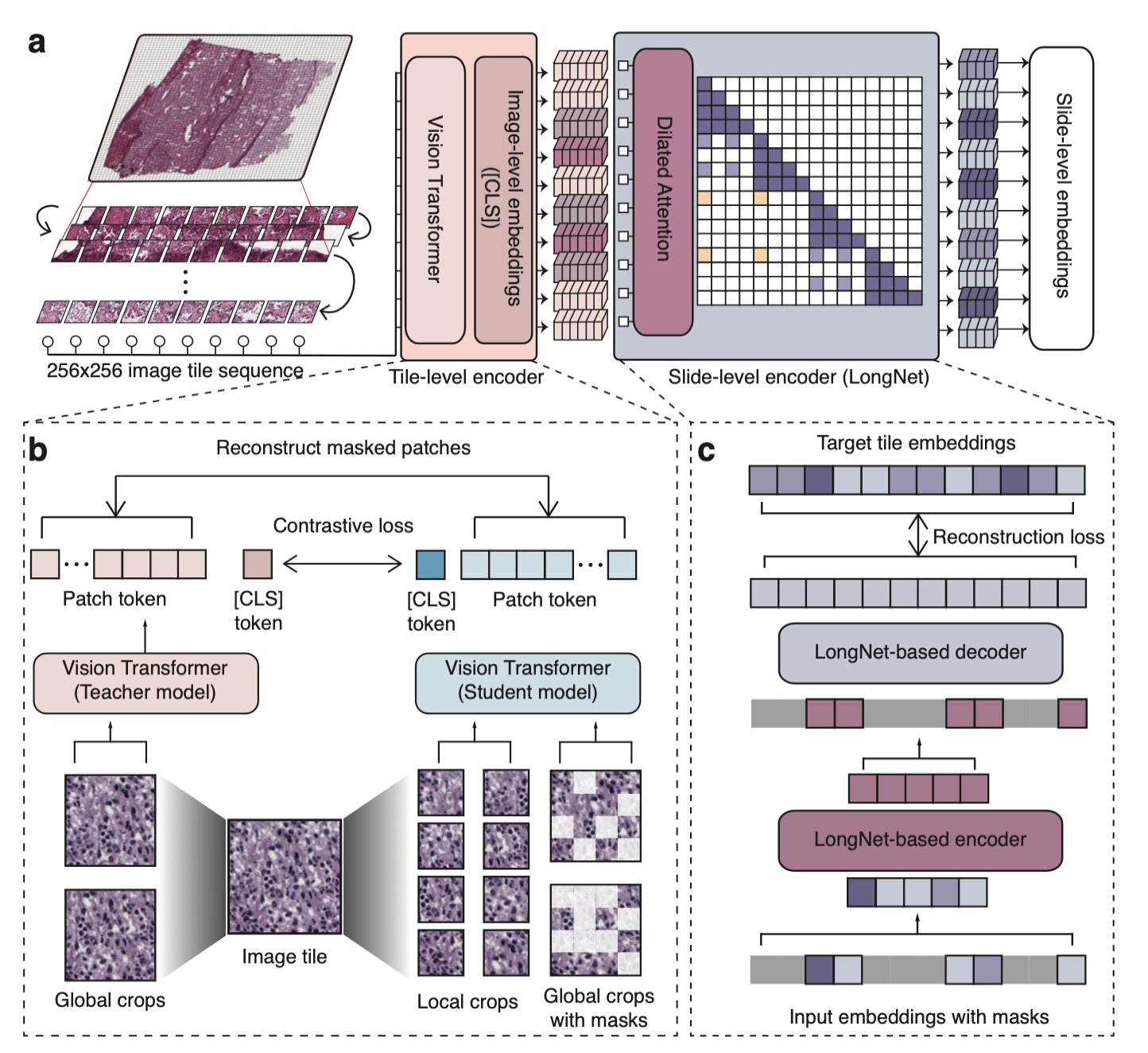
*Overview of the GigaPath model architecture. Prov-GigaPath-Flash follows the same tile-encoder + slide-encoder design with lighter backbones.*
Like Prov-GigaPath, the model consists of a **tile encoder**, which extracts local
patterns at the patch (tile) level, and a **slide encoder**, which aggregates tile
embeddings into a slide-level representation.
| Component | Architecture | Embedding dim | Params |
| --- | --- | --- | --- |
| Tile encoder | DINOv2-small ViT-S/16 (SwiGLU, LayerScale) | 384 | ~22M |
| Slide encoder | LongNet, 12 layers | 384 | ~21M |
Compared to Prov-GigaPath (ViT-giant tile encoder + 12L/768d slide encoder over
1536-dim tile embeddings), both the tile-embedding dimension and the slide encoder
hidden dimension are 384.
## Repository Contents
Following the original Prov-GigaPath packaging:
- `config.json` + `pytorch_model.bin` — tile encoder (timm format)
- `slide_encoder.pth` — slide encoder (`{"model": ...}`, encoder weights only)
## Install
Loading requires the [Prov-GigaPath code](https://github.com/prov-gigapath/prov-gigapath),
which registers the GigaPath-Flash architectures (`gigapath_tile_enc_dinov2s` and
`gigapath_slide_enc12l384d`).
```Shell
git clone https://github.com/prov-gigapath/prov-gigapath
cd prov-gigapath
conda env create -f environment.yaml
conda activate gigapath
pip install -e .
```
## Model Download
Set your HuggingFace read-only token as an environment variable to access the weights:
```Shell
export HF_TOKEN=
```
## Inference
The model consists of a tile encoder, that extracts local patterns at patch level,
and a slide encoder, that outputs representations at slide level. When doing
inference at the slide level, we recommend following this pipeline: (1) Tile the
whole slide into N image tiles, with the coordinates of each tile. (2) Get the
embeddings for each tile using the tile encoder. (3) Pass the N image tile
embeddings and their coordinates into the slide encoder, to get slide-level
representations.
### Inference with the tile encoder
```Python
from PIL import Image
from torchvision import transforms
import torch
import gigapath.tile_encoder as tile_encoder # registers gigapath_tile_enc_dinov2s
tile_enc = tile_encoder.create_model("hf_hub:prov-gigapath/prov-gigapath-flash")
transform = transforms.Compose(
[
transforms.Resize(256, interpolation=transforms.InterpolationMode.BICUBIC),
transforms.CenterCrop(224),
transforms.ToTensor(),
transforms.Normalize(mean=(0.485, 0.456, 0.406), std=(0.229, 0.224, 0.225)),
]
)
sample_input = transform(Image.open("images/prov_normal_000_1.png").convert("RGB")).unsqueeze(0)
tile_enc.eval()
with torch.no_grad():
output = tile_enc(sample_input).squeeze() # 384-dim tile embedding
```
### Inference with the slide encoder
To run inference with the slide encoder, provide both the tile embeddings and their
coordinates:
```Python
import gigapath.slide_encoder as slide_encoder
slide_enc = slide_encoder.create_model(
"hf_hub:prov-gigapath/prov-gigapath-flash", "gigapath_slide_enc12l384d", 384
)
slide_enc.eval()
with torch.no_grad():
output = slide_enc(tile_embed, coordinates).squeeze() # slide-level embedding
```
**Note** Older versions of timm have compatibility issues. Please ensure you use a
newer version: `pip install timm>=1.0.3`.
## Model Uses
### Intended Use
The data, code, and model checkpoints are intended to be used solely for (I) future
research on pathology foundation models and (II) reproducibility of the experimental
results reported in the reference paper. The data, code, and model checkpoints are
not intended to be used in clinical care or for any clinical decision-making purposes.
### Primary Intended Use
The primary intended use is to support AI researchers reproducing and building on
top of this work. GigaPath should be helpful for exploring pre-training, and
encoding of digital pathology slides data.
### Out-of-Scope Use
**Any** deployed use case of the model --- commercial or otherwise --- is out of
scope. Although we evaluated the models using a broad set of publicly-available
research benchmarks, the models and evaluations are intended *for research use only*
and not intended for deployed use cases.
## Usage and License Notices
The model is not intended or made available for clinical use as a medical device,
clinical support, diagnostic tool, or other technology intended to be used in the
diagnosis, cure, mitigation, treatment, or prevention of disease or other conditions.
The model is not designed or intended to be a substitute for professional medical
advice, diagnosis, treatment, or judgment and should not be used as such. All users
are responsible for reviewing the output of the developed model to determine whether
the model meets the user’s needs and for validating and evaluating the model before
any clinical use.
## Acknowledgements
We would like to express our gratitude to the authors and developers of the
exceptional repositories that this project is built upon: DINOv2, MAE, Timm, and
TorchScale. Their contributions have been invaluable to our work.
## Citation
If you find this model useful for your research and applications, please cite using
this BibTeX:
```bibtex
@article{usuyama2026gigapathflash,
title={{GigaPath-Flash} and {GigaTIME-Flash}: Efficient Pathology Foundation Models for Whole-Slide and Tumor Microenvironment Analysis},
author={Usuyama, Naoto and Valanarasu, Jeya Maria Jose and Yao, Sicong and Xu, Hanwen and Bagga, Jaspreet and Qin, Guanghui and Kramer, Robert E. and Wong, Cliff and Lee, Soohee and Qiu, Hao and Zhao, Theodore Zhengde and Ben Shimol, Racheli and Crabtree, Angela and Matlock, Kevin and Lozano Garcia, Eduardo Alejandro and Sangani, Naiteek and Santamaria-Pang, Alberto and Rokuss, Maximilian and Hasija, Yashna and Patel, Naisargi Manishkumar and Entenmann, Jason and Bartlett, Alexandra Q. and Wright, Bill J. and Fox, Bernard A. and Piening, Brian and Zhang, Sheng and Wang, Sheng and Naumann, Tristan and Bifulco, Carlo and Poon, Hoifung},
journal={arXiv preprint arXiv:2607.18218},
year={2026},
doi={10.48550/arXiv.2607.18218},
url={https://arxiv.org/abs/2607.18218}
}
@article{xu2024gigapath,
title={A whole-slide foundation model for digital pathology from real-world data},
author={Xu, Hanwen and Usuyama, Naoto and Bagga, Jaspreet and Zhang, Sheng and Rao, Rajesh and Naumann, Tristan and Wong, Cliff and Gero, Zelalem and González, Javier and Gu, Yu and Xu, Yanbo and Wei, Mu and Wang, Wenhui and Ma, Shuming and Wei, Furu and Yang, Jianwei and Li, Chunyuan and Gao, Jianfeng and Rosemon, Jaylen and Bower, Tucker and Lee, Soohee and Weerasinghe, Roshanthi and Wright, Bill J. and Robicsek, Ari and Piening, Brian and Bifulco, Carlo and Wang, Sheng and Poon, Hoifung},
journal={Nature},
year={2024},
publisher={Nature Publishing Group UK London}
}
```