

DLSA
Official implementation of DLSA: Dual-Level Semantic Alignment with Adaptive Multi-Scale Modeling for Referring Remote Sensing Image Segmentation, accepted to EMNLP 2026.
News
- August 2026: DLSA was accepted to EMNLP 2026.
- Source code is available in the GitHub repository, and trained models are available in this repository.
Models
We provide final checkpoints trained on RefSegRS and RRSIS-D through our Hugging Face model repository.
| Dataset | Checkpoint | SHA-256 |
|---|---|---|
| RefSegRS | DLSA-RefSegRS | a4cfa5d0e5ee338643c56027b6737b8919c1a3d5739fe61755dce7dd3081ac18 |
| RRSIS-D | DLSA-RRSISD | f6c9e514e18e602fc058706b7f0243c2c42ef68e1a37a27f5c0c777e09a84047 |
Place downloaded checkpoints under checkpoints/ as
dlsa_refsegrs.pth and dlsa_rrsisd.pth. The public checkpoints contain the
model parameters and configuration required for evaluation; optimizer states
are intentionally omitted.
Framework
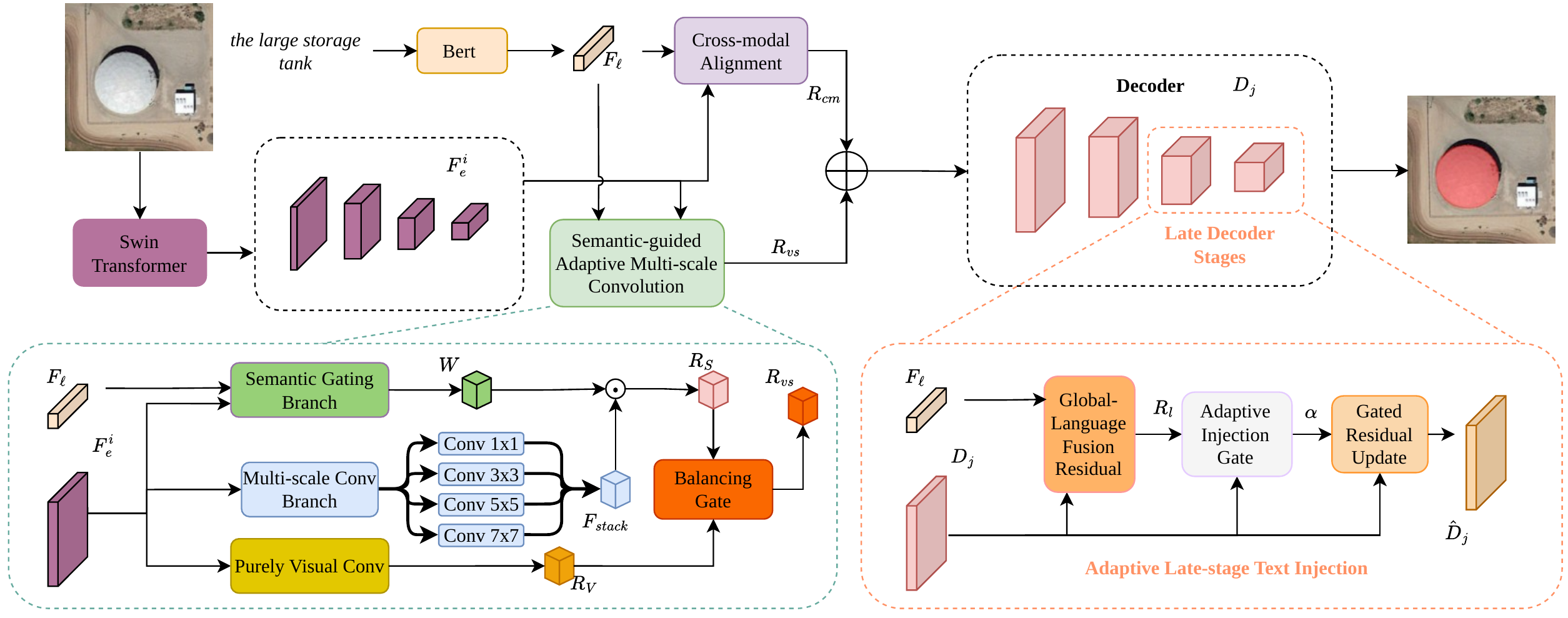
DLSA performs semantic alignment at both the multi-scale visual encoding and
mask decoding stages. The implementation is organized around the SgAMC
modules in sgamc/ and the adaptive language-guided decoder modules in
alti/.
Installation
The reference environment uses Python 3.7, PyTorch 1.13.1, torchvision 0.14.1, and CUDA 11.7.
conda env create -f environment.yml
conda activate dlsa
Alternatively, create a Python 3.7 environment, install PyTorch 1.13.1 with
CUDA 11.7, and then run pip install -r requirements.txt.
Preparation
Datasets
Download RefSegRS and RRSIS-D from their official project pages. This repository does not redistribute either dataset. Arrange them as follows:
datasets/
|-- RefSegRS/
|   |-- images/
|   |-- masks/
|   |-- output_phrase_train.txt
|   |-- output_phrase_val.txt
|   `-- output_phrase_test.txt
`-- RRSIS-D/
    |-- rrsisd/
    |   |-- refs(unc).p
    |   `-- instances.json
    `-- images/
        `-- rrsisd/
            `-- JPEGImages/
The data roots can be changed through the DATA_ROOT environment variable
in every provided script.
Initial Weights
Download the BERT-base-uncased files from the
official BERT project to
bert-base-uncased/. Download the Swin Transformer base checkpoint from the
official Swin Transformer project
and place it at:
pretrained_weights/swin_base_patch4_window12_384_22k.pth
The supplied DLSA checkpoints are sufficient for evaluation.
Training and Inference
Clone the GitHub repository, then train DLSA with:
bash scripts/run_refsegrs_pipeline.sh
bash scripts/run_rrsisd_pipeline.sh
Evaluate the released checkpoints:
bash scripts/test_refsegrs.sh
bash scripts/test_rrsisd.sh
Use SPLIT=val to evaluate the validation split. GPU IDs and paths can be
overridden without editing the scripts, for example:
GPU=1 SPLIT=val CHECKPOINT=/path/to/model.pth \
  DATA_ROOT=/path/to/RefSegRS bash scripts/test_refsegrs.sh
Acknowledgements
This code is built on RMSIN. We thank the authors for making their work publicly available.
Citation
The final BibTeX entry will be added after the EMNLP 2026 proceedings are published.
License
This repository is released under the GNU General Public License v3.0. See
LICENSE and THIRD_PARTY.md for details.