

llama-3-8b-instruct-262k-chinese
llama-3-8b-instruct-262k-chinese基于Llama-3-8B-Instruct-262k,使用ORPO方法,在中英文偏好数据集shibing624/DPO-En-Zh-20k-Preference 上微调得到的对话模型。
模型的部署、训练等方法详见MedicalGPT的GitHub仓库:https://github.com/shibing624/MedicalGPT
Relate models
- 完整模型权重:https://huggingface.co/shibing624/llama-3-8b-instruct-262k-chinese
- lora权重:https://huggingface.co/shibing624/llama-3-8b-instruct-262k-chinese-lora
Features
模型优势:
- 支持超长context length 262k token,适合RAG
- 支持中英文
- 支持多轮对话,代码编码、推理能力强,英文知识充分
- 模型推理需要显存:
| Quantization | Peak Usage for Encoding 2048 Tokens | Peak Usage for Generating 8192 Tokens |
|---|---|---|
| FP16/BF16 | 18.66GB | 24.58GB |
| Int4 | 9.21GB | 14.62GB |
缺点:
- model size只有8B,知识类问答幻觉明显
- 中文知识欠缺,容易幻觉,特别是中文古文知识,属于llama类模型通病
如何使用
import transformers
import torch

model_id = "shibing624/llama-3-8b-instruct-262k-chinese"
pipeline = transformers.pipeline(
    "text-generation",
    model=model_id,
    model_kwargs={"torch_dtype": torch.float16},
    device="cuda",
)

messages = [{"role": "system", "content": ""}]
messages.append({"role": "user", "content": "介绍一下机器学习"})
prompt = pipeline.tokenizer.apply_chat_template(
        messages,
        tokenize=False,
        add_generation_prompt=True
    )
terminators = [
        pipeline.tokenizer.eos_token_id,
        pipeline.tokenizer.convert_tokens_to_ids("<|eot_id|>")
    ]
outputs = pipeline(
    prompt,
    max_new_tokens=512,
    eos_token_id=terminators,
    do_sample=True,
    temperature=0.6,
    top_p=0.9
)
content = outputs[0]["generated_text"][len(prompt):]
print(content)
result:
机器学习(Machine Learning)是一种基于计算机算法的自动数据分析技术,用于从数据中学习并预测未来的结果。它是人工智能(AI)和数据挖掘(Data Mining)的子领域,旨在通过训练和调整算法来发现数据中的模式、关系和规律。

机器学习算法可以分为监督学习、无监督学习和半监督学习三类:

1. 监督学习(Supervised Learning):在这种类型的学习中,算法被提供带有标签的数据集,用于训练。算法学习如何将输入数据映射到输出数据,并在新数据上进行预测。常见的监督学习算法包括逻辑回归、决策树、支持向量机(SVM)、随机森林和神经网络。
2. 无监督学习(Unsupervised Learning):在这种类型的学习中,算法没有标签数据。算法学习数据中的模式、结构和关系,并可能发现新的数据集群或特征。常见的无监督学习算法包括聚类、主成分分析(PCA)、独立成分分析(ICA)和高维度数据降维。
3. 半监督学习(Semi-supervised Learning):在这种类型的学习中,算法被提供部分带有标签的数据集。算法学习如何将输入数据映射到输出数据,并在新数据上进行预测。半监督学习算法结合了监督学习和无监督学习的优点,常见的半监督学习算法包括自我标注(Self-Labeling)和基于图的半监督学习(Graph-based Semi-supervised Learning)。

机器学习的应用广泛,包括自然语言处理、计算机视觉、推荐系统、人工智能和自动驾驶等领域。它的优势包括:

1. 自动化:机器学习算法可以自动从数据中发现模式和关系,无需人为干预。
2. 高效性:机器学习算法可以处理大量数据,并且可以在不需要人为干预的情况下进行预测。
3. 适应性:机器学习算法可以根据数据集的变化和更新进行调整。
4. 精准性:机器学习算法可以通过训练和测试来提高预测的准确性。
train detail
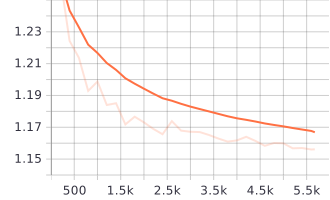
train loss:
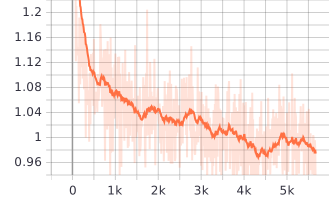
eval loss:
About Llama-3-8B-Instruct-262k
Gradient incorporates your data to deploy autonomous assistants that power critical operations across your business. To learn more or collaborate on a custom model.
This model extends LLama-3 8B's context length from 8k to -> 160K, developed by Gradient, sponsored by compute from Crusoe Energy. It demonstrates that SOTA LLMs can learn to operate on long context with minimal training (< 200M tokens) by appropriately adjusting RoPE theta.

Approach:
- meta-llama/Meta-Llama-3-8B-Instruct as the base
- NTK-aware interpolation [1] to initialize an optimal schedule for RoPE theta, followed by a new data-driven RoPE theta optimization technique
- Progressive training on increasing context lengths similar to the Large World Model [2] (See details below)
Infra:
We build on top of the EasyContext Blockwise RingAttention library [3] to scalably and efficiently train on contexts up to 262144 tokens on Crusoe Energy high performance L40S cluster.
Data:
For training data, we generate long contexts by augmenting SlimPajama.
Progressive Training Details:
| Parameter | 65K | 262K |
|---|---|---|
| Initialize From | LLaMA-3-8B-Inst | 65K |
| Sequence Length | 2^16 | 2^18 |
| RoPE theta | 15.3 M | 207.1 M |
| Batch Size (Tokens / Step) | 2.097 M | 4.192 M |
| Steps | 30 | 24 |
| Total Tokens | 63 M | 101 M |
| Learning Rate | 2.00E-05 | 2.00E-05 |
| # GPUs | 32 | 32 |
| GPU Type | NVIDIA L40S | NVIDIA L40S |
- Downloads last month
- 44