
Spaces:
Running on Zero

A newer version of the Gradio SDK is available: 6.29.1
title: GeoNeXt
emoji: 🌐
colorFrom: indigo
colorTo: purple
sdk: gradio
sdk_version: 4.44.1
python_version: '3.10'
app_file: app.py
pinned: false
license: apache-2.0
GeoNeXt
Video Generative Models as Geometry Learner
Video Generative Models as Geometry Learner
Haosen Yang, Jifei Song, Zhensong Zhang, Xiatian Zhu*, Jiankang Deng*
ECCV 2026
This repository is the official implementation of "Video Generative Models as Geometry Learner".
Demo
https://github.com/user-attachments/assets/f07bffc9-1ad5-4d4d-82e4-ea2411397eff
Updates
2026/08/31: Inference code released.
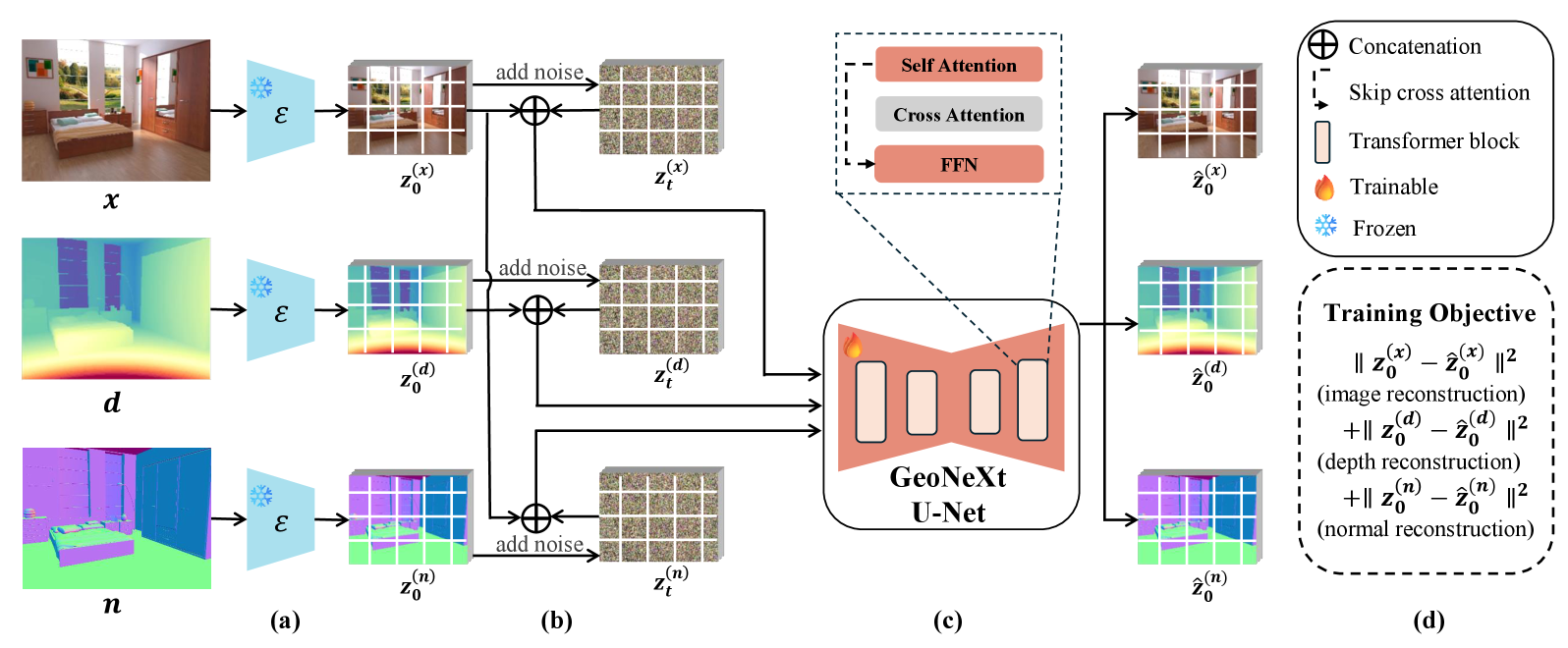
Framework
Requirements
- Linux
- Python ≥ 3.10
- CUDA GPU with 24 GB VRAM (sufficient for inference)
Note: GeoNeXt-Wan and GeoNeXt-SVD should be installed in separate environments.
GeoNeXt-SVD
conda create -n geonext_svd python=3.10 -y
conda activate geonext_svd

git clone https://github.com/Creative-Intelligence-Studio/GeoNeXt.git
cd GeoNeXt
python -m pip install torch==2.3.1 torchvision==0.18.1 \
  --index-url https://download.pytorch.org/whl/cu121
python -m pip install -r requirements-svd.txt
python -m pip install -e .
GeoNeXt-Wan
GeoNeXt includes the tested DiffSynth inference implementation under
diffsynth/; no separate DiffSynth checkout is required.
conda create -n geonext_wan python=3.10 -y
conda activate geonext_wan

git clone https://github.com/Creative-Intelligence-Studio/GeoNeXt.git
cd GeoNeXt
python -m pip install torch==2.3.1 torchvision==0.18.1 \
  --index-url https://download.pytorch.org/whl/cu121
python -m pip install -r requirements-wan.txt
python -m pip install -e .
The tested Wan dependency stack uses Diffusers 0.28.0, Transformers 4.40.1, PEFT 0.7.0, and Accelerate 0.29.3. Avoid upgrading these packages independently.
🤗 Pretrained Models
Our pretrained models are available on the Hugging Face Hub:
| Version | Hugging Face Model | Depth | Normal | #Params |
|---|---|---|---|---|
| GeoNeXt-Wan | happy0612/GeoNeXt-Wan | ✅ | ✅ | 1.42B |
| GeoNeXt-SVD | happy0612/GeoNeXt-SVD | ✅ | ✅ | 1.52B |
The selected GeoNeXt checkpoint, base model, and VAE are downloaded automatically on the first inference run and then reused from the Hugging Face cache.
To download both GeoNeXt checkpoints manually instead:
hf download happy0612/GeoNeXt --local-dir checkpoints
Local model paths can still be supplied with --checkpoint, --base-model,
and --vae-model for offline use.
Inference
The --input argument accepts either one image or a directory. Supported image
formats are JPEG, PNG, WebP, and BMP.
GeoNeXt-Wan
conda activate geonext_wan

python inference.py \
  --input assets/input \
  --output outputs/wan \
  --steps 5
GeoNeXt-SVD
conda activate geonext_svd

python inference.py \
  --backend svd \
  --input assets/input \
  --output outputs/svd \
  --steps 5
Run python inference.py --help for all shared options.
Mesh export is optional and is enabled only when --export mesh is provided.
Exported meshes use MoGe alignment by default. Use --align-space relative
explicitly to export a mesh without MoGe.
Outputs
Both backends write the same directory structure:
outputs/<backend>/
├── depth_raw/         # Normalized disparity in [0, 1] (.npy)
├── depth_vis/         # Colorized depth maps (.png)
├── normal_raw/        # Surface normals in [-1, 1] (.npy)
├── normal_vis/        # RGB normal visualizations (.png)
└── geometry/<image>/  # Optional depth, intrinsics, and mesh files
Metric-scale alignment
Mesh export uses metric-space MoGe alignment by default. Activate the corresponding backend environment and install the pinned MoGe-2 integration once:
./scripts/setup_moge.sh third_party/MoGe
The setup script reuses the active environment's tested PyTorch installation and does not modify its PyTorch, CUDA, Transformers, Diffusers, or NCCL packages. Then export an aligned mesh with:
python inference.py \
  --backend wan \
  --input assets/input/case1.jpg \
  --output outputs/wan-moge \
  --export mesh
To export relative geometry without installing MoGe, add
--align-space relative.
Web viewer
After exporting a mesh, start the viewer with:
python -m http.server 8000
Open http://localhost:8000/viewer/ and select the exported .ply file.
Citation
If GeoNeXt contributes to your work, please cite our paper:
@article{geonext2026,
  title   = {Video Generative Models as Geometry Learner},
  author  = {Yang, Haosen and Song, Jifei and Zhang, Zhensong and Zhu, Xiatian and Deng, Jiankang},
  journal = {arXiv preprint arXiv:2608.28549},
  year    = {2026}
}
Acknowledgements
This release builds on Wan, Stable Video Diffusion, Hugging Face Diffusers, DiffSynth, MoGe, and Trimesh. Please also follow the licenses and citation requirements of those projects. See NOTICE.md for third-party notices.