

File size: 11,971 Bytes
317f4c4 e25ed7e 317f4c4 928366e cec8dd9 317f4c4 f073b9e 317f4c4 e25ed7e 317f4c4 | 1 2 3 4 5 6 7 8 9 10 11 12 13 14 15 16 17 18 19 20 21 22 23 24 25 26 27 28 29 30 31 32 33 34 35 36 37 38 39 40 41 42 43 44 45 46 47 48 49 50 51 52 53 54 55 56 57 58 59 60 61 62 63 64 65 66 67 68 69 70 71 72 73 74 75 76 77 78 79 80 81 82 83 84 85 86 87 88 89 90 91 92 93 94 95 96 97 98 99 100 101 102 103 104 105 106 107 108 109 110 111 112 113 114 115 116 117 118 119 120 121 122 123 124 125 126 127 128 129 130 131 132 133 134 135 136 137 138 139 140 141 142 143 144 145 146 147 148 149 150 151 152 153 154 155 156 157 158 159 160 161 162 163 164 165 166 167 168 169 170 171 172 173 174 175 176 177 178 179 180 181 182 183 184 185 186 187 188 189 190 191 192 193 194 195 196 197 198 199 200 201 202 203 204 205 206 207 208 209 210 211 212 213 214 215 216 217 218 219 220 221 222 223 224 225 226 227 228 229 230 231 232 233 234 235 236 237 238 239 240 241 242 243 244 245 246 247 248 249 250 251 252 253 254 255 256 257 258 259 260 261 262 263 264 265 266 267 268 269 270 271 272 273 274 275 276 277 278 279 280 281 282 283 284 285 286 | ---
license: gemma
pipeline_tag: text-generation
---
**Typhoon2.1-Gemma3-12B**: Thai Large Language Model (Instruct)
**Typhoon2.1-Gemma3-12B** is a instruct Thai 🇹🇭 large language model with 12 billion parameters, a 128K context length, and function-calling capabilities. It is based on Gemma3 12B.
By using this model, you agree to the OpenTyphoon Terms and Conditions and acknowledge the Privacy Notice: https://opentyphoon.ai/tac · https://opentyphoon.ai/privacy
Remark: This is text only model. We removed vision encoder for this version due to complexity. Stay-tune for version with vision encoder soon.
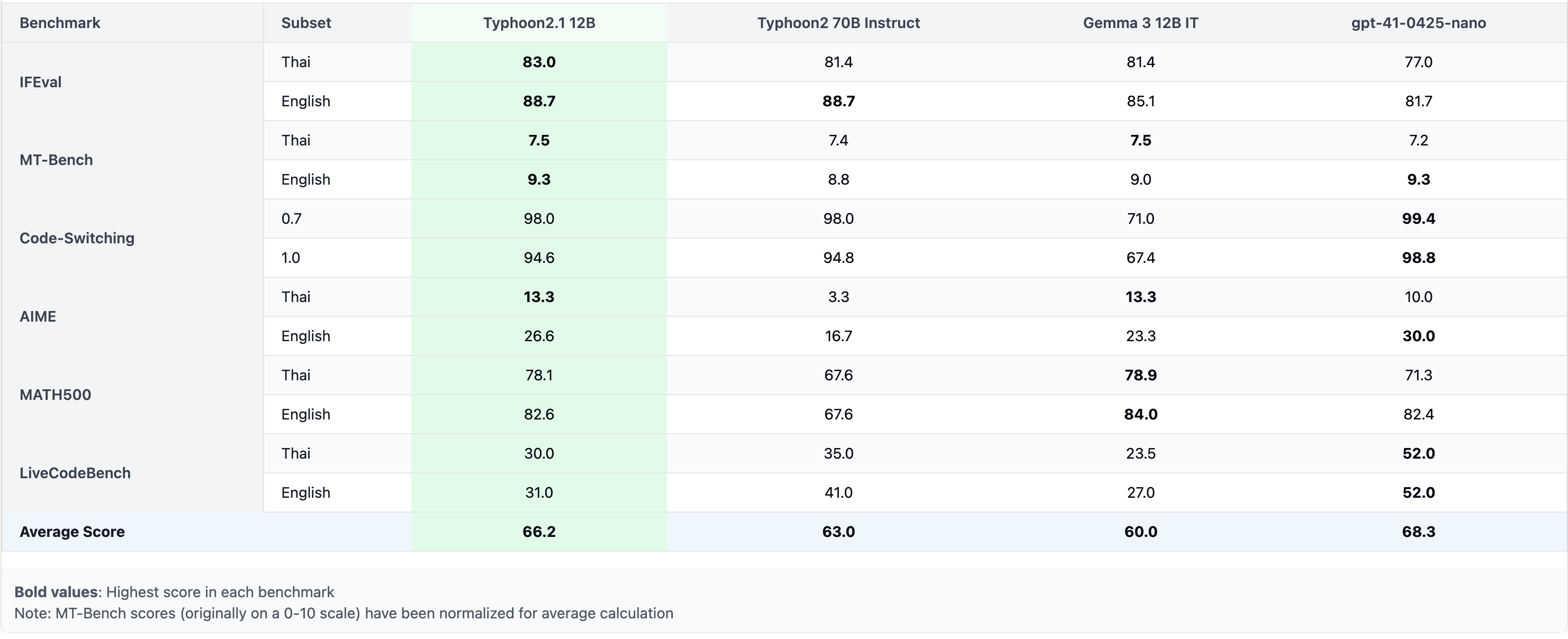
## **Performance**
## **Model Description**
- **Model type**: A 12B instruct decoder-only model based on Gemma3 architecture.
- **Requirement**: transformers 4.50.0 or newer.
- **Primary Language(s)**: Thai 🇹🇭 and English 🇬🇧
- **Context Length**: 128K
- **License**: [Gemma License](https://github.com/google-deepmind/gemma/blob/main/LICENSE)
## Usage Example
This code snippet shows how to use the Typhoon2.1-Gemma3-12B model for Thai or English text generation using the transformers library. It includes setting up the model and tokenizer, formatting chat messages in a system-user style, and generating a response.
```python
from transformers import AutoTokenizer, AutoModelForCausalLM
import torch
model_id = "scb10x/typhoon2.1-gemma3-12b"
tokenizer = AutoTokenizer.from_pretrained(model_id)
model = AutoModelForCausalLM.from_pretrained(
model_id,
torch_dtype=torch.bfloat16,
device_map="auto",
)
messages = [
{"role": "system", "content": "You are a male AI assistant named Typhoon created by SCB 10X to be helpful, harmless, and honest. Typhoon is happy to help with analysis, question answering, math, coding, creative writing, teaching, role-play, general discussion, and all sorts of other tasks. Typhoon responds directly to all human messages without unnecessary affirmations or filler phrases like “Certainly!”, “Of course!”, “Absolutely!”, “Great!”, “Sure!”, etc. Specifically, Typhoon avoids starting responses with the word “Certainly” in any way. Typhoon follows this information in all languages, and always responds to the user in the language they use or request. Typhoon is now being connected with a human. Write in fluid, conversational prose, Show genuine interest in understanding requests, Express appropriate emotions and empathy. Also showing information in term that is easy to understand and visualized."},
{"role": "user", "content": "ขอสูตรไก่ย่าง"},
]
input_ids = tokenizer.apply_chat_template(
messages,
add_generation_prompt=True,
return_tensors="pt",
enable_thinking=False # Switches between thinking and non-thinking modes. Default is False.
).to(model.device)
outputs = model.generate(
input_ids,
max_new_tokens=512,
do_sample=True,
temperature=0.6,
top_p=0.95,
)
response = outputs[0][input_ids.shape[-1]:]
print(tokenizer.decode(response, skip_special_tokens=True))
```
## Deploy as Server
This section shows how to run Typhoon2.1 as an OpenAI-compatible API server using vllm.
```bash
pip install vllm
vllm serve scb10x/typhoon2.1-gemma3-12b --max-model-len 16000 --dtype bfloat16 --tool-call-parser pythonic --enable-auto-tool-choice
# adjust --max-model-len based on your avaliable memory
# you can use --quantization bitsandbytes to reduce the memory use while trade-off inference speed
```
## Using Tools
You can provide tools to the vLLM-powered OpenAI-compatible API for functionality.
```
from openai import OpenAI
import json
client = OpenAI(base_url="http://localhost:8000/v1", api_key="dummy")
def get_weather(location: str, unit: str):
return f"Getting the weather for {location} in {unit}..."
tool_functions = {"get_weather": get_weather}
tools = [{
"type": "function",
"function": {
"name": "get_weather",
"description": "Get the current weather in a given location",
"parameters": {
"type": "object",
"properties": {
"location": {"type": "string", "description": "City and state, e.g., 'San Francisco, CA'"},
"unit": {"type": "string", "enum": ["celsius", "fahrenheit"]}
},
"required": ["location", "unit"]
}
}
}]
response = client.chat.completions.create(
model=client.models.list().data[0].id,
messages=[{"role": "user", "content": "What's the weather like in San Francisco?"}],
tools=tools,
tool_choice="auto"
)
tool_call = response.choices[0].message.tool_calls[0].function
print(f"Function called: {tool_call.name}")
print(f"Arguments: {tool_call.arguments}")
print(f"Result: {get_weather(**json.loads(tool_call.arguments))}")
```
## Switching Between Thinking and Non-Thinking Mode
Typhoon supports two modes:
Non-thinking mode (default): Fast response generation without extra reasoning steps.
Thinking mode: The model first reasons internally, then provides a clearer and potentially more accurate final answer.
You can enable thinking mode by:
Setting enable_thinking=True in apply_chat_template.
Using a special system prompt that instructs the model to reason inside <think>...</think> tags.
You can turn on thinking mode by either
- add enable_thinking=True to apply_chat_template
```python
input_ids = tokenizer.apply_chat_template(
messages,
add_generation_prompt=True,
return_tensors="pt",
enable_thinking=True # Switches between thinking and non-thinking modes. Default is False.
).to(model.device)
```
- manually by supply thinking mode system prompt
```
You are a helpful assistant. First, think through the reasoning internally, then present the reasoning within <think>...</think>. After thinking, clearly state a response that addresses the user's request and aligns with their preferences, not just providing a direct answer.
```
- in vllm powered openai compatible client you can add chat_template_kwargs to the post payload
```json
{
"model": "scb10x/typhoon2.1-gemma3-12b",
"messages": [
{"role": "user", "content": "Give me a short introduction to large language models."}
],
"chat_template_kwargs": {"enable_thinking": true}
}
```
## Budget forcing
This section introduces budget forcing, an advanced technique to let the model spend more time and tokens reasoning before producing a final answer—great for improving performance on complex questions.
```
from vllm import LLM, SamplingParams
from transformers import AutoTokenizer
class BudgetForcingHandler:
def __init__(self, model_name: str, max_think_token: int, max_ignore=5, temperature=0.6, seed=32):
self.temperature = temperature
self.seed = seed
self.max_think_token = max_think_token
self.max_ignore = max_ignore
self.model = LLM(model_name, dtype='bfloat16', enforce_eager=True)
self.tokenizer = AutoTokenizer.from_pretrained(model_name)
self.alternative_str = '\nAlternatively'
self.system = """You are a reasoning assistant. First, think through the reasoning internally, then present the reasoning within <think>...</think>. After thinking, clearly state the final answer."""
def __call__(self, prompts: List[str]):
count_prompt = len(prompts)
prompts = [self.tokenizer.apply_chat_template([{'role': 'system', 'content': self.system}, {'role': 'user', 'content': f'Please solve this math question, and put your final answer within \\boxed{{}}.\n{p}'}], add_generation_prompt=True, tokenize=False) for p in prompts]
sampling_params = SamplingParams(
max_tokens=self.max_think_token,
seed=self.seed,
stop=["</think>"],
skip_special_tokens=False,
temperature=self.temperature,
)
o = self.model.generate(
prompts,
sampling_params=sampling_params
)
outputs = [output.outputs[0].text for output in o]
token_count = [len(output.outputs[0].token_ids) for output in o]
for i in range(len(prompts)):
prompts[i] = prompts[i] + outputs[i]
for _ in range(self.max_ignore): # Num of times to skip stop token
inference_loop_prompts = []
inference_idx = []
max_inference_token = 0
print('current token count: ', token_count)
for i in range(len(prompts)):
left_budget = self.max_think_token - token_count[i]
if left_budget > 0:
prompts[i] = prompts[i] + self.alternative_str
inference_loop_prompts.append(prompts[i])
inference_idx.append(i)
if left_budget > max_inference_token:
max_inference_token = left_budget
outputs = ['' for _ in range(len(prompts))]
if max_inference_token == 0 or len(inference_loop_prompts) == 0:
break
sampling_params = SamplingParams(
max_tokens=max_inference_token,
min_tokens=1,
seed=self.seed,
stop=["</think>"],
skip_special_tokens=False,
temperature=self.temperature,
)
o = self.model.generate(
inference_loop_prompts,
sampling_params=sampling_params
)
assert len(inference_idx) == len(inference_loop_prompts)
assert len(inference_idx) == len(o)
for i, output in zip(inference_idx, o):
outputs[i] = output.outputs[0].text
for i, idx in enumerate(inference_idx):
token_count[idx] = token_count[idx] + len(o[i].outputs[0].token_ids)
for i in range(len(prompts)):
prompts[i] = prompts[i] + outputs[i]
print('generating answer...')
prompts = [p + '\nTime\'s up. End of thinking process. Will answer immediately.\n</think>' for i, p in enumerate(prompts)]
sampling_params = SamplingParams(
max_tokens=2048,
min_tokens=0,
seed=self.seed,
skip_special_tokens=False,
temperature=self.temperature,
)
o = self.model.generate(
prompts,
sampling_params=sampling_params,
)
for i in range(len(prompts)):
prompts[i] = prompts[i] + o[i].outputs[0].text
assert len(prompts) == count_prompt
return prompts
handler = BudgetForcingHandler("scb10x/typhoon2.1-gemma3-12b", max_think_token=2048)
handler(["How many r in raspberry?"])
```
## **Intended Uses & Limitations**
This model is an instructional model. However, it’s still undergoing development. It incorporates some level of guardrails, but it still may produce answers that are inaccurate, biased, or otherwise objectionable in response to user prompts. We recommend that developers assess these risks in the context of their use case.
## **Follow us**
**https://twitter.com/opentyphoon**
## **Support**
**https://discord.gg/us5gAYmrxw**
## **Citation**
- If you find Typhoon2 useful for your work, please cite it using:
```
@misc{typhoon2,
title={Typhoon 2: A Family of Open Text and Multimodal Thai Large Language Models},
author={Kunat Pipatanakul and Potsawee Manakul and Natapong Nitarach and Warit Sirichotedumrong and Surapon Nonesung and Teetouch Jaknamon and Parinthapat Pengpun and Pittawat Taveekitworachai and Adisai Na-Thalang and Sittipong Sripaisarnmongkol and Krisanapong Jirayoot and Kasima Tharnpipitchai},
year={2024},
eprint={2412.13702},
archivePrefix={arXiv},
primaryClass={cs.CL},
url={https://arxiv.org/abs/2412.13702},
}
``` |